Business
She Built a $100 Million Business in 7 Years. Here’s How She Scaled From Scrappy Startup to Costco and Whole Foods.
Reading in data-saving mode. Read full article from Entrepreneur website.
Published 10/23/2026 2:34:29 PM
How She Built a $100 Million Better-for-You Business in 7 Years
Key Takeaways
- The idea for Trubar emerged during a family trip to Disney, where existing snack options left Groussman feeling “ucky” and “uncomfortable.”
- She started selling protein bars by the checkout counter at local stores.
- Groussman sold Trubar for $173 million earlier this year, and she stayed on as CEO.
She started with a wooden tray from Bed Bath & Beyond, a handful of protein bars and a simple proposition for local businesses: Put these on the counter, and see if customers buy them.
They did. Then the small businesses ordered more.
That scrappy test would become the foundation of Trubar, the better-for-you snack company Erica Groussman built into a business now in 32,000 U.S. retail locations. The company’s journey has included early retail wins, a stint under the umbrella of a public company and an eventual $173 million acquisition. Trubar has shipped nearly 46 million protein bars in 2026, and the business grossed about $100 million in 2025.
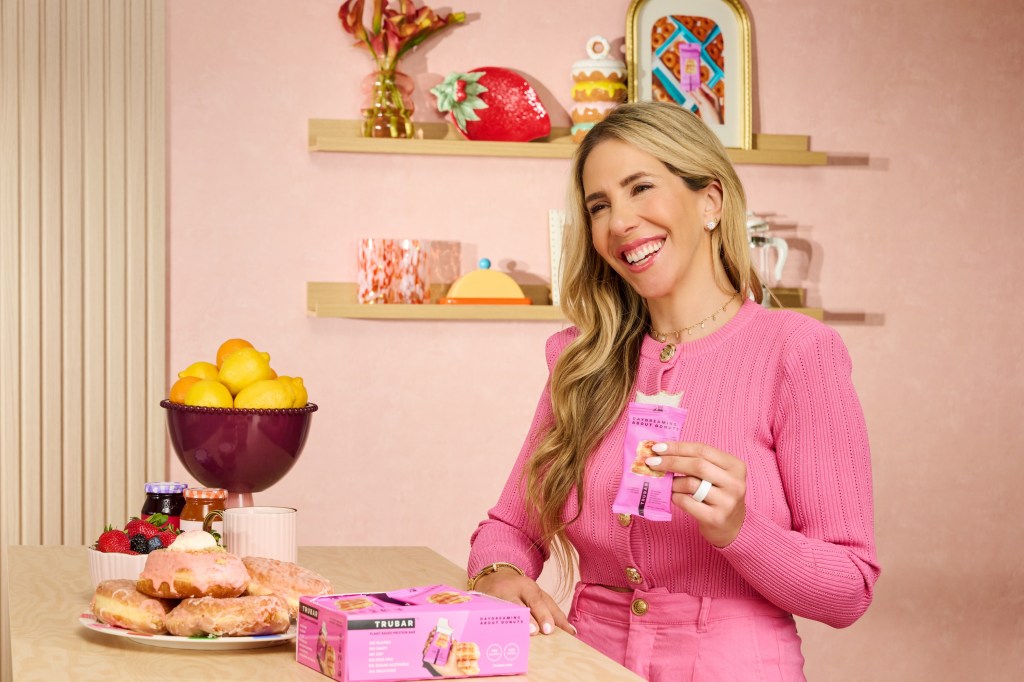
Through it all, Groussman says that her secret is hard work.
“I think that one of the biggest secrets is working your butt off,” Groussman says. “Really getting it into every hand that you can possibly get it into.”
The origins of a better protein bar
Groussman didn’t start out in the food industry. Early in her childhood, her mother gave her a newspaper route, an early lesson in earning money and showing up for work.
Groussman ended up studying communications at UCLA, then worked in film finance and real estate before getting married and having children. She was a stay-at-home mom raising two children when she got the idea for Trubar.
It all began during a family trip to Disney. Groussman had packed snacks, including a protein bar from an established brand. It tasted good, she recalls, but it did not make her feel good afterward.
“I remember just feeling very ucky,” she says. “My belly was very distended and uncomfortable. That was my epiphany. There has to be a better way.”
Her goal was not merely to develop a protein bar with a health-forward label. It had to satisfy a more difficult standard: tasting like a dessert while avoiding the unpleasant aftermath she associated with other bars on the market.
To create it, Groussman worked with a food scientist, relying on research, conversations and people in her personal network to find the right collaborator. The work was iterative and sensory. She still approaches product development by tasting, evaluating texture and diagnosing aftertastes.
“We’ll taste the bar, and I’ll say what I taste,” she says. “What am I getting afterwards? What’s the aftertaste? What do I want to see more of? Do I want more crunchy?”
Getting products to customers
After developing the concept, Groussman raised funds from family and friends and partnered with a food scientist and co-manufacturer to bring the product to life. Trubar officially launched in 2018, with Groussman serving as CEO.
The earliest flavors included Daydreaming About Donuts, Oh Oh Cookie Dough, Saltylicious Almond Love and Smother Fudger Peanut Butter. The cookie dough flavor was an early bestseller.

Groussman’s early proof of demand came from getting products into people’s hands. She placed bars on counters wherever local businesses would let her. Juice shops, delis, beauty salons and independent stores became her first sales channels.
“I put it on any counter I could possibly get, and I would just be like, ‘Here, sell these,’” she says.
The shops set their own prices, generally around $3 to $4 a bar, and ordered more when the initial stock sold through. For Groussman, that simple loop validated the concept.
“That’s how I knew it was good because they were selling,” she says. “People were buying them and then asking to buy more.”
Making a costly mistake
Groussman felt it was time to expand beyond small stores. She says she initially sought help from an individual she believed had more experience running a protein bar business. At the time, she was balancing running the company with raising her children and building a home.
Groussman brought the individual on to help manage Trubar, though she remained CEO. The arrangement ultimately proved costly; the person’s spending outpaced the company’s early sales.
In retrospect, she says, she underestimated her own capabilities.
“I knew more than I thought I knew,” Groussman says. “We always doubt ourselves.”
The outside operator, she says, “ran it into the ground,” leaving the business with $7 million in debt. Trubar had made some early sales to smaller retailers, but that paled in comparison to the millions of dollars of debt the business had accrued.
Groussman’s husband urged her to view the venture as a loss and move on. But she could not let it go.
“It’s a part of me,” she recalls telling him. “I really want to keep it going.”
Expanding into Whole Foods and Costco
Groussman turned to scrappy tactics to get Trubar into bigger retailers. One pivotal breakthrough came at Whole Foods. Groussman says she reached out persistently to a contact on LinkedIn and secured a trial in 30 locations around 2020. With no marketing budget, Trubar became the top-selling bar in those stores, she says, competing alongside established brands such as RXBAR and Kind.
Costco was another early milestone, though not an immediate victory. Trubar first entered Costco in Canada with a single truckload during the Covid-19 period, Groussman says. The brand struggled there, partly because it was less established in the Canadian market and may have faced a pricing disadvantage as a U.S. brand.
The U.S. rollout came later and proved far more successful. That experience reinforced a practical point for CPG founders: A difficult launch in one market does not necessarily invalidate the product. Distribution strategy, brand familiarity, price positioning and timing all matter.
Becoming the CEO of a public company
While Trubar was expanding into larger retailers, Groussman was simultaneously making behind-the-scenes changes.
In 2021, Trubar was acquired by a publicly traded holding company as part of a broader corporate transaction. Groussman agreed to this structure because it allowed the business to expand and her to remain CEO without taking on personal debt.
The holding company had a portfolio that included a skincare brand and a CBD company. Eventually, the other businesses failed while Trubar emerged as the strongest brand in the group.
Groussman says the experience was frustrating. She describes a period when money generated by Trubar was used to support other businesses in the portfolio, even as her own brand was gaining traction.
But the upheaval also reshaped her role. She remained founder and CEO of Trubar, a title she had held since the brand’s inception. In 2024, she added an additional role. She became CEO of the publicly traded company, which was renamed around the Trubar business and included Trubar alongside other businesses in its portfolio.
“I was the only one standing,” she says. “I was a CEO of a publicly traded company.”
A hands-on CEO
Today, Groussman says Trubar has approximately 28 employees. Her management approach is deliberately hands-on. Rather than positioning herself as a distant executive with a high-level view of the business, she stays closely involved in operations, product decisions and emergencies.
She says employees can come to her when they need help, and she tries to lead by example. “I will not ask you to do something that I wouldn’t do myself,” she says.
That philosophy recently played out during a new product launch for Walmart. One of the shipments was expected to arrive late, threatening the timeline. Groussman began calling packaging contacts outside the company’s normal supplier network and found a provider that could complete the job in two weeks.
“I like to make sure the wheels are moving,” she says. “When anything is slightly going wrong, I’m like mama bear. What do I gotta do? Who do I need to talk to?”
Another issue involved a mislabeled product box. The products and ingredient list were correct, she says, but a front-facing element incorrectly referred to cashews instead of almonds, or vice versa. The team immediately sourced green circular stickers from nearby Staples stores and applied them on-site to correct the error before delivery.
The immediate response mattered, but so did the follow-up investigation. “The next week after we fixed it all and it’s all okay, that’s when you go back, and you say, ‘Where did this mistake happen?’” she says. “What is broken in our path?”
Advice for CEOs
Groussman’s larger operating philosophy is to solve first and diagnose problems second. She says teams can become paralyzed by a desire to have every detail in place before acting. She says that instinct can become a liability for founders.
“Just get 80%, just go,” she says. “Just start, just do what you can do and just start etching away and moving in the direction.”
She has a similarly pragmatic view of hiring. “You interview for your resume; you hire for chemistry,” Groussman says. In a fast-moving and sometimes chaotic environment, she looks for people who can make decisions, take initiative and thrive.
“I want my team to be able to make decisions and to grow,” she says. “If they come up with an idea, try it. What’s the harm?”
Scaling after an acquisition
Earlier this year, Trubar was acquired by Eti Gida, a Turkish snack company, for $173 million, according to Groussman. She remains at the helm as CEO and continues to run day-to-day operations. Her team is also still intact, a condition she viewed as essential in evaluating potential partners.
For Groussman, the acquisition marks a new stage rather than an ending. Trubar launched Trubar Kids last year and recently introduced Trubar Pro. She also sees room to extend the brand into other categories.
“It was always known that they wanted to keep me as well as my team,” she says. “I’m not done. It’s my baby.”
§
Opinions expressed by Entrepreneur contributors are their own.
Key Takeaways
- Use AI to reclaim time for strategic work. Automate routine tasks and build systems that let you focus on the decisions and challenges that require your expertise.
- Build a business that can grow without your constant involvement. Develop your team’s problem-solving skills, invest in lasting relationships and share credit to create a stronger, more independent organization.
Throughout my career as a business leader, entrepreneur and executive coach, I’ve learned to focus on the work that matters most — the decisions, challenges and relationships where my experience and judgment make the biggest difference. That means building better systems, developing new skills, strengthening relationships and empowering my team. These investments compound over time, helping my businesses grow without requiring me to weigh in on every decision.
If you want to do the same, here are five practical changes you can make today.
1. Stop doing everything. Start building your AI stack.
Doing less yourself doesn’t mean working less. Your value isn’t measured by how much you personally execute. Administrative tasks can quickly consume your day without moving your business forward.
I divide my workload into two categories: below-the-line and above-the-line work. Below-the-line tasks include email, scheduling and project tracking. Above-the-line work is where your judgment matters most: setting strategy, making critical decisions, solving problems and building relationships.
AI creates opportunities to move more work below the line. Start by listing what consumes your time, then determine what you can automate, delegate or eliminate. Build a focused ecosystem of AI agents that can research your industry, track competitors, monitor key performance indicators (KPIs) and prepare meeting notes.
This approach helps me protect 90-minute blocks for deep work, giving me more time to focus on challenges that genuinely require my expertise. After spending too many years on below-the-line tasks, my advice is simple: Let AI handle more of the administrative work so you can focus your best skills on what matters most.
2. Stop thinking you know it all. Start updating your skills.
The moment you think you know everything may be the moment a competitor passes you by. Maintaining a humble, curious mindset has helped me recognize new opportunities, grow as a leader and strengthen my businesses. Learning doesn’t end with a degree. Keep developing new skills, pursuing relevant credentials and embracing a learner’s mindset throughout your career.
AI is a good place to start. Go beyond basic chatbot prompts and learn how AI agents, automation and interconnected systems can work together to improve your business. One agent might research competitors, another monitor regulatory changes and a third identify potential investors or financing opportunities. AI can also surface emerging industry topics, creating opportunities to contribute thought leadership before a conversation gains momentum.
I recommend programs from Vanderbilt Executive Education and MIT Professional Education. Both offer focused learning opportunities centered on executive strategy without getting lost in the technical details.
3. Stop taking over every project. Start coaching your team.
Entrepreneurs are often wired to jump in and solve problems immediately. Eventually, that instinct can become counterproductive. You’ve built a team for a reason, and neither you nor your employees need you involved in everything.
I learned this firsthand as an executive at Intel. During a period when I was pushing myself too hard, the pressure spilled over onto my team. Instead of delegating thoughtfully, I sent early-morning emails and created unnecessary work. When team members told me they were stressed, it was a wake-up call. I realized my team needed me to operate at my best and help them do the same.
I started with a simple coaching principle: Stop offering answers and solutions too quickly. When someone brings you a problem, ask them to recommend a solution, too.
Try asking questions such as:
- What do you think we should do?
- What are the primary risks?
- What does success look like?
If you want your team to think strategically, give them opportunities to contribute to important decisions. Challenge their thinking, encourage them to evaluate trade-offs and let them own the solutions.
You’ll gain a better understanding of their strengths while developing decisive leaders who can exercise sound judgment without relying on you for every answer.
4. Stop networking. Start building lasting relationships.
Networking in the digital age can mean little more than accepting an invitation or adding a connection. But a connection is only the beginning. Would that person invest in you or your business? Could you call each other for advice, an introduction or a potential partnership?
The strongest relationships become more valuable over time. Alpine Investors founder Graham Weaver calls these “lifetime relationships.”When Weaver started his company at 28, he struggled to raise funds. Two investors with whom he had built relationships eventually backed him, helping get the business off the ground. He has said the company wouldn’t exist without their belief in him.
Building lasting relationships requires more than accepting another LinkedIn request. Someone you meet today could eventually become a strategic partner, join your board or help you raise capital. One day, you may be the person they turn to.
Prioritize meaningful relationships over simply accumulating social media connections. Invest time in being authentic. Send the card. Check in when you don’t need anything. Pick up the phone when someone calls for advice.
These small gestures build trust over time and create a network of people who will be there when it matters most.
5. Stop chasing recognition. Start sharing the spotlight with your team.
At a certain point in your career, success becomes less about what you accomplish personally and more about the leaders you develop.
Sharing credit is also a performance strategy. It recognizes strong contributions, reinforces positive behaviors and builds a team capable of achieving more without routing every decision through you.
Give talented employees opportunities to take ownership. Include them when recognition is given, let them lead presentations, put them in front of clients and trust them to make important decisions.
Research from Gallup found that 61% of employees who received both feedback and recognition from their manager at least weekly were engaged, compared with 38% of employees who received weekly feedback but less frequent recognition.
When your people deliver results, make sure they receive the credit. Recognizing their contributions reinforces a culture in which people feel valued and motivated to do their best work.
Build your own playbook
Think of these five shifts as a starting point, not a rigid formula. Put them into practice, pay attention to what works and adjust what doesn’t.
Through experimentation, you’ll develop an approach that fits your leadership style, your business and your team. Keep investing in the systems, skills and relationships that help you operate at your best.
And never stop looking for that edge.