×
Tech

How Africa’s fragmented payment systems are holding back cross-border trade

Cross-border trade is held up by Africa's fragmentation

African countries must harmonise regulatory requirements, connect  payment systems and invest in shared financial infrastructure to make cross-border trade faster and cheaper, experts stated at the 2026 Moonshot by TechCabal conference. 

Speaking on a panel  titled, “Commerce Without Borders: Cross-Border Without Friction”, Tola Onayemi, chief executive officer (CEO) of Norebase; Tatiana Ndlovu, executive head of marketing at Nedbank Africa Regions; and Iheakachi Nwabueze, vice-president of global marketing and growth at Grey, said fragmented regulations and disconnected payment systems continue to raise the cost and complexity of doing business across the continent.

Cross-border trade between African countries reached $220.3 billion in 2024, growing 12.4% from the previous year, according to Afreximbank’s African Trade Report 2025.

Yet businesses trading across the continent continue to navigate different currencies, payment systems and regulatory requirements, which can make transactions more expensive and complicated.

The speakers said greater interoperability and less regulatory duplication would help businesses reach more customers across borders.

Onayemi said payment systems across Africa were largely designed around individual countries rather than a connected continental market, creating a sharp contrast between domestic transactions and cross-border payments.

Using Nigeria as an example, he said domestic transfers could be completed within seconds, but that efficiency often broke down when transactions crossed national boundaries.

“Once you start to move that from outside one jurisdiction to the other, that interoperability breaks apart,” he said.

He argued that connecting existing payment infrastructure, rather than repeatedly building separate systems, could help reduce the cost of moving money across the continent.

“If we own that layer, what it means is that we’re able to set a lot more of the pricing and the cost,” Onayemi said.

He called for a shared infrastructure that would enable  financial institutions and payment providers to connect their services while continuing to serve their customers.

He cited Nigeria’s domestic payment infrastructure as an example of how providers could offer services through a common underlying system instead of independently recreating the same capabilities.

Such an approach, he said, could reduce duplication and help lower the cost of cross-border transactions.

Onayemi also identified regulatory fragmentation as a barrier to expansion.

He explained that a financial technology company seeking to operate in Nigeria, Kenya and Ghana could need separate licences and funds held locally in each market to facilitate payments.

The requirement to maintain funds in multiple countries, he said, adds to the complexity of settling transactions and reconciling balances.

He said fragmented corporate and administrative requirements make it harder for businesses to expand across African markets.

For merchants, the challenge extends beyond accepting payments to receiving funds, settling transactions and arranging the logistics needed to deliver goods across borders.

Ndlovu believes the solutions must also account for customers’ expectations, arguing that people should have the same confidence when buying goods and services across borders as they do in their domestic markets.

Customers need to know the price of a product, whether a supplier can be trusted, when an order will arrive and what recourse is available if a transaction goes wrong, she said.

“The reality is that the same empathy design principles that you apply on local products, you should absolutely be able to apply cross border,” Ndlovu said.
§

Oji Udezue has built products that made millions in Silicon Valley, serving as chief product officer at Typeform and Calendly, product lead at Twitter, and head of product at Atlassian. On Moonshot’s Emerging Tech stage, he returned to the question he says keeps drawing him back to Africa: who is a technology actually for?

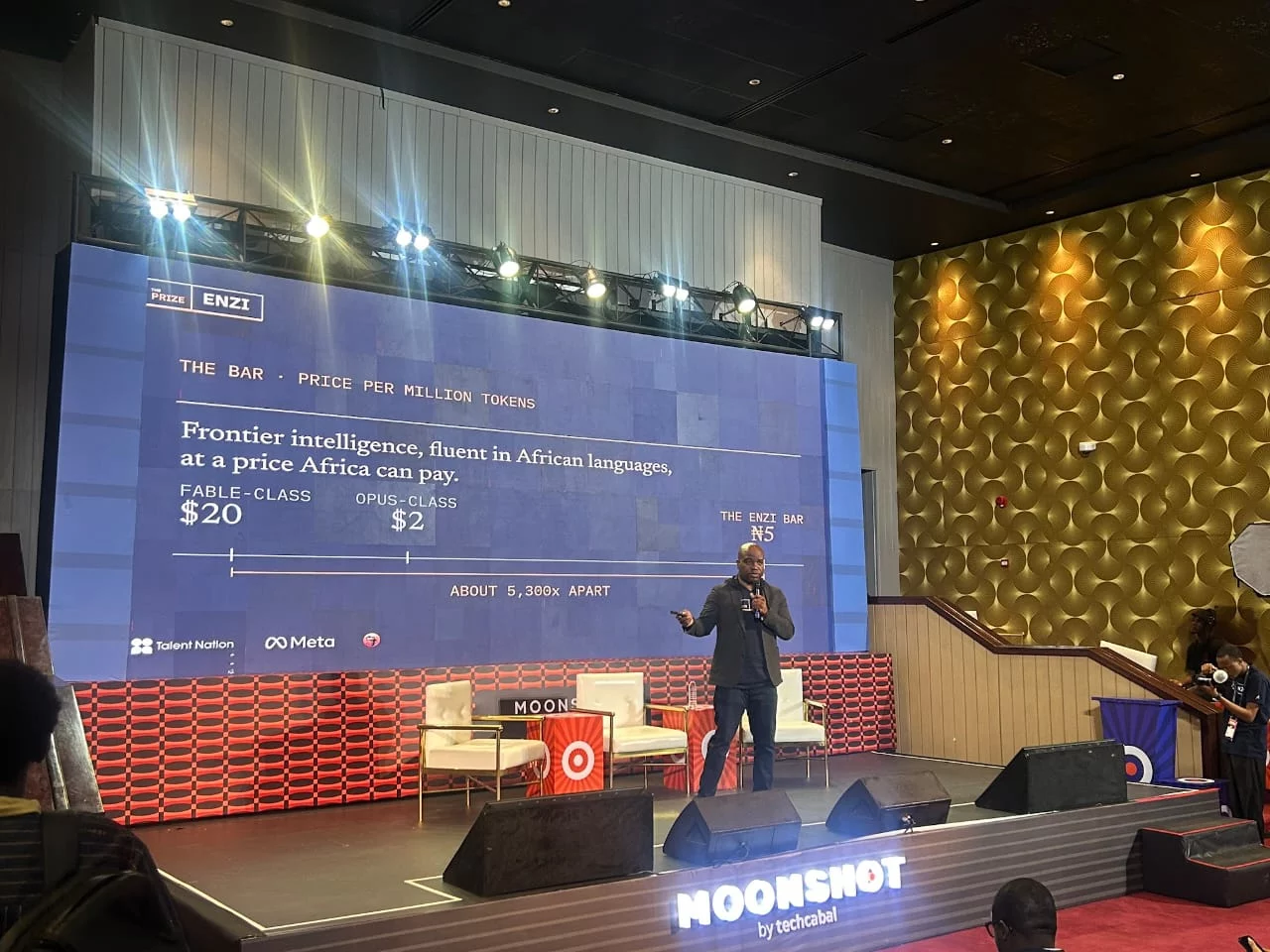
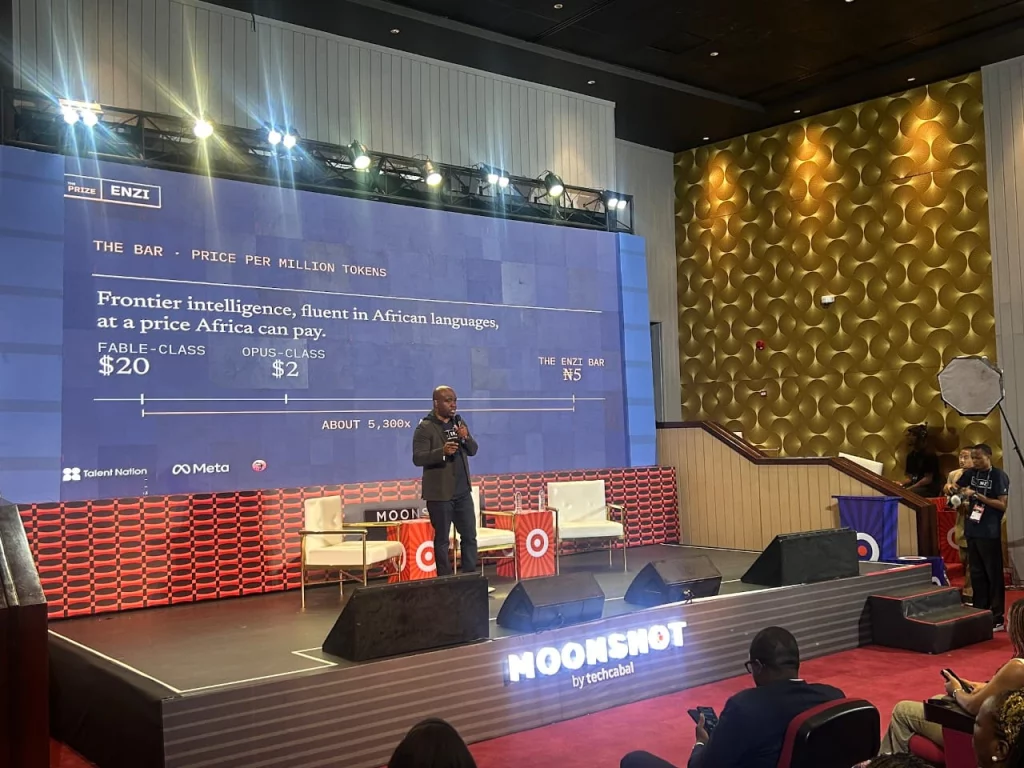
Frontier AI, he argued, is being priced out of reach for most of the continent, and the Enzi Prize is his attempt to change who can afford to use it. “It’s for the person in your village who’s not educated,” he said. “Otherwise, we would be the most selfish generation that ever existed.”

His argument rests on a number. Running a frontier, “Fable-class” model costs roughly $50 per million tokens today, by Udezue’s benchmark. The prize aims to bring that down to about $5, and ideally to a much lower amount. “We say 100x because maybe we’re hedging our bets,” he told the room.

To pursue that goal, the Enzi Prize Foundation, a Delaware non-profit backed by the Africa Deep Tech Foundation, TechCabal, Future Africa and Talent Nation, is offering a $10 million prize purse as part of a roughly $14 million initiative.

The aim is to make AI cheaper and fluent in African languages and contexts. According to Udezue, a cheap model that scores well on standard tests is of little use if it has never heard of a tropical disease or the things “people in my village know that are not anywhere on the internet”. Entries must first meet a minimum standard — what he called “a master’s in intelligence and a PhD in African context and African languages” — before competing on cost.

Submissions, whether cloud systems or models that run on a phone, are ranked on a public, open-source leaderboard, with rotating, sealed questions to prevent teams from gaming it. Winners retain their intellectual property but must publish an open, royalty-free version for use in Africa and the Global South.

The model is the Ansari X-Prize: offer a reward for a desired breakthrough and let competition draw in investment to achieve it. “If I put up $10 for you to chase,” he said, “people will spend $9 to chase 10.” He noted that a $20,000 pilot had already “brought a lot of talented people out of the woodwork”, producing the demos shown earlier that afternoon. “What would $10 million do?”

The purse is not yet fully funded. Udezue said he had spoken with OpenAI and Google that day, and estimated that winning the prize could take three to six years. His closing appeal was less for money than for belief: “Let’s make inference part of African innovation.”

§

Africa’s artificial intelligence developers should measure success by improvements in healthcare, education and incomes rather than the number of products they launch, the Gates Foundation’s Nigeria director told Moonshot by TechCabal in Lagos.

Uche Amaonwu said AI could widen access to knowledge, services and economic opportunity, but warned that its benefits would depend on deliberate choices about how the technology was developed, financed and deployed.

“For a technology to really be impactful, it has to touch the lives of people,” he said during a keynote address.

His remarks set out a challenge for developers and investors seeking applications for AI across the continent: moving promising tools beyond trials and into the institutions and communities expected to use them.

Amaonwu pointed to the foundation’s Goalkeepers report on AI and equity, released around the UN General Assembly, describing its message as “exciting, but also cautionary”. AI could become “a powerful equaliser”, he said, but that outcome was far from assured.

“If we are not deliberate about how AI is developed and deployed, we could end up widening the very inequalities that we’re actually trying to close.”

The foundation’s approach, he said, starts with three objectives: preventing avoidable maternal and child deaths, protecting the next generation from deadly infectious diseases, and helping hundreds of millions of people escape poverty.

These were “human condition goals”, he said. AI’s value would lie in whether it accelerated progress towards them.

A central part of that effort is the Nigeria AI Scaling Hub, hosted by Lagos Business School in partnership with the Federal Ministry of Communications, Innovation and Digital Economy. Backed by up to $7.5mn from the foundation over three years, the hub aims to expand the use of proven AI tools in health, agriculture and education.

Its focus is the difficult transition from a successful pilot to sustained adoption. A tool that works in a trial still needs infrastructure, institutional support and a viable funding model before it can reach people consistently.

Amaonwu identified four requirements for making that transition.

Developers needed shared infrastructure, including connectivity, trusted data, and systems capable of exchanging information, so that each company did not have to build the same foundations independently.

Tools also needed to reflect Nigerian conditions and languages, earn users’ trust from the outset, and have a clear route to adoption and payment. Identifying who would use a product — and who would finance its continued use — was as important as developing it.

The argument places responsibility beyond technology companies. Governments shape the conditions for adoption through regulation and public systems, while investors determine which businesses receive the capital to expand.

Amaonwu urged the Moonshot audience to return the following year with evidence of practical results like clinics where patients had received care, classrooms where children had caught up, and farmers who had secured better prices for their harvests.

“No one in this room can do all of this alone,” he said. The future worth building was “the one that we must build together”.

Web hosting by Somee.com