
Oji Udezue has built products that made millions in Silicon Valley, serving as chief product officer at Typeform and Calendly, product lead at Twitter, and head of product at Atlassian. On Moonshot’s Emerging Tech stage, he returned to the question he says keeps drawing him back to Africa: who is a technology actually for?
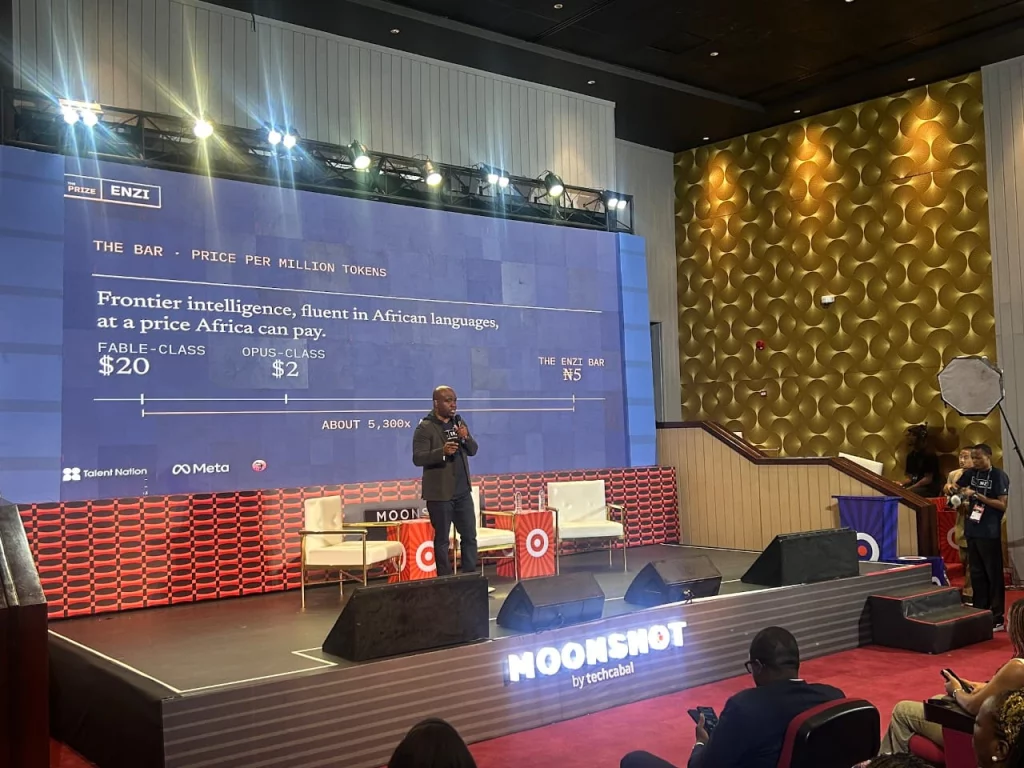
Frontier AI, he argued, is being priced out of reach for most of the continent, and the Enzi Prize is his attempt to change who can afford to use it. “It’s for the person in your village who’s not educated,” he said. “Otherwise, we would be the most selfish generation that ever existed.”
His argument rests on a number. Running a frontier, “Fable-class” model costs roughly $50 per million tokens today, by Udezue’s benchmark. The prize aims to bring that down to about $5, and ideally to a much lower amount. “We say 100x because maybe we’re hedging our bets,” he told the room.
To pursue that goal, the Enzi Prize Foundation, a Delaware non-profit backed by the Africa Deep Tech Foundation, TechCabal, Future Africa and Talent Nation, is offering a $10 million prize purse as part of a roughly $14 million initiative.
The aim is to make AI cheaper and fluent in African languages and contexts. According to Udezue, a cheap model that scores well on standard tests is of little use if it has never heard of a tropical disease or the things “people in my village know that are not anywhere on the internet”. Entries must first meet a minimum standard — what he called “a master’s in intelligence and a PhD in African context and African languages” — before competing on cost.
Submissions, whether cloud systems or models that run on a phone, are ranked on a public, open-source leaderboard, with rotating, sealed questions to prevent teams from gaming it. Winners retain their intellectual property but must publish an open, royalty-free version for use in Africa and the Global South.
The model is the Ansari X-Prize: offer a reward for a desired breakthrough and let competition draw in investment to achieve it. “If I put up $10 for you to chase,” he said, “people will spend $9 to chase 10.” He noted that a $20,000 pilot had already “brought a lot of talented people out of the woodwork”, producing the demos shown earlier that afternoon. “What would $10 million do?”
The purse is not yet fully funded. Udezue said he had spoken with OpenAI and Google that day, and estimated that winning the prize could take three to six years. His closing appeal was less for money than for belief: “Let’s make inference part of African innovation.”


