
Business
The Best Idea for His Business Came From a Customer. And It Led to 300% Growth: ‘We’re Going All-In on This’
Reading in data-saving mode. Read full article from Entrepreneur website.
Published 11/3/2026 1:40:00 PM
How Fit:match Grew 300% by Taking a Risk and Going With Its Gut
There are some founders who think that only good ideas can come from them. Haniff Brown is not one of those founders.
In 2024, the Williams College math major and former private equity investor was promoting his company Fit:match’s AI body-scanning technology as a way to help shoppers find clothes that fit. Then a major English soccer team asked if he’d bring the tech to their youth academy for an entirely different use. He almost said no, but went anyway, and after listening to the coaches, he found an entirely different use for the tech — and much bigger business in the process.
Today, Fit:match partners with FIFA, Major League Soccer and Major League Baseball to deliver athletes a full set of anthropometric and body-composition measurements in seconds. Brown spoke with Entrepreneur to share his insights and advice for building, growing and seizing unexpected opportunities.
Let’s start with the elevator pitch. What is Fit:match?
Fit:match is a body intelligence platform. Think of us almost like the ChatGPT or the Claude or the Gemini of the human body. We provide remote access to body intelligence and body analytics at scale. So if you want precision or data analytics on the human body, we are the company providing that for hospitals, for athletes, and coaches, and really across the board.
Talk to us about the pivot from your tech focusing on people buying clothing.
I think it was in 2024 when we got a call from a really large sports team in England. We were doing some work in a retailer and they said to us, “Hey, we really like your technology. I know that you’re using it for shopping, but can you swing by our youth academy out in the countryside in England?” At first, we were like, no, the technology is built for this purpose. But sometimes as an entrepreneur, you just have to take a risk and you have to go with your gut. And I felt, why not? So when I was there, I started to talk to the coaches, I started to talk to the scouts and then the sports scientists. And that really was the aha moment for us. What they told us at that academy is, “Hey, if you can get this body scanning process down to 10 to 15 seconds, you would unlock a huge advantage for us.” Because most assessments in sports take a long time and involve pulling an athlete out of training. I came back from that trip and I was just like, “We’re going all-in on this.”
You’re a die-hard Manchester United fan — how does it feel to build a business around something you love?
What makes me the happiest is the fact that whether it is the MLB or Major League Soccer, we’re doing it at the youth level. If you can democratize it the right way, you can get access to more youth, you can help develop ecosystems and pathways that don’t exist today, and you can also provide data to parents so they can make better decisions for their sons and daughters.
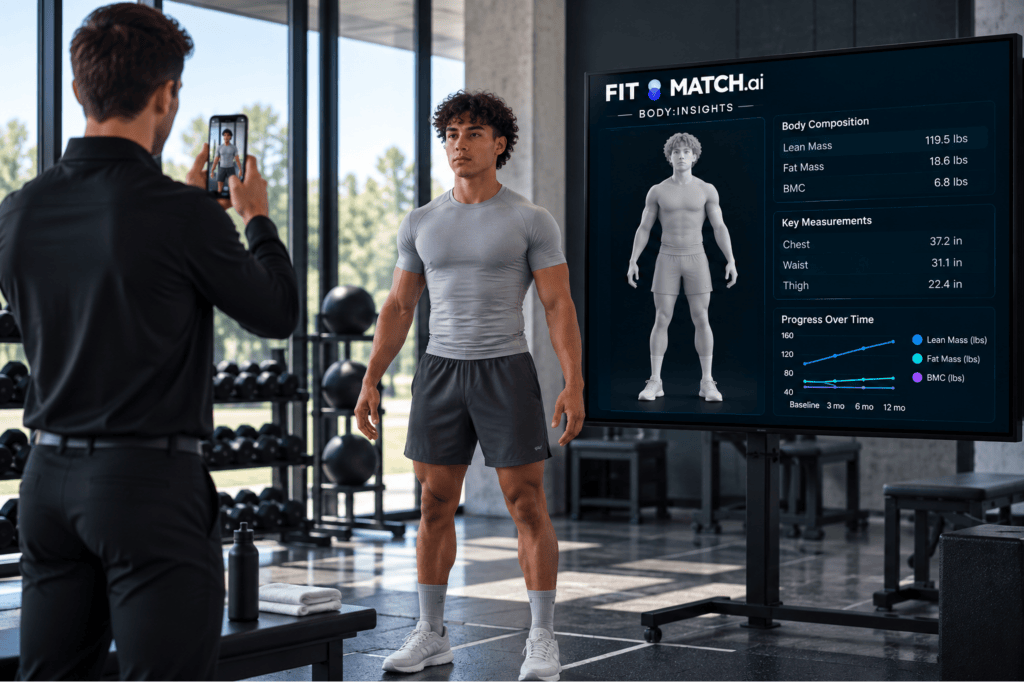
Photo credit: Fit:match
For entrepreneurs, how important is it to put your product in people’s hands toexperience it?
You have entrepreneurs, and then you have founders that are trying to build something that doesn’t exist. I’m on the latter piece. A big part of this journey for me has not only been, “Hey, the technology works!” but it’s also now proving to enterprises, businesses, markets and consumers that this is something they can do. A big part of how I’ve tackled adoption is to put the technology out there as much as possible. Because the more that’s hidden, the more obstacles you have to face in that selling journey. So every client call that I have now, whether I’m talking to Cleveland Clinic or a sports team in Peru, I start with a demo of the technology. Not a video, not a picture. We have someone on our team get on the call, take out their iPhone, click four pictures, and go through the technology, because I want to educate the person on the other side that this is easy. This is an experience that I always tell people my eight-year-old son can do and my 70-year-old mom can do. And what I found is the ROI and the payback on putting it out there has been huge.
What’s your advice to founders out there seeking funding?
I’ve been fairly open about this. I do not like fundraising. I like building products, I like scaling teams, I like having fun on that side of the business. So I view fundraising almost as if you’re going in a car from Los Angeles to New York, and somewhere along the line you’re gonna break down and not have any fuel left. And you need a gas station along the journey. Fundraising is those gas stations. It’s not the means, it’s not the ends — it’s just some fuel that you need to get to the next stage and execute your journey. If I build the right product, if I build the right market, if I have customers who are paying, I’ll find the right investor. I find a lot of entrepreneurs try to focus on fundraising first, then those things second. What I found is that fundraising becomes easier once you solve for those things. So my advice is to focus on the stuff that investors really want to see.
There are some founders who think that only good ideas can come from them. Haniff Brown is not one of those founders.
In 2024, the Williams College math major and former private equity investor was promoting his company Fit:match’s AI body-scanning technology as a way to help shoppers find clothes that fit. Then a major English soccer team asked if he’d bring the tech to their youth academy for an entirely different use. He almost said no, but went anyway, and after listening to the coaches, he found an entirely different use for the tech — and much bigger business in the process.
Today, Fit:match partners with FIFA, Major League Soccer and Major League Baseball to deliver athletes a full set of anthropometric and body-composition measurements in seconds. Brown spoke with Entrepreneur to share his insights and advice for building, growing and seizing unexpected opportunities.
