×
Tech

Lagos Life maker Vatar raises $500,000 one week after launch

Lagos Life maker Vatar raises $500,000 one week after launch

Vatar Inc., the company behind the viral Nigerian browser game Lagos Life, has closed a $500,000 angel round at a $10 million valuation three days after incorporation, according to a company statement.

“We built something people love that is growing very fast, so a lot of investors wanted to be involved,” Shalom Rayhamen, co-founder and CEO of Vatar Inc., told TechCabal in an interview. “We got the opportunity to connect and hear their offers, and because we are growing so fast, we closed it quickly so we could focus on the product.” 

Olugbenga “GB” Agboola, Flutterwave’s CEO, invested through his fund, Resilience17. Oo Nwoye, Nathan Nwachuku, Terra Industries CEO, and Abdulhamid Hassan, Mono’s CEO, also participated in the round, which the company says closed in a day. 

Lagos Life is part of a wave of Nigerian-made browser games sparked by Lagos Run, Opeyemi Adeniran’s game about driving a danfo, the iconic yellow bus, through Lagos, which drew more than 140,000 players in its first week. Rayhamen built Lagos Life days after seeing Lagos Run on X, and copycats soon followed.

The developers are building fast with AI, and the games spread through links shared on social media. In a fortnight, the shift shows that a game made by Nigerians, about Nigeria, can reach a mass audience almost immediately.

Lagos Life hit 4.3 million users on Thursday evening, with users from 15 countries. More than 100,000 were playing on Thursday evening, Rayhamen said, and the game has peaked at more than 200,000 players at once. After Nigeria, most users come from the US, UK, Ghana, Canada and the Netherlands, she added.

“Just signing up, setting up your character. That makes you registered,” Rayhamen said.

Rayhamen co-founded Vatar Inc. with Owen Rayhamen, the chief product officer, and Anderson Oriahi, the chief business development officer, on October 6. The funding will go to product, marketing, and hiring. 

“We can still reach more people,” she said, adding that four million players is still a small share of Nigeria’s population. 

How the game works

Lagos Life is a free life-simulation game that runs in a web browser. Players create a character, get a job, earn virtual naira, pay rent, and meet other players in a shared city. They buy generators to deal with power cuts, ride danfo buses, and live under a virtual governor and commissioners. Players pick who holds office, Rayhamen said, because a world where people earn money needs people in charge.

The in-game clock runs on real Lagos time. Real locations such as the Quilox nightclub and the Amala Shitta food spot appear in the city so players recognise them. 

“It’s intentional,” Rayhamen said.

Each new player starts as either “Nepo,” with money and connections, or “Lapo,” a reference to microfinance loans and a hard start. Rayhamen said players asked for the feature. Some now say it promotes classism, which she said “wasn’t what I had in mind.” 

“You release features, and some people will say ‘yay’ and some people say ‘nah’,” she said.

She expected players to want to socialise, but was surprised by how much. Recent requests include cooking, starting a family and sending children to school. “It’s almost blurring the line between the physical and the simulation,” she said.

The game’s virality and users’ ability to message each other have raised questions around content moderation and user protection. Rayhamen said Vatar has added an age check and tools to help users protect themselves.

“We screen and censor messages,” she said. “We have put mechanisms in place to keep users safe. Users can report other users, and they can block anyone they do not want to talk to.”

How it makes money

Selling games to Nigerians has long been hard. Credit card penetration in Nigeria is about 3.5%, making paid downloads and in-app purchases hard. Lagos Life is free to play and has charged brands since it launched.

Businesses rent billboards and plots inside the virtual city, while musicians pay to have their songs played in its clubs. Chowdeck, a food delivery company, appears as an app on every character’s phone and has partnered with Vatar Inc. 

Rayhamen told TechCabal the game currently has five revenue streams, including advertising, music promotion, company deals, and football streaming. Players can also pay real money to top up their in-game cash. 

“People want to have like an edge in games,” she said.

Vatar says it has earned and contracted more than $170,000 since launch. That is up from about $46,900 in its first four days, a figure Rayhamen posted on X. Payments run through Flutterwave, she said. 

“This is actually a business,” she said, adding that “the infrastructure is expensive.” She declined to say how much the game costs to run and did not say whether Vatar is profitable.

Built in one night

Rayhamen started building the game at 9 p.m. on Wednesday, September 30. After working until 5 a.m., she took a nap and released it at 7 a.m. on October 1, Nigeria’s Independence Day.

“The first thing I worked on was the world itself, then the avatars, meaning the people,” she said. 

“I started by researching the places I wanted to put in and placed them to create the world. The avatars take a lot of time because you have to think about everything an avatar should be able to do. It should be able to walk, sit down, sleep, and dance,” she added.

She used AI for research and coding through Anthropic’s API. “I’m pro AI,” she said. “I know how to use AI to my advantage.”

Rayhamen is a software developer with nearly a decade of experience, mostly in JavaScript for web and mobile. She holds a UK Global Talent visa, according to the company’s statement. 

She built the game while caring for her four-month-old baby. “I’m a mom, so I’m proud of that,” she said, hoping her story encourages other nursing mothers and challenges the idea that marriage and children end a woman’s ambitions.

The idea came from The Sims 3, which she played as a child, and from Lagos Run, a browser game in which players drive a danfo bus through Lagos. 

“I didn’t know it was going to grow so fast,” she said. Since launch, she has been rebuilding the game’s systems to handle the traffic. She uses AI agents to collect player requests from social media and sort them into bugs, urgent fixes, and new features. The agents are expensive, she said, but they help her decide what to build next.

Rayhamen said she has released products for years, and Lagos Life is her first big hit. “I’ve finally built something that people love,” she said. 

What’s next 

Port Harcourt, Nigeria’s oil hub in the Niger Delta, went live in the game around October 6, Rayhamen said.  She declined to name the countries or cities Vatar plans to feature next. “I want people to anticipate,” she said. 

Copycats have already appeared, including PH Lifestyle, a Port Harcourt Life game, and London Red Bus, a version of Lagos Run. Rayhamen said developers with AI tools should build something original. 

“I feel like that is not creativity,” she said. “You have that opportunity, and all you can do is copy.”

Rayhamen said the moment Lagos Life stops feeling new will help Vatar, because the team can then build features players have not asked for. “When they get used to it, then we blow their minds,” she said.

Editor’s note: An earlier version of this article described Vatar’s $500,000 raise as a pre-seed round. Vatar has since clarified that it was an angel round. The article has been updated.

True scale demands moving beyond surface-level integrations to robust execution. We’ve filtered the noise out of Moonshot 2026, optimising the conference strictly for high-calibre connections between startup founders, global financial operators, enterprise leaders and individuals rewiring Africa’s technical frameworks. Get 20% off Early Bird tickets for a limited time.

§

CrissCross, the South Africa-headquartered cross-border payments infrastructure company, has secured an undisclosed investment from Circle Ventures, the corporate venture arm of Circle Internet Group, the company that issues USD Coin (USDC), a digital stablecoin.

The investment, made through Stitch Group, CrissCross’s parent company, will help the company expand its local payment connections and liquidity, build more stablecoin settlement capabilities for enterprise customers, and grow the team supporting clients across the continent.

Stablecoins are increasingly being used to move money across borders, making them a growing part of Africa’s payments infrastructure. Circle’s investment marks its second notable bet on the sector in 2026. In July, it invested in Nigerian fintech Flutterwave as the company expanded USDC settlement across its payments platform, allowing businesses to collect payments locally and settle in USDC. s.

“Africa’s cross-border payments market is massive, complex, and underserved,” James Cope, general manager at CrissCross, said in a statement. “Circle Ventures’ investment validates what we’ve been building: infrastructure that can handle that complexity at scale.”

Lex Campbell and Byron Coetsee founded CrissCross to make cross-border payments more efficient for enterprise businesses operating in African markets. The company was acquired early by Stitch and now sits within Stitch Group, the South Africa-based payments group. CrissCross provides businesses with a single application programming interface (API) to collect money, make payouts, manage funds and exchange currencies across African markets. 

For collections, CrissCross lets customers pay merchants using familiar local methods such as bank transfers, mobile money and cards. For payouts, businesses can send individual or bulk payments directly to local bank accounts and mobile wallets. Its treasury tools let companies manage funds across multiple currencies, while its foreign exchange infrastructure lets them convert between local currencies, US dollars, and euros.

CrissCross connects blockchain-based settlement to local fiat payment networks. A business can move value between markets using stablecoins, while the recipient can receive local currency in a bank account. The company says it chooses between stablecoin and fiat rails based on a client’s requirements. It makes money from the payments and currency conversions it processes for clients, and says its pricing varies depending on the markets, payment methods, and services each customer uses.

“Stablecoins help funds move between markets quickly and transparently, and the money is delivered in local currency to the recipient’s bank account or mobile wallet,” the company said in a statement shared with TechCabal. “We use stablecoin or fiat rails depending on what each client needs for speed, cost and compliance.”

CrissCross is trying to close the gap between global stablecoin liquidity and local payment infrastructure. In October, CrissCross partnered with Velocity, a stablecoin payments and treasury platform, to connect institutional on-chain liquidity with local collections, payouts and FX. The partnership aimed to connect global stablecoin liquidity to local bank accounts and payment rails.

Sub-Saharan Africa received more than $205 billion in on-chain crypto value between July 2024 and June 2025, up 52% from the previous year. As crypto activity grows, so does demand for infrastructure that connects digital assets to local payment systems and enables cross-border payments.

“We’re excited to support CrissCross as they bring stablecoin-powered payments infrastructure to scale across African markets — some of the most complex and underserved corridors in the world,” said Brian Schultz, vice president of corporate development and ventures at Circle.

CrissCross says it currently operates across more than 30 markets spanning West, Central, East, Southern and North Africa, including both CFA franc zones, and supports more than 20 currencies. Its customers include multinational enterprises, financial institutions and platforms that need to move money across complex African payment corridors. The company wants to become the infrastructure that lets global businesses treat Africa as one connected market rather than a collection of separate payment systems.

“We want global businesses to find it as easy to collect and pay out across African markets as anywhere else they operate,” it said. “A company operating in Nigeria, Senegal or Kenya should be able to do it through the same infrastructure, with predictable settlement and full visibility over its funds. More enterprises are building their growth plans around African markets, and we want CrissCross to be the payments infrastructure they use to do it.”

Stablecoins are becoming the layer underneath payments for African payments companies. In June, Flutterwave announced an investment from Ripple as part of its Series E and said it would integrate RLUSD, Ripple Payments, and the XRP Ledger into its payment infrastructure. It has also partnered with Polygon and Tempo to build out stablecoin settlement infrastructure. 

Onafriq, which operates across more than 40 African countries, has taken a similar route. In February, it partnered with Conduit to use stablecoins such as USDC to fund accounts and rebalance treasury holdings, and announced another partnership in July with digital-asset infrastructure provider Privy to develop regulated stablecoin-powered payment services for financial institutions.

Yellow Card has shifted its focus towards businesses, providing stablecoin payment infrastructure, fiat settlement rails, custody, and local stablecoin issuance. Once associated with crypto trading, dollar-backed stablecoins are now being positioned as a way for businesses to settle transactions and move money across borders.

True scale demands moving beyond surface-level integrations to robust execution. We’ve filtered the noise out of Moonshot 2026, optimising the conference strictly for high-calibre connections between startup founders, global financial operators, enterprise leaders and individuals rewiring Africa’s technical frameworks. Get 20% off Early Bird tickets for a limited time.

§

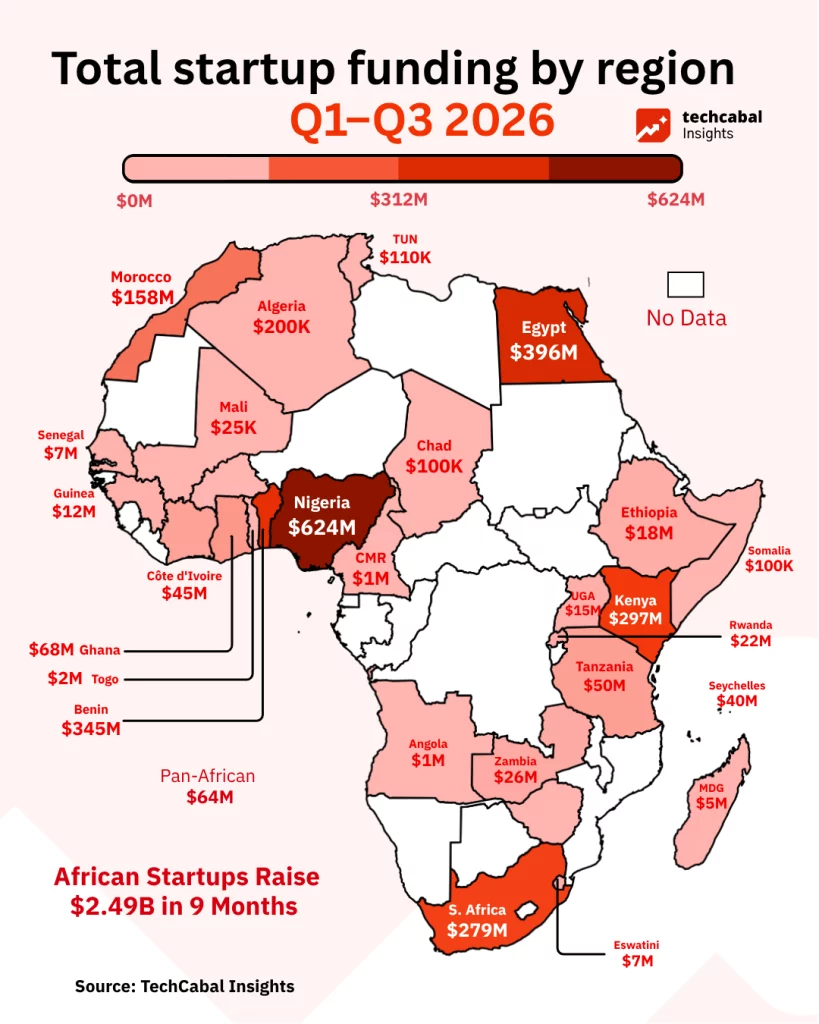
In the first nine months of 2026, African startups raised $2.49 billion across 315 disclosed deals, representing 7.8% year-on-year growth from the $2.30 billion raised across 403 disclosed deals in the same period in 2025.

While overall transaction volume dropped in the first half of the year, funding activity rebounded sharply in Q3 2026. Q3 alone brought in $1.025 billion across 167 deals, up from $785 million across 149 deals in Q3 2025, driven by stronger deal flow and larger growth rounds.

Energy, fintech, and clean tech lead big deals

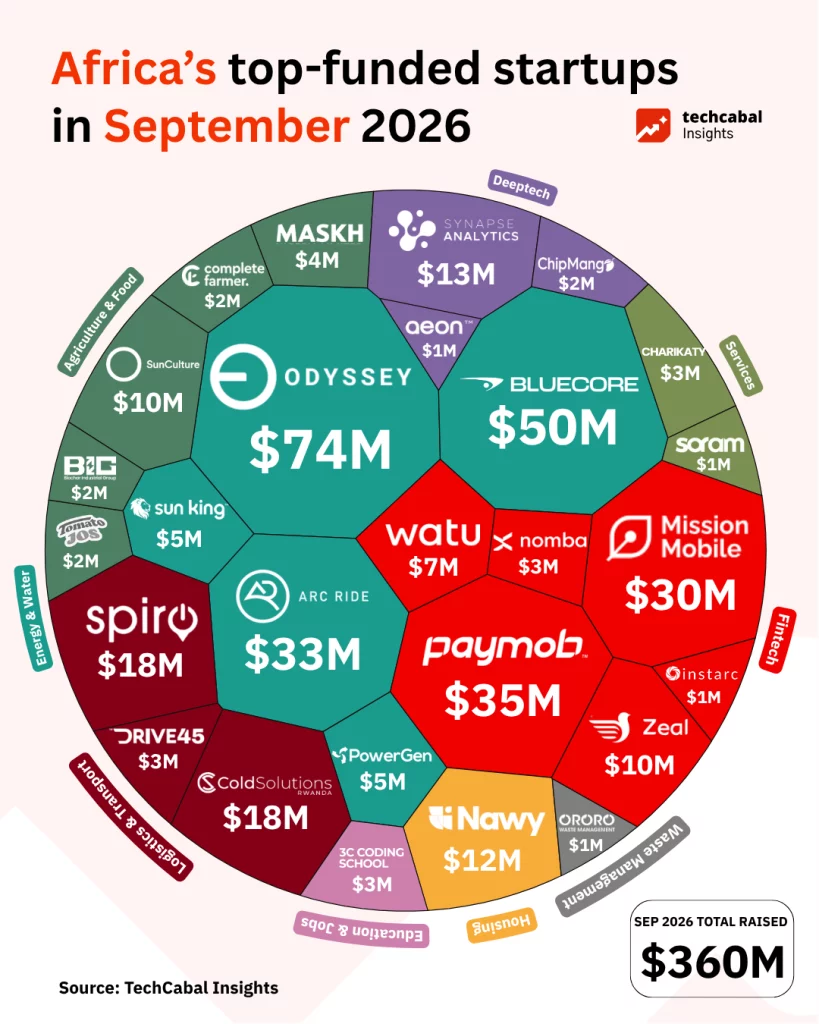
September kept up the Q3 momentum, with investors directing relatively large capital checks into energy infrastructure, mobility, and digital payments platforms.

  • Bluecore Energy (Ghana) raised a $50 million seed round, backed by Slauson & Co., Harlem Capital, Chris Larsen, Collab Capital, HartBeat Ventures, Tesla, Uber, and Amazon, to develop maritime nuclear technology.
  • Odyssey Energy Solutions (Nigeria) secured $74 million in combined capital, including a $47 million debt facility from BII, BIO, Cygnum Capital, and TripleJump, alongside $27 million in equity from Broadscale Group, FMO, and Al Mada Ventures.
  • Paymob (Egypt) raised $35 million in Pre-Series C funding led by Mubadala and EBRD.
  • Mission Mobile (South Africa) pulled in $30.7 million from DN Invest for device-financing infrastructure.
  • ARC Ride (Kenya) completed a $33.3 million round ($23.3M equity led by Novastar Ventures, Norrsken22, and IFC, plus $10M debt) for its e-mobility battery-swapping network.
  • Spiro added $18 million in debt from the Africa Go Green Fund, matching an $18 million debt round raised by Cold Solutions (Kenya) from Cygnum Capital.
  • Synapse Analytics (Egypt) raised $13 million in Series A funding led by Partech, while Nawy Now (Egypt) secured a $12.3 million debt facility.
  • Zeal (Egypt) and SunCulture (Kenya) each pulled in $10 million.

Top funding destinations: Nigeria and Egypt lead

Nigeria remains Africa’s top funding destination so far in 2026, pulling in $624 million across the first nine months. Egypt ranks second with $396 million, followed by Benin ($345 million), Kenya ($297 million), and South Africa ($279 million).

LPs inject $3.08B into African fund managers

Capital is also flowing steadily into fund managers (GPs)  deploying capital on the ground.

According to our State of Tech in Africa H1 2026 Report, LPs committed over $1.7 billion to fund managers in the first half of the year. Q3 2026 added another $1.23 billion in new commitments, bringing total capital raised by African fund managers to $3.08 billion between Q1 and Q3 2026.

Major Q3 2026 fund closes

  • Ninety One closed its Africa Credit Opportunities Fund 3 at $404 million to scale private debt financing.
  • Airnergize Capital (South Africa) reached a $239 million final close for its Clean Energy Fund, backed by DBSA, Standard Bank, and Nedbank.
  • Acumen Capital Partners reached a $90 million second close for its Resilient Agriculture Fund (ARAF) and secured $12 million for ARAF II.
  • Ventures Platform completed an $84 million second close for its Pan-African Fund II, backed by Norfund and the European Bank.
  • CardinalStone Capital Advisers hit a $76 million first close for its West Africa SME growth fund.
  • AgDevCo achieved a $49 million first close targeting early-stage East African agritech.

Fund managers have secured over $3.08 billion in new LP commitments between Q1 and Q3 2026 across climate tech, private credit, and early-stage equity. While this fresh dry powder sets the stage for a strong finish to the year, founders must adapt their fundraising strategies to access it. Securing these new funds requires startups to look beyond traditional equity, build capacity for venture debt, and demonstrate the robust unit economics that today’s capital allocators demand.

Web hosting by Somee.com