×
Tech

“It’s for the person in your village”: Oji Udezue’s $10mn Enzi Prize to crack AI’s cost wall for Africa

Oji Udezue's $10m Enzi Prize to crack AI's cost for Africa

Oji Udezue has built products that made millions in Silicon Valley, serving as chief product officer at Typeform and Calendly, product lead at Twitter, and head of product at Atlassian. On Moonshot’s Emerging Tech stage, he returned to the question he says keeps drawing him back to Africa: who is a technology actually for?

Frontier AI, he argued, is being priced out of reach for most of the continent, and the Enzi Prize is his attempt to change who can afford to use it. “It’s for the person in your village who’s not educated,” he said. “Otherwise, we would be the most selfish generation that ever existed.”

His argument rests on a number. Running a frontier, “Fable-class” model costs roughly $50 per million tokens today, by Udezue’s benchmark. The prize aims to bring that down to about $5, and ideally to a much lower amount. “We say 100x because maybe we’re hedging our bets,” he told the room.

To pursue that goal, the Enzi Prize Foundation, a Delaware non-profit backed by the Africa Deep Tech Foundation, TechCabal, Future Africa and Talent Nation, is offering a $10 million prize purse as part of a roughly $14 million initiative.

The aim is to make AI cheaper and fluent in African languages and contexts. According to Udezue, a cheap model that scores well on standard tests is of little use if it has never heard of a tropical disease or the things “people in my village know that are not anywhere on the internet”. Entries must first meet a minimum standard — what he called “a master’s in intelligence and a PhD in African context and African languages” — before competing on cost.
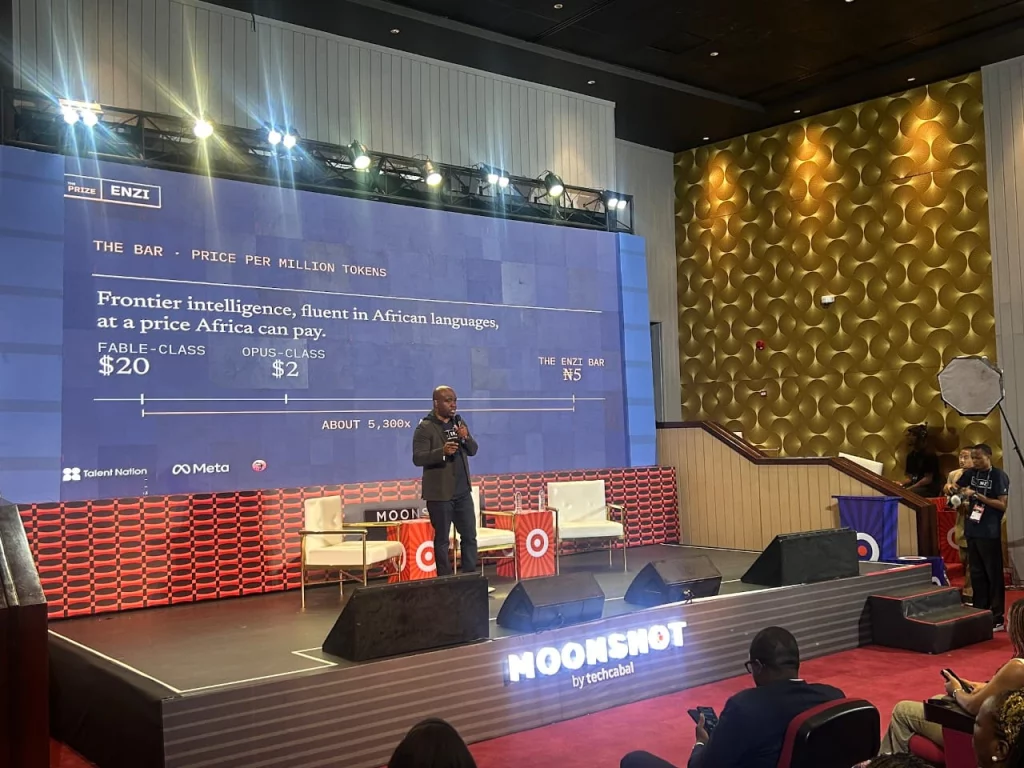
Submissions, whether cloud systems or models that run on a phone, are ranked on a public, open-source leaderboard, with rotating, sealed questions to prevent teams from gaming it. Winners retain their intellectual property but must publish an open, royalty-free version for use in Africa and the Global South.

The model is the Ansari X-Prize: offer a reward for a desired breakthrough and let competition draw in investment to achieve it. “If I put up $10 for you to chase,” he said, “people will spend $9 to chase 10.” He noted that a $20,000 pilot had already “brought a lot of talented people out of the woodwork”, producing the demos shown earlier that afternoon. “What would $10 million do?”

The purse is not yet fully funded. Udezue said he had spoken with OpenAI and Google that day, and estimated that winning the prize could take three to six years. His closing appeal was less for money than for belief: “Let’s make inference part of African innovation.”

§

Credit Direct, the consumer lending subsidiary of FCMB Group, a Nigerian financial services group, is expanding beyond traditional lending into embedded finance as it seeks to make credit and other financial services more accessible to individuals and businesses.

Victoria Arinze, product marketing lead at Credit Direct, said at Moonshot by TechCabal in Lagos that Credit Direct wants to use partnerships with businesses and merchants to bring credit closer to these transactions.

Embedded finance involves integrating financial services into platforms where customers already make payments or conduct other transactions, allowing them to access services such as loans without having to approach a financial institution separately. 

The continent’s 50 million small and medium-sized enterprises (SMEs) face a funding gap estimated at more than $330 billion. Credit Direct aims to close this by extending its lending expertise and integrating financing into the platforms that businesses and people use.

“We are primarily a credit organisation, and that has not changed and will never change. Credit is still the core of what we do,” Arinze said “What we’ve realised, however, is that credit really is not the end of how a person’s finances is built. When you give them credit, they then need to live their life, and living their life means being able to pay for things when they want to or when they have to.”

Founded in 2007, Credit Direct has spent nearly two decades lending to Nigerians, including customers in markets traditional lenders have often been reluctant to serve. Its 2025 Nigeria Credit Landscape Report, which draws on data from more than 300,000 borrowers, found that the average loan amount on its platform increased by 23.5% to ₦449,178 ($326.75) in 2025, with rent, medical bills, and school fees being the three leading reasons customers borrowed.

Credit Direct is also expanding into SME financing through CreditDirect Business, one of its newer products. The product offers general-purpose loans, invoice-backed financing, and loan purchase order (LPO) contract financing, with loans of up to ₦50 million ($37,130) available to eligible businesses. Loan amounts depend on factors including cash flow, existing obligations, and the nature of the business. Arinze said it is still relatively new and that the company is using customer feedback and engagement to determine how its products should evolve. 

“We’re not really looking to outbank the banks or out-fintech the fintechs. It’s really the people at the end of the day, and getting to that strength to partner with the persons that we have to when we need to,” she said.

Arinze said the company is now exploring expansion into other West African markets, with discussions currently ongoing. It did not disclose specific countries or timelines.

Web hosting by Somee.com