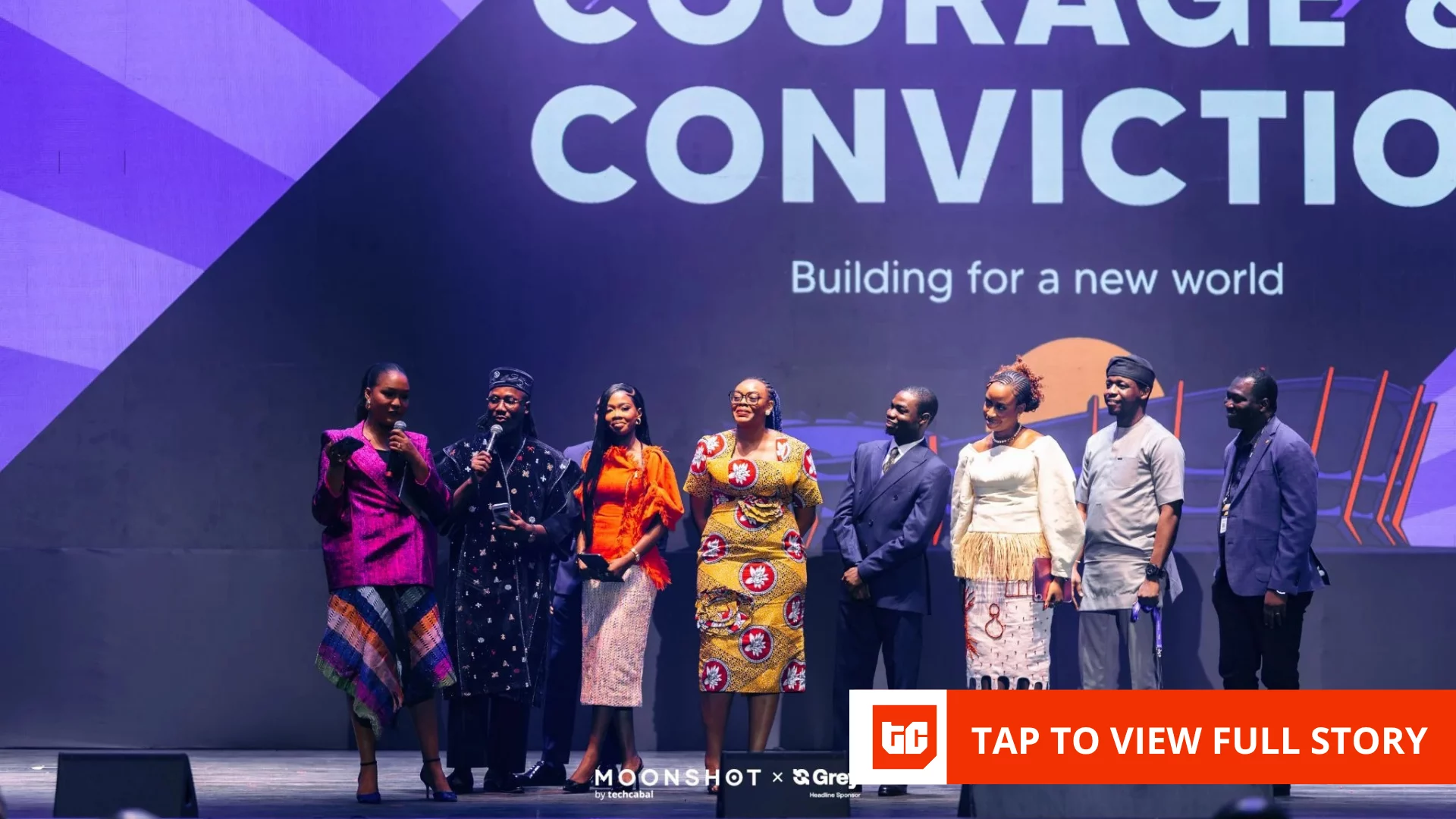
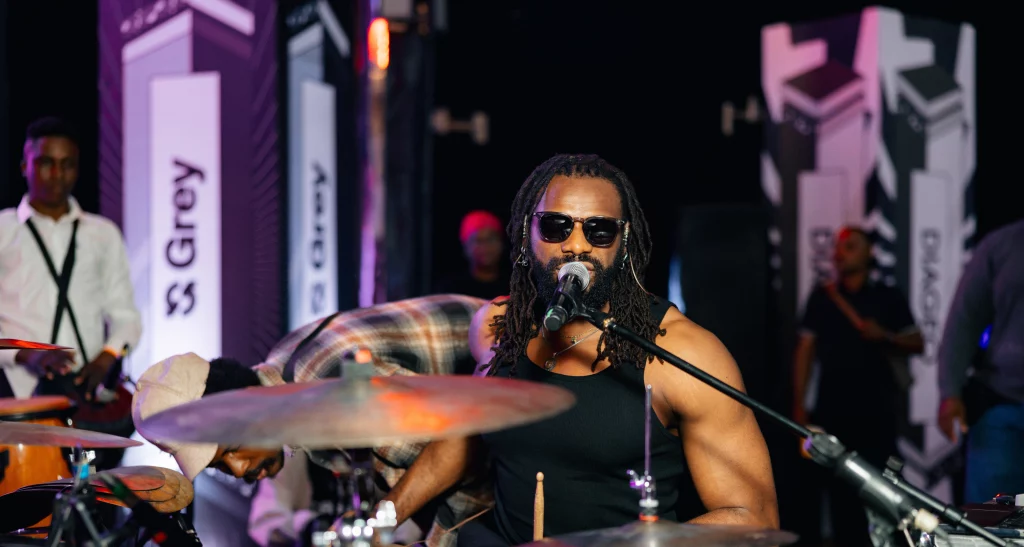
Atop Lagos’s newly renovated National Theatre, now the Wole Soyinka Centre for Arts & Culture, The Cavemen’s rendition of Redemption Song rose into the humid evening air. It was Tuesday, October 27, the opening mixer for Moonshot by TechCabal 2026, and one of Bob Marley’s seminal works felt like a fitting place to begin. Drawing partly on the words of Pan-Africanist Marcus Garvey, the song asks listeners to imagine freedom and their own responsibility for securing it.
How many people caught the symbolism? Here we were, gathered to discuss Africa’s technological future inside a cultural landmark that had been neglected for years before the Bankers’ Committee, led by the Central Bank, committed ₦68 billion ($58 million) and effort to restore it. The venue gave the conference’s theme, “Courage and Conviction,” a physical form.
“Our ecosystem is learning again what ambition costs,” Big Cabal Media (BCM) chief executive Tomiwa Aladekomo said in his opening remarks.
With Marley’s song in mind, it’s difficult not to think about what it takes to keep believing in something long enough to build it.
Over the next two days, that belief found expression in the crowds moving through the theatre, the companies exhibiting their products and, particularly, the young people arriving with ideas of their own.
The young want to build
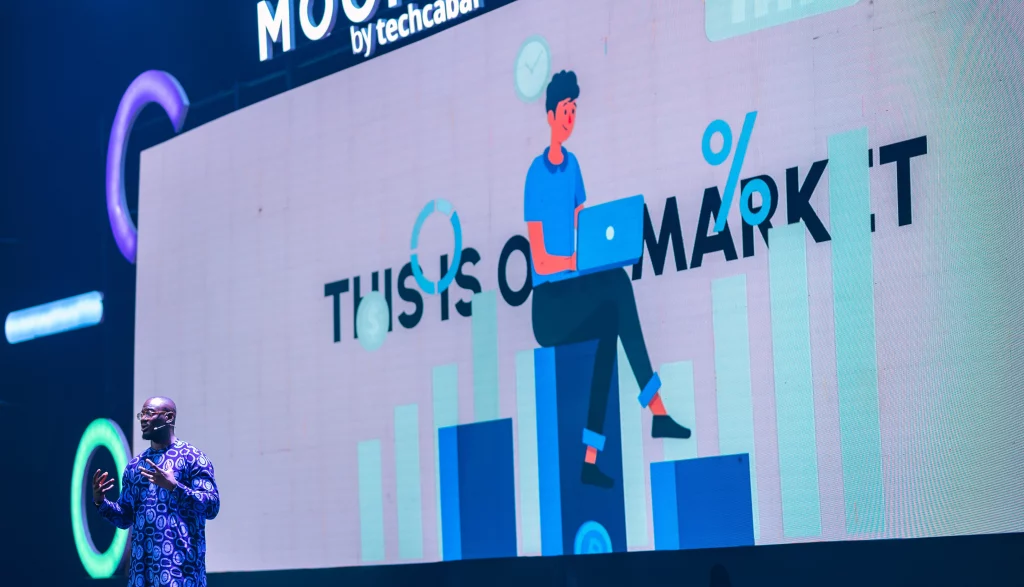
The young people at Moonshot were difficult to miss. They were pitching, demonstrating products and looking for people who could help their businesses grow. In a country as youthful as Nigeria, their presence made sense. What stood out was how many were entering technology with building solutions to local problems in mind.
One of the more revealing moments came not from a stage discussion but from the corridors. After interviewing Flutterwave chief executive Olugbenga Agboola, Opeyemi Kareem, one of the youngest members of the TechCabal newsroom, walked alongside him through the busy venue.
It was an ordinary encounter at a conference designed to bring people together, but it captured something important about Moonshot: the distance between an aspiring journalist, entrepreneur or young technologist and some of the continent’s most influential technology leaders can suddenly be smaller.
Access to people who have built businesses, raised capital and navigated difficult markets is one of the less quantifiable benefits of gatherings like this.
Starting a company is an unusually demanding expression of confidence in the future. The electricity may be unreliable, customers may struggle to pay, while investors may take months to reply.
Yet people keep starting.
Africa’s young population—more than 60% of its people are under 25, according to the African Union—is frequently presented as an economic advantage. Realising that advantage requires institutions, financing, and opportunities that enable people to turn their abilities into productive work. The enthusiasm visible at Moonshot creates an obligation for those with resources to help it develop.
A founder’s determination can start a company. Whether that company survives also depends on the conditions around it.
By the next Moonshot, some of these founders would have changed direction. Some businesses would have closed. Others would have found customers, hired colleagues and earned the confidence to enter another market. Giving more of them a fair chance to reach that point would be a meaningful investment in the future on display in Lagos.

Building through the friction
For many entrepreneurs at Moonshot, an ordinary workday involves solving problems that have little to do with the product they set out to build.
When power goes out, a connection drops, or a payment takes longer than expected, someone on the team spends time resolving the issues instead of speaking with a customer.
These costs do not appear in the stories told about African ingenuity. The founder finds a workaround, and the business carries on. But every workaround consumes money, attention, and time. Eventually, the question is how much more a company could accomplish if fewer things stood in its way.
Idorenyin Obong, co-founder and chief executive of Grey, a US-based cross-border payments company, described one such obstacle while speaking to journalists on the sidelines of Moonshot.
“Most times, if you’re trading within Africa, there’s always some form of intermediary currency,” he said.
A Nigerian business paying a supplier in Kenya can find itself converting naira into dollars before the money becomes shillings. Grey says it has developed direct currency routes to reduce the number of steps.
The customer wants to know how much the payment will cost and when it will arrive. The supplier wants to release the goods. Somewhere between the two is a business opportunity for whoever can make that exchange dependable.
That is worth remembering after a conference full of ambitious ideas. There is considerable value in making an everyday task work properly.
Repeated often enough, that confidence makes room for growth.
Continental ambition requires local knowledge
Another encouraging feature of Moonshot was the determination among startups to look beyond their home markets.
For businesses gathering in Lagos, the continent offered customers, partners and possibilities still to be explored. The ambition felt expansive, and the work required to fulfil it will be painstaking.
A founder can enter a second market with a successful product and discover that almost everything around it needs to be rethought. The learning starts again.
This is where gatherings such as Moonshot are important. A conversation with an operator from another market can expose a faulty assumption before it becomes an expensive decision. A useful introduction can lead to a partner who understands what a visiting founder has yet to learn.
For younger companies, another lesson came from Flutterwave chief executive Olugbenga “GB” Agboola’s account of the company’s next phase. Speaking at Moonshot, he described plans to expand beyond payment processing into other financial services.
“If you can trust us with your payment, it’s much easier to sell to actually keep the money for you,” he said.
The sequence offers important lessons to founders across the continent. Solve a problem well enough for customers to trust the business. Pay attention to what they need next. Then establish whether the company has the people, systems, and licenses to provide it.
The same discipline should travel with a business across borders. Ambition opens the conversation, but local knowledge helps turn it into a lasting operation.
A bigger room brings greater expectations
Moonshot’s move to the National Theatre was an achievement in itself. Over 7,000 people came through a venue whose size now leaves room for the annual gathering to grow.
Moving to a bigger venue was a bet on the appetite for conversations on the future of Africa’s tech—and a commitment by BCM to give them more room. The crowds at the National Theatre showed how much that room was needed.
The programme’s breadth helped. Conversations ranged from payments and telecommunications to artificial intelligence, climate technology and the creative economy, with investment and public policy running through them.
One thread running through several discussions was that Africa’s technology story cannot be told through startups alone. Behind the applications people use every day are transport networks, payment rails, reliable connectivity, location data, financing and the infrastructure that allows businesses to operate.
The creative economy faces a similar challenge: talented filmmakers, musicians and content creators need distribution, commercial partnerships and payment systems to turn their work into sustainable businesses.
These are not necessarily the most glamorous parts of the technology conversation, but they are where the next opportunities and some of the hardest problems lie.
For founders, that offered a chance to look beyond their own sector and understand how developments elsewhere could shape the business they were building.
Innovation needs a harder test
There was another question worth carrying home: how will the industry know whether all this activity is improving anything?
Another question is who gets to participate in the growth of the technology economy. South Africa’s past discussions around digital skills and youth employment offered a useful reminder that building a technology ecosystem is not only about producing more startups or attracting investment.
It is also about creating pathways into work for the millions of young Africans who may never become founders but could become developers, technicians, digital marketers, designers and other skilled professionals.
At Moonshot, the wider conversation about Africa’s digital future was therefore also a conversation about jobs, access to skills and whether the industry can create opportunities at a scale that matches the continent’s youthful population.
Uche Amaonwu, director of the Gates Foundation’s Nigeria Country Office, brought that question to the AI discussion. He argued that success should be judged by improvements in people’s lives, with healthcare, education and agriculture among the areas where the technology could prove useful.
A health product must fit into the working day of the people expected to use it. An educational service needs evidence that students are learning. A tool for farmers must offer advice they can act on, at a cost they can afford.
Somebody must adopt the product and pay for it. And the benefit must survive contact with an ordinary day outside fancy air-conditioned boardrooms.
What happens after the gathering
After the two days of these conversations, the temptation is to carry everything home: every contact, every idea, every promise to catch up.
Then the ordinary working week resumes.
The people who get lasting value from Moonshot will have to make choices. Which conversation deserves a follow-up? Which assumption needs testing? Which potential partnership addresses a problem the business actually has?
For a founder, that might mean sending a specific question to an operator who has already entered the next market. For an investor, it could be taking a second look at a company whose progress is easier to understand through its customers than its pitch deck. For an established business, it might mean giving a young supplier its first meaningful contract, and paying on time.
These are modest actions compared with the ambitions expressed on stage. They are also how those ambitions acquire substance.
Africa’s technology future will be shaped by whether more promising companies can reach the point where customers depend on them, employees can build careers within them, and investors can see a credible return. Getting there will require reliable infrastructure, financing, and institutions that make the work easier to sustain.
The young founders at Moonshot offered reasons to believe that the future is worth committing to. Their determination was visible, and the support around them now needs to become equally tangible.
By the next gathering, there should be stories of what really followed some of these conversations. A product improved because someone asked a difficult question, a market entered through a connection made in Lagos, a business kept alive by a customer willing to take a chance.
The National Theatre supplied a fitting backdrop. Restoring it required people to commit resources and stay with the work long enough for others to gather inside.
“Won’t you help to sing these songs of freedom?”The Cavemen brought an important question into Lagos.
After two days, it was a question to take home. The founders showed what they were prepared to attempt, and around them were people who could offer capital, open a door, or become a first customer.
When Moonshot 2027 returns, the most interesting question will be what its participants made possible.