Food prices across major Lagos markets recorded a reversal in October 2026, with more staples posting price increase than declines, despite a month-on-month fall in Nigeria’s national food inflation rate.
The latest Nairametrics market survey of 67 food staples across Mushin, Daleko, Mile 12 and Oyingbo markets showed that 31 items recorded increased in price in October, significantly higher than the 17 in September.
Meanwhile, 20 items declined in price, down from 35 items in the previous month, while 16 items remained unchanged compared to 15 items in September.
The October price movements suggest that while the harvest season and improved supplies continued to moderate prices for some perishables and imported food item, supply disruptions, seasonal demand, transportation costs, and storage-related factors pushed up the prices of several key staples including maize, garri, onions, beans, milk products, and frozen foods.
What the traders are saying
Mrs. Kemi Adewale, a tomato wholesaler at Mile 12 Market, said the sharp decline in tomato prices was driven by increased supplies from major farming belts across northern and central Nigeria.
- “We received more tomato trucks in October than we did in September. When supply increases like this, buyers have more options and prices naturally come down.”
Similarly, pepper traders attributed the decline to abundant harvests and intense competition among sellers.
Alhaji Musa Ibrahim, a pepper dealer in Mile 12, explained:
- “Pepper became more available this month and many traders were competing for the same customers. Since pepper spoils quickly, nobody wants to keep stock for too long. Most sellers preferred to reduce prices and sell faster rather than risk losses.”
According to Mr. Emeka Nwosu, a frozen fish distributor in Daleko Market:
- “Many households are still managing tight budgets. Even when stock is available, customers are buying smaller quantities. Suppliers had to reduce prices slightly to encourage sales.”
Mr. Adebayo Olatunji, a grain merchant at Oyingbo Market, said demand from poultry operators and feed millers remained exceptionally strong.
- “Many people expected maize prices to fall because harvests have started, but demand is still very high. Poultry farms and feed producers are buying aggressively, and that is competing with household demand.”
Another trader, Mrs. Hadiza Bello, who sources grains from northern Nigeria, noted that some farmers and aggregators were deliberately holding inventories.
- “A lot of suppliers believe prices could rise further towards the end of the year, so they are not releasing all their stock to the market. That has reduced immediate supply and pushed prices higher.”
Alhaji Ibrahim Yusuf, an onion trader at Mile 12 Market, said:
- “Supply was not as plenty as what we saw a few months ago. Fewer trucks arrived in the market and that immediately affected prices because onions are traded largely based on available truckloads.”
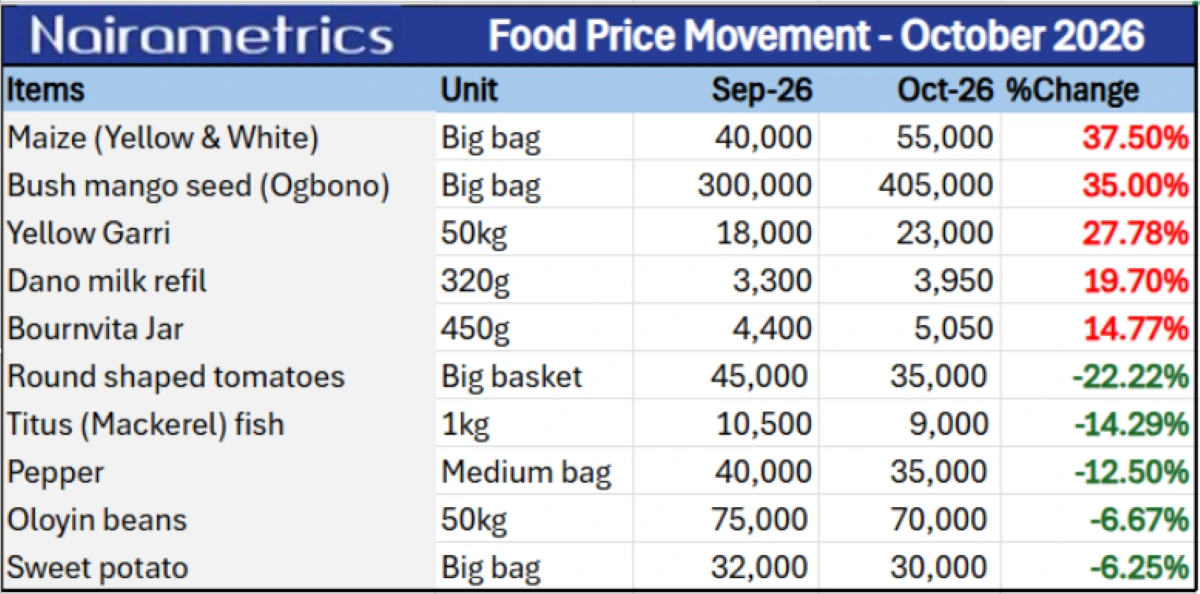
Items that recorded price increases
Yellow and white maize posted the highest increase among widely consumed staples. A 50kg bag of both yellow and white maize climbed from N40,000 in September to N55,000 in October, representing a 37.5% month-on-month increase.
- Bush mango seed (ogbono) also recorded a sharp increase, rising from N300,000 to N405,000 per big bag, representing a 35% increase.
- Yellow garri recorded another significant increase, rising from N18,000 to N23,000 per 50kg bag, representing a 27.78% increase. While white garri rose from N19,500 to N21,000, representing a 7.69% rise.
- 320g pack of Dano refill milk increased from N3,300 to N3,950, representing a 19.70% rise, while 900g pack of Peak refill milk rose by 17.39%, from N9,200 to N10,800.
- Bournvita in a 500g/450g jar increased from N4,400 to N5,050, representing a 14.77% increase.
- Frozen chicken also became more expensive. The average price of a carton of chicken lap rose from N48,000 to N55,000, representing a 14.58% increase.
Other notable increases included:
- Dry onions rose 10%, from N200,000 to N220,000 in October.
- 70g Golden Penny noodles, up 4.88%, from N8,200 to N8,600.
- 50kg Brown beans, up 4.76%, from N105,000 to N110,000.
- 500g Bonita pasts, up 4.17%, from N1,200 to N1,250.
Items that posted downward price movement
Despite the wider increase in the number of staples that became more expensive, some food items recorded notable reductions in October.
Round-shaped tomatoes recorded the largest decline among the items reviewed in the survey.
- The average price of a big basket fell from N45,000 in September to N35,000 in October, representing a 22.22% decrease, while Oval-shaped tomatoes fell from N80,000 to N70,000 per big basket, a 12.50% decline.
- Titus mackerel also declined by 14.29%, from N10,500 to N9,000 per kilogram.
- The average price of a medium bag fell from N40,000 to N35,000, representing a 12.50% decrease, while the big bag also declined by 12.50%, from N80,000 to N70,000.
- Oloyin beans declined by 6.67%, from N75,000 to N70,000, while sweet potatoes fell by 6.25%, from N32,000 to N30,000.
Other reductions included:
- 350g pack of Cowbell refill milk, declined by 4.47%, from N3,020 to N2,885.
- 5kg pack of Honeywell semo fell by 3.44%, from N8,150 to N7,870, while Ayoola poundo yam flour, 4.5kg, declined by 2.45%, from N18,800 to N18,340.
- 25 liters of Local palm oil, down 2.08%, from N48,000 to N47,000.
- 50kg Royal Stallion short-grain rice, down 2.04%, from N49,000 to N48,000.
Inflationary contribution
Lagos market survey in October comes after Nigeria’s headline inflation rate declined to 14.63% year-on-year in September 2026, from 15.39% in August.
This represents a reduction of 0.76 percentage points and marks a further moderation in the annual rate of price increases.
- On a month-on-month basis, headline inflation slowed to 0.06% in September, compared with 0.71% in August. This indicates that the average price level increased only marginally during the month, although it did not mean that all prices fell.
- Food inflation rate stood at 19.59% in September, marginally higher than the 19.57% recorded in August, but lower than the 20.16% recorded in September 2025.
Notably, Lagos records the highest food inflation in September. The state recorded 34.40% year-on-year food inflation compared with 30.89% in August.
This means food prices in Lagos were significantly higher than their levels a year earlier, even as the national month-on-month food inflation rate turned negative.
Lagos’ headline inflation also moderated, falling to 17.35% in September, from 23.68% in August.
About the Nairametrics Food Price Survey
The Nairametrics Food Price Watch is a monthly market survey tracking the prices of major food items across Nigeria.
This report specifically covers four key markets in Lagos State: Mushin, Daleko, Oyingbo, and Mile 12 Market.
The survey provides up-to-date insights into food price trends, helping businesses, policymakers, and consumers make informed decisions.