×
Tech

Spend first, measure later: Inside African banking’s AI boom 

Are Lenders Seeing the Returns Yet?

According to a 2026 report surveying 277 banking executives across 37 African nations, 83.2% of institutions plan to increase their AI spending over the next 12 months. Yet nearly a third do not formally track the return on investment. More strikingly, among the lenders that do not measure returns at all, 82% still plan to expand their budgets anyway. Between dollar-denominated cloud hosting bills, legacy core banking integration bottlenecks, and an acute regional deficit of machine learning engineers, African lenders are doubling down on an expensive technology whose ultimate fiscal contribution is still an article of faith. In this edition of Delve into AI, EMMANUEL NWOSU examines the uncomfortable disconnect between operational speed and audited balance-sheet yield inside Africa’s multi-million-dollar banking automation race.

Loan documentation has historically been an administrative bottleneck, even within well-capitalised financial institutions. At Standard Bank, a vetting process that previously took roughly an hour now wraps up in about 60 seconds, powered by artificial intelligence. 

The metric, disclosed in the South African lender’s Capital Markets Day filing in March 2026, applies to its commercial asset finance division. It serves as a flagship case study for how Africa’s largest bank by assets is operationalising machine intelligence. 

Standard Bank reported that its conversational bot handles 65% of all incoming digital customer queries, while over 39,000 employees—approximately 72% of its total workforce—were regular enterprise users of generative AI by August 2026. 

These workflows showcase the immediate operational promise of automation: administrative backlogs evaporate into single-minute tasks, customer friction drops, and bank staff are freed to focus on high-touch advisory roles requiring human judgement. 

Yet the net financial dividend remains murky. Deploying AI across regulated financial environments requires rigorous data governance protocols, expensive software licencing, complex systems integration, and widespread workforce reskilling. For these outlays to be commercially defensible, banks must prove that bottom-line yield outweighs implementation overhead. 

Industry data reveals an uncomfortable divergence between capital expenditure and performance tracking. According to The State of AI in African Banking—a 2026 joint report by banking software provider Backbase and African Banker, surveying 277 executives across 37 African nations—83.2% of institutions plan to increase their AI allocations over the next 12 months. Yet only 67.1% formally track the return on investment (ROI) of those deployments. 

More strikingly, among the third of respondents whose banks do not track AI returns at all, 82% still plan to expand their budgets. African banking leaders are aggressively capitalising a technology whose commercial contribution they have yet to quantify. 

This absence of measurement does not signify failure. Algorithmic systems can compress turnaround times, sharpen fraud monitoring, and elevate customer experience without immediately shaving costs from the income statement. 

But the distinction between operational efficiency and financial return becomes harder to ignore as AI moves beyond isolated experiments and into systems that banks use every day.

However, as AI transitions from experimental sandbox pilots into core banking architecture, the distinction between unmonetised operational speed and audited fiscal return becomes impossible to ignore. 

Faster work, uncertain financial returns

Standard Bank has been building its AI capabilities on technology investments made over several years. In its March investor presentation, the bank said conversational AI was handling 65% of digital queries on its personal banking app, reducing the workload associated with customer service.
Signage for Standard Bank Group Ltd in the Sandton business district of Johannesburg, South Africa. Image Source: Waldo Swiegers/Bloomberg

It also reported that engineering productivity had improved by more than 20% in the previous year, while AI was beginning to accelerate work in lending. Its commercial asset finance example, in which loan documentation processing fell from roughly an hour to a minute, underscores the extent of the improvement possible in some administrative processes.

The bank has also expanded the technology across its workforce. In August, it reported more than 39,000 active users of generative AI, supported by approved enterprise tools.

Consider the loan documentation process. Reducing processing time from an hour to a minute frees up the employees responsible for that work. The bank may then be able to process more applications with the same workforce, reduce overtime, or redirect staff to other responsibilities.

Those benefits become measurable financial savings only when they result in expenses avoided or additional income that can reasonably be attributed to the investment.

Standard Bank said it plans to redirect the time employees save using AI towards customer relationships and work requiring more complex decisions. This suggests that the bank is looking beyond cutting operating costs to extracting more value from its existing workforce. On its own, it does not specify revenue generation or cost savings.

Sticking with Standard Bank’s lending business, AI could help employees process more loan applications without a corresponding increase in staff costs. If used to assess borrowers’ creditworthiness, it could also help the bank make better lending decisions and reduce the risk of defaults. These are two different benefits, and Standard Bank has not established whether its AI investments have delivered either financially.

The bank’s non-performing loan ratio stood at 5.6% at the end of June, down from 6.2% the previous year. Credit impairment charges, which reflect expected losses from loans, also fell by 12% to R7.13 billion ($435.5 million) in the first half of 2026. The lender has not attributed the improvement to AI usage.

At Nedbank, another tier-1 South African lender, the improvements are also measurable.

According to its 2025 integrated report, the bank said it implemented 30 advanced AI use cases during the year. Its broader programme, combining AI, generative AI, analytics, machine learning, and robotic process automation, helped save approximately 312,000 employee-hours across media and content creation, document translation, and personal productivity. Global payment processing times also fell by about 30%.

Nedbank has applied predictive models to identify customers more likely to purchase investment products, alongside analytics that help it target potential credit card and loan customers.
In August, Nedbank said its investments in AI, automation, and digital banking has unlocked about R375 million ($22.7 million). Image Source: ITWeb.

These uses illustrate how banks expect to earn returns from AI in two broad ways: spending less to provide existing services and earning more by serving customers more effectively.

The cost of making AI work

AI does not operate independently of a bank’s existing technology. Models need access to reliable data, secure computing systems, and the applications through which employees and customers use them. Banks also need processes for testing outputs, controlling access to sensitive information, and monitoring decisions made with AI.

Those requirements can make the expense of deploying AI considerably larger than the cost of a software subscription.

At its 2026 Capital Markets Day, Standard Bank reported total technology spending of R23.5 billion ($1.44 billion) in 2025, equivalent to 27.7% of its operating expenses. It said 88% of its legacy servers had been decommissioned and that 71% of computing workloads eligible for migration had moved to the cloud at the time of the presentation.

The bank subsequently reported that cloud migration had reached 78% of eligible computing workloads by the end of June 2026.

Standard Bank said its technology investments helped improve efficiency over several years, contributing to a decline in its group cost-to-income ratio from 59.1% to 50.2%. This means that for every R100 ($6.09) the bank earned in operating income, it spent about R50 ($3.05) on operating expenses, compared with roughly R59 ($3.6) previously.

Standard Bank’s technology spending has continued to rise alongside its expanding AI operations. The bank spent R23.51 billion ($1.43 billion) on technology in 2025, up 4.9% from R22.4 billion ($1.36 billion) in 2024. In the first half of 2026, its software, cloud, and technology-related expenses rose 6% to R7.16 billion ($436.5 million). The bank attributed the increase partly to expanding its AI capabilities, alongside investments in specialised technology expertise, core banking systems and cybersecurity.

Yet, its overall technology spending grew by only 2% to R11.83 billion ($721 million) during the six months, as lower amortisation and other technology costs offset part of the increase. Standard Bank has been following what it calls a save-to-invest strategy, using efficiencies from earlier technology investments to fund newer capabilities, including AI.

The bank’s investment in modernising its technology systems comes amid the backdrop of its AI-readiness ambition; it illustrates the work required to introduce new capabilities into an established banking business.

To prove this point, African banks face AI integration challenges. In the Backbase and African Banker survey, 50.2% of respondents identified integrating AI with existing technology as their biggest internal obstacle to adoption.

Banks may have to connect customer records, transaction histories, and other information stored across systems developed at different times. A lender introducing AI into credit assessment, for example, needs reliable access to the financial information used to evaluate borrowers. Bringing those records together can require upgrades to existing systems, additional computing infrastructure, and specialised employees to maintain them.

These requirements add to the initial and ongoing cost of using AI. Where banks purchase cloud services or software in foreign currencies, exchange-rate movements can also increase their expenses in local currency.
An artificial intelligence sign at the MWC25 tech show in Barcelona, Spain on March 4, 2025. Image Source: Angel Garcia/Bloomberg

The financial case for AI depends on more than how much time a system saves. Banks must weigh those gains against the full cost of introducing and operating the technology, including the infrastructure needed to support it.

Why the returns remain difficult to measure

The Backbase and African Banker research suggests that some African banks are getting the financial results they expected from AI. Among respondents whose institutions formally measure returns, 85.1% said their investments had met or exceeded their projections.

The banks, however, were measuring performance against their own targets. The survey does not establish how much they invested, the financial value generated, or whether returns were calculated consistently across institutions.

Consider AI-powered lending. If a bank approves more applications after introducing AI, the additional loans could increase its interest income. But the financial benefit would depend on funding costs, the performance of those loans, and whether the technology improved lending decisions. Similarly, an AI fraud detection system’s value lies in the losses it prevents, not simply the number of suspicious transactions it flags.

The survey also found that 71.7% of respondents working with third-party AI providers measure returns, compared with 31% of those developing AI entirely in-house, underscoring how banks differ considerably in their ability to deploy proprietary AI—another cost centre. 

In June 2026, Evident’s inaugural AI Index for Banks in the Middle East and Africa assessed 25 major banks on AI talent, innovation, leadership, and transparency. Standard Bank ranked second and Nedbank fourth, making them the only two South African banks among the four regional leaders. Other South African lenders, FirstRand, Capitec, and Absa, rounded off the top ten list. 

Evident attributed their comparatively strong performance partly to larger pools of AI talent, proximity to research universities, and engagement with emerging central bank regulation. 

The concentration suggests that South African banks have built stronger AI capabilities than many of their regional peers. Across the 25 institutions assessed, Evident found that specialist AI development talent, relative to workforce size, was only half the level recorded among its benchmark of major global banks. 

This shortage has financial implications. Banks without sufficient internal expertise must either invest in building their own AI capabilities or rely on external providers, while still paying to integrate and maintain the technology.

Some banks outside Africa have begun providing a clearer account of the financial value they derive from AI. Singapore’s DBS Bank reported approximately S$1 billion ($783 million) in economic value from data analytics and AI in 2025, up from S$750 million ($587 million) in 2024. By the end of 2025, it had deployed more than 2,000 models across over 430 use cases.

DBS has gone beyond reporting how many tasks AI completes or how much time employees save. It has placed a monetary value on the technology’s contribution to its business, although it is unclear whether the Singaporean lender is now profitable on its AI usage.

The comparison brings the financial question facing African banks into clearer focus. Standard Bank and Nedbank have demonstrated improvements in productivity, while many institutions surveyed by Backbase report meeting their AI investment targets. But they provide little indication of how much individual AI programmes cost or what they return financially.

Productivity is a key use case for AI in banking, and across other non-financial organisations. But the opportunity here is establishing what that productivity is worth. 

True scale demands moving beyond surface-level integrations to robust execution. We’ve filtered the noise out of Moonshot 2026, optimising the conference strictly for high-calibre connections between startup founders, global financial operators, enterprise leaders and individuals rewiring Africa’s technical frameworks. Get 20% off Early Bird tickets for a limited time.

Moonshot mast head

§

What if frontier AI doesn’t need a multi-billion-dollar data centre to be smart? Every time an AI model generates code or reasons through a prompt, an immense amount of electricity is burned behind the scenes. As workloads grow more complex, running frontier systems is becoming too expensive for markets without unlimited power grids. Enter Ayomide Daniels, founder of Alchymia AI. Instead of patching existing transformer models, Daniels spent the last decade designing foundational architectures that adapt computational effort to the complexity of the task—slashing training energy by two-thirds and enabling models to run on edge devices. The company is even testing the limits of physical AI with a screenless, palm-sized computer that projects interactive holograms. For Delve into AI, OPEYEMI KAREEM goes inside Alchymia’s quest to make high-level intelligence accessible to the resource-constrained world.

Every time you prompt an artificial intelligence (AI) chatbot to dissect a relationship or parse a private dilemma, a remote server hums into gear—and that computation demands energy. 

Google estimates that a median text prompt on its Gemini app consumed 0.24 watt-hours of electricity in May 2025, roughly what a television burns in nine seconds. Multiplied across billions of daily interactions spanning code generation, high-level reasoning, image synthesis, and autonomous agent tasks, the collective electrical draw is staggering. 

The International Energy Agency (IEA) estimates that complex, multi-step workloads can consume hundreds or thousands of times more electricity than basic text generation, placing acute strain on global power grids. For Nigerian founder Ayomide Daniels, this inefficiency represents a fundamental architectural flaw. 

Daniels is the founder of Alchymia AI, an applied research lab building foundational models engineered to produce high-level intelligence at a fraction of the compute and energy demanded by standard industry frameworks. Originally incorporated in 2016 as Immersive Research, the firm has spent a decade pursuing structural efficiency. 

“We focus on architecture because it dictates the underlying compute and energy profile of a model,” Daniels told TechCabal. 

Rather than applying surface-level optimisations to existing transformer designs, Alchymia went back to the drawing board to build alternative model architectures from scratch. 

“We focus on architecture because it determines the underlying compute and energy profile of a model,” Daniels told TechCabal in an interview on Wednesday.

For Alchymia, that has meant going back to the underlying design of an AI model rather than trying to make existing systems better.

Building AI differently

The company’s departure from convention came in the form of Regent, an open-source model designed as an alternative to the transformer architecture that underpins models from OpenAI and Google. 

Unlike standard transformers—whose computational costs scale exponentially with context length—Regent maintains a fixed memory footprint, selectively retrieving information only when required. 

Crucially, the model is lightweight enough to run locally on consumer hardware without pinging hyperscale cloud clusters. 

It also features a real-time verification loop: instead of generating an entire response before validating its accuracy, Regent evaluates confidence token by token. If certainty falls below a predetermined threshold, the system throttles its generation speed, queries its internal knowledge base, and self-corrects. 

For high-stakes deployments in healthcare or public administration, verifiable error-checking is critical. 

Building on Regent, Alchymia developed Darkhorse, its latest frontier model. Darkhorse uses adaptive computation, dynamically scaling its processing depth to match the complexity of a prompt rather than routing every request through a uniform computational pipeline. 

Simple queries require minimal compute, while complex logical problems trigger deeper evaluation, lowering overall inference costs. 

According to internal company benchmarks, Darkhorse requires approximately one-third of the energy needed to train comparable models and halves the energy consumption per token during inference. 

While these claims await independent verification, Alchymia states it has invested over $2.3 million of non-dilutive capital over the past five years to reach this stage. 

“We want to build foundational models suited for regions across Africa and Asia—markets that lack access to unlimited data centres and outsized balance sheets,” Daniels explained. 

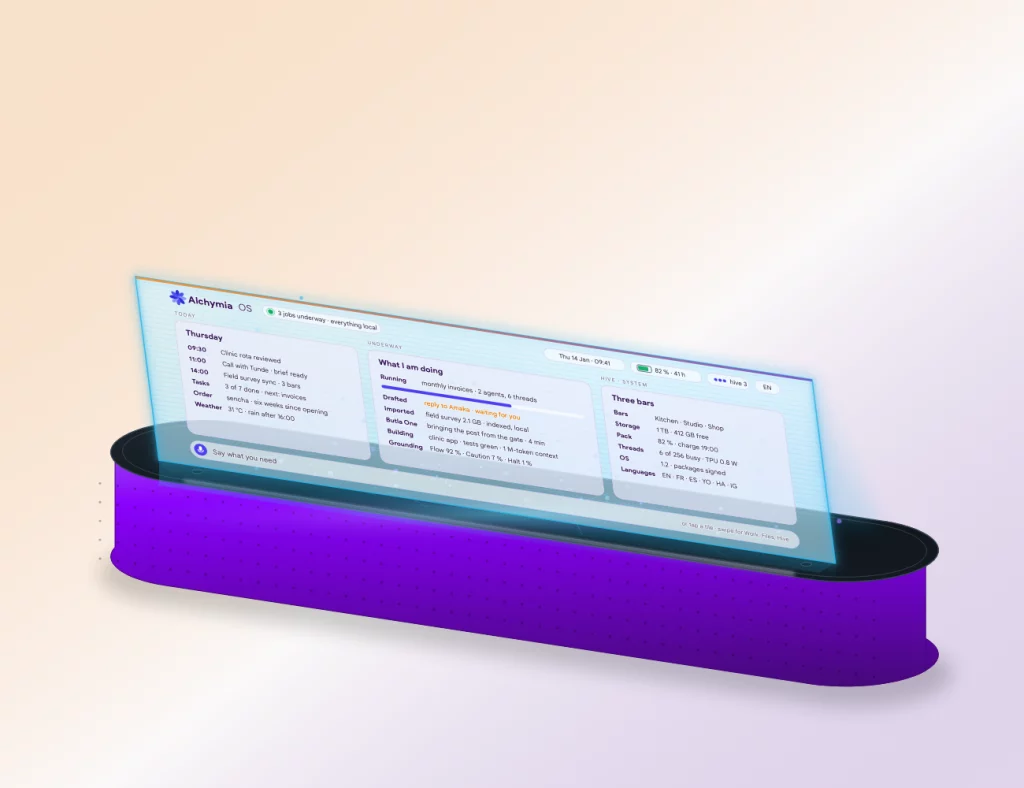
Prototype of Alchymia Bar, a small, screenless computer designed to run the company’s AI locally. Image source: https://alchymia.ai/

Taking AI into the physical world

The models are only part of Alchymia’s plan. Daniels said he wants the company’s AI to move beyond the familiar setup of a person prompting AI chatbots on a laptop screen. 

The company is working towards what he calls physical AI, which is a system that can understand instructions and act on them through devices such as drones, robots and other machines.

“The point of Alchymia is to bring AI into the physical world, something beyond just screens,” Daniels said.

What matters to Alchymia is that the model does not have to be built specifically for one machine. 

Its goal is to create AI that can be deployed across different kinds of hardware and still understand what it is being asked to do.

The company is also building its own computer around this idea. Alchymia Bar is a small, screenless computer designed to run the company’s AI locally. 

Daniels described it as roughly the size of a Samsung Galaxy phone, and it uses beams of light to project its display, like a hologram. 

The projected interface gives users access to applications and allows them to interact with the computer much like they would with a regular machine. 

Daniels explained that the computer runs Darkhorse locally and can handle coding, writing, documents, 3D workflows and media. 

The computer is still a product in development, with plans to launch it commercially in 2027.

“The computer is not there to replace the normal machine or laptop,” he said. “It is just a starting point to ensure we are going to empower everyone who doesn’t have access to these things just because of where they are born or whatever predicament they are in.” 

Alchymia is building towards a world in which AI does not have to remain tethered to the biggest data centres to be useful. Daniels said his focus is on making AI more efficient and available in places where conventional computing has struggled to reach.

“The entire point of why we do this is to ensure we put this technology in everybody’s hand regardless of whether you are poor, you are rich, you have elite education or not,” Daniels said.

True scale demands moving beyond surface-level integrations to robust execution. We’ve filtered the noise out of Moonshot 2026, optimising the conference strictly for high-calibre connections between startup founders, global financial operators, enterprise leaders and individuals rewiring Africa’s technical frameworks. Get 20% off Early Bird tickets for a limited time.
§

DPI Venture Capital, the early-stage arm of Development Partners International—a private equity firm managing more than $3 billion in assets across Africa—has reached a final close of over $112 million for its Nclude Fund. 

Ashley Lewis, managing partner and head of DPI Venture Capital, told TechCabal that virtually all the capital was committed by financial services institutions, with 93% originating from within Africa. By comparison, African investors supplied just 37% of the funding secured by the continent’s startups in the first half of 2026, according to TechCabal Insights. 

At $112 million, Nclude’s final close exceeds the combined total raised by all Africa-focused venture funds in 2025: the African Private Capital Association (AVCA) recorded just six final closes totalling $107 million that year, an 87% drop compared with 2024.

The fund is notable not only for its scale in a depressed market, but because it reverses the conventional architecture of African venture capital, where development finance institutions (DFIs) and Western limited partners typically anchor the ecosystem.

“There is a lot of discussion about how funds can move beyond the DFI-backed model to more commercial funding, and I think Nclude and DPI Venture Capital show that there are working paths to capital from unusual sources,” said Lewis. 

Nclude started in March 2022 as a fintech fund in Egypt, launched after the Central Bank of Egypt approved it. Banque Misr was the anchor investor, with National Bank of Egypt and Banque du Caire as strategic investors, and the Egyptian Banks Company, e-Finance and Mastercard joined later. Global Ventures managed the fund at first, but in 2025, after a restructuring, DPI became its adviser and launched DPI Venture Capital to run it.

When DPI assumed control, Banque Misr stated that the fund held $105 million in assets under management against an initial $150 million target. While the $112 million close settles below that original ambition, Lewis maintained that DPI did not establish a rigid cap. 

With unallocated capital already available upon takeover, the manager spent roughly 12 months curating a select group of commercial institutional investors whose strategic footprints aligned with the fund’s financial services mandate. 

The fund targets core fintechs alongside embedded finance providers—such as real estate platforms distributing mortgage products. Under DPI’s stewardship, Nclude expanded its mandate to span seed through Series C rounds, carved out a minimum 10% allocation for seed-stage bets, and began deploying outside Egypt, with up to 30% of capital permitted across broader regional markets. 

Writing equity cheques between $500,000 and $10 million, the fund has backed 15 companies over the past 18 months; Lewis expects the portfolio to mature at between 22 and 24 investments. 

Its portfolio includes Nawy, the Egyptian proptech platform that secured a $52 million Series A; Paymob, the digital payments infrastructure provider that closed a $35 million pre-Series C round led by Mubadala and the EBRD; FlapKap, a UAE-based revenue-based financing platform for SMEs that raised $34 million; Money Fellows, a digitised money circles (ROSCAs) platform that raised $13 million; Kera, a healthcare AI company operating across Senegal and Côte d’Ivoire; and Accord Partners, an accounting and corporate audit AI aggregator focused on Saudi Arabia. 

Below, Ashley Lewis discusses how DPI structured the raise, where the capital is being deployed, and the secondary and trade exit pathways the firm is prioritising in a constrained market. 

This interview has been edited lightly for clarity and length.

What was the fundraising process like?

We became advisers to the Nclude Fund in 2025, and getting there took some time. During that period we started to rethink what success would look like. The fund was championed by the Central Bank of Egypt, and all its LPs were financial services players, mostly banks. We wanted to continue in that vein. There was a special connection between the regulatory view, the financial services view, and what technology can do for the ecosystem.

Success for us meant going to a small number of LPs and keeping the base the same. The ones we brought on are, for the most part, African and regional financial services players.

That made this fundraise different from what most GPs go through, where you are looking at DFIs and global LPs. It still takes time to get LPs over the line, and we worked closely with them over about 12 months.

What target did you set?

We approached the target differently. We focused on aligned partnerships and did not set an explicit fund size target. When we became adviser, the fund still had dry powder to deploy, so we wanted investors aligned with the broader vision who were also financial services players. That is different from how most funds set a target and then go to market to maximise it.

How have you deployed capital since DPI took over?

Our first goal was to look after the existing portfolio. There were eight companies in it. Several needed follow-on investment and some were raising competitive rounds, so we put capital into those first.

Then we saw a strong opportunity in Egypt and closed several rounds there. We led a round for Money Fellows and invested in the proptech company Nawy, among others.

The other ambition was to use the international mandate, which allows 30% of the fund to go anywhere in Africa or the Middle East. That led to two deals: Kera, a health AI business in Senegal and Côte d’Ivoire, and Accord Partners, an Egyptian founder’s AI roll-up that launched first in Saudi Arabia.

What has changed since DPI took over?

Four things. We grew the team. We expanded the mandate, which ran from seed to Series B, to include Series C, because we were seeing well-priced deals at that stage. We restructured parts of the fund so at least 10% now goes to seed.

And we launched a VC academy this year, which was already in the mandate but had never been used, to train the next generation of venture capital leaders in how we invest.

Does the fund have an AI mandate?

We do not have an AI-specific mandate. But AI is clearly disrupting many technology businesses, and new founders are launching with it at the core. Our mandate remains tech, embedded finance and financial inclusion, and AI is changing how products in this space are delivered, which changes how we invest.

Our two latest companies are AI-native. Accord Partners is built around using AI to change auditing and accounting, doing roll-ups more efficiently to produce better outcomes for mid-sized firms. Kera has leadership with AI-native backgrounds and is bringing better ways of managing patients and insurance products into the health ecosystem. We still consider both fintech businesses.

AI is no longer its own vertical. It cuts across everything, and we see it in every business we screen.

What does a company outside fintech need to stand out to you?

On the surface, one might look like a proptech business, a used-car marketplace or a health company. Built into its model is a financial product that improves affordability and access for consumers and small businesses, or changes how customers engage with the business.

These companies have an unfair advantage from their data and their closeness to customers, which lets them size, price and deliver that product well. We need to see it built in before we can invest.

Nawy is the example. On the surface it brokers and sells homes, and it has also built one of the leading mortgage products in the market. That is not its main focus, and it helps make homes more affordable for buyers.

Your cheques range from $500,000 to $10 million. How do you split between stages?

This is a multi-stage fund, which gives us flexibility to adapt to the market.

We expect 10% to 20% of the portfolio to be seed stage, and right now we are closer to 20%. Later-stage cheques run upwards of $5 million, and those will be the anchor businesses.

The split is about diversification and maximising returns. We have made big bets at Series B and pre-Series C, and I am excited to explore the earlier stages too.

How much dry powder is left?

We do not want to disclose the amount. We have dry powder, we are actively deploying, and we have made a lot of investments over the last 18 months, so the portfolio is becoming quite robust.

How many more companies will you add, and in which sectors?

We have invested in 15 and expect to be closer to 22 to 24 by the end of the fund’s life. The mandate remains fintech and fintech-enabled. At the outer edges of African technology, such as deep tech or space tech, it will be very hard for us to invest unless there is a financial product built in.

Some areas keep coming up. The future of work, and how workers can be better supported in their financial lives. Health, where we have doubled down and have a handful of portfolio companies. SME lending, where I still think there is disruption to come. And what look like traditional businesses — selling cars, furniture, other goods — where the question is how to better finance the customers underneath.

What support do you give startups beyond capital?

At DPI we have a fully embedded value creation team that works with companies day to day, and as the newest part of DPI we have been able to draw on it.

One big piece of work this year is a playbook for companies outside Egypt that want to expand into the country. We use our regulatory connections, our banking connections and our understanding of the market to help them through that.

We have also helped companies through very difficult times, including raising equity and debt through our networks. We are active on governance, with board and observer seats. Different companies need different levels of support, and with some we meet every week.

What exit routes do you see?

One of the biggest benefits of sitting inside DPI is that the firm has exited many companies through different routes. Optasia listed on the Johannesburg Stock Exchange in November 2025.

Last week MNT-Halan, another of our fintech unicorns, listed on the Egyptian Exchange. We have seen IPOs in Morocco too, so we have validated the public listing route.

We have also exited to buyers in the Middle East. That matters, because several of our companies are active in Saudi Arabia, the UAE and Oman and are looking at potential acquisitions from Saudi buyers, sovereign or otherwise. We have validated sales to strategic buyers, and management buybacks.

The first three are the routes many of our early-stage companies are working towards, and they can learn directly from how our DPI colleagues did it.

What should people take from how this fund was raised?

The uniqueness of the funding sources. Nearly 100% of the funding came from financial services organisations, and 93% of the capital came from Africa. African corporates are really engaged in this space.

There is a lot of discussion about how to scale a fund and move out of the DFI-backed model into more commercial funding.

Nclude is a good case for pathways to capital from unique sources. That 93% matters: sourcing capital directly from Africa to back African founders and solutions.

True scale demands moving beyond surface-level integrations to robust execution. We’ve filtered the noise out of Moonshot 2026, optimising the conference strictly for high-calibre connections between startup founders, global financial operators, enterprise leaders and individuals rewiring Africa’s technical frameworks. Get 20% off Early Bird tickets for a limited time.

§

In April 2022, Five35 Ventures, a gender-focused venture capital firm, wrote one of its first cheques to Complete Farmer, a Ghanaian agritech company that connects smallholder farmers to buyers, inputs and financing.

In March 2026, it sold its entire stake. Five35 says the sale returned 3.5 times its money, an internal rate of return of 38% over four years, and that Complete Farmer’s valuation rose from $6 million to $49 million over the same period.

Five35 is a pan-African fund that writes pre-seed and seed cheques into tech-enabled companies, focusing on markets beyond the big four of Nigeria, Kenya, Egypt and South Africa.

“We invest in exceptional businesses first, and the gender lens helps us find overlooked ones,” said Hema Vallabh, Five35’s founding partner. “Turning that value into realised returns for our investors is the real test of our success. Over the next six to 18 months, we will write bigger cheques now that we have an anchor, invest more in secondary markets, and then move into our harvest period, where we will look harder at exits.”

Exits are rare in African venture capital and rarer in agritech, according to Briter, which calls exit routes the sector’s tightest constraint, as fragmented supply chains and heavy working capital needs make it hard for companies to scale.

Vallabh, an engineer who founded the women’s entrepreneurship platform WomHub, runs the fund with general partner Fatou Touré. Five35 was raising $30 million in 2022. When the capital winter hit, Vallabh cut the target and raised her first $1 million through cheques starting at $35,000, mostly from first-time investors. The Mastercard Foundation Africa Growth Fund came in as an anchor in late 2025, and she expects to close in the next three to six months.

The sale was partly a commercial call and partly a strategic one: a first-time manager still raising money needed to show investors it could return cash.

Vallabh explains below what Five35 means by a gender lens, why it sold its best performer early, how it raised money as a first-time manager, and what female founders face when they pitch that most investors never see.

This interview has been edited for length and clarity.

How do you invest on the continent?

We invest at pre-seed and seed in companies that are significantly tech-enabled, and we are sector agnostic. We are pan-African, with a bigger focus on sub-Saharan Africa and a small allocation for North Africa. We invest in the big four of South Africa, Nigeria, Egypt and Kenya, and we are also excited about secondary markets such as Ghana, Senegal and the DRC.

We invest with a gender lens, and for us that goes beyond female founders. Our definition is about intentionality. A company can be co-owned or co-led by women, with a woman in a real leadership role such as CEO or CTO.

It can have an intentionally female workforce, with women spread across the business and not only at the lower levels. Or it can have an intentionally female customer base. The test is how we get more women participating in economic activity, living better lives and making more money.

For the customer base, the example I use is a male founder who builds a maternal health app. He is deliberately serving women, and those women become healthier and more economically active. We are a fully gender-lens fund, and for every investment, it has to be clear why we consider it one.

Complete Farmer has a male founder. How does it fit your gender lens?

It is a good example of our thesis. Desmond is a male founder, but Complete Farmer is a B2B and B2C platform, and when we invested, about 55% to 60% of its customers were women. Women also made up about 80% of its post-harvest workforce.

Because of the platform, more female farmers were taking their produce to market more efficiently and more profitably. The model gave farmers a market before they planted, which made their income more predictable and reduced waste. The gender impact was built into what made it a commercially compelling business.

Why did you build Five35 around a gender lens?

I have worked in this space for 20 years. I am an engineer turned entrepreneur turned investor. My first organisation was a non-profit that helped get more women into engineering. I later turned it into a commercial business, WomHub, which today works across talent, incubation and acceleration, co-working spaces and capital.

Someone who starts a fintech fund usually comes from banking. Gender is my specialisation. It is the right thing to do, and it is also an overlooked market that repeatedly shows better returns. Our pipeline comes from the WomHub network and two decades of work, and our partners help us support founders in ways other funds cannot.

At pre-seed and seed, you are backing the founder more than the numbers, because the numbers are not there yet. Research shows female founders are disadvantaged at this stage because they do not fit the mould.

Pitch competitions, to put it a little facetiously, are designed for the very articulate white male American founder. A more introverted founder may not pitch as well and still be very good at building her business. That is why we need more fund managers and investment committee members who look like the founders we want to back.

You argue that gender-lens investing is commercial. On what basis?

Our name comes from data. Research shows that adding more female entrepreneurs to the African economy could lift GDP by up to 5%, and that diverse teams can deliver a 35% higher return than all-male teams when the playing field is level. Our job is to help level it.

Our investors expect competitive financial returns, as they would from any other venture fund. We compete for capital with gender-agnostic funds. We care about impact, including job creation, and we want it alongside strong financial returns.

You see this in our portfolio. We first made 16 small investments, which I call our track record builders, and Complete Farmer was one of them. After our anchor investment, we made two new investments and three follow-ons. We now have 18 investments and a zero per cent failure rate. A few are struggling, and none has folded, and we are in year four, going into year five. These are unrealised gains, and the fund overall sits at about 2x.

Agritech exits are rare. What did Complete Farmer do differently?

Part of it was deliberate, and part of it was timing. Agritech is hard to scale because supply chains are fragmented, working capital needs are different, and operations are complex.

Complete Farmer did more than build an app for farmers. It built a full commercial supply chain platform that solved real problems on both sides of the market. Connecting production to predictable demand was unusual.

It also had strong leadership and strong execution, and it showed commercial viability fairly early. I am yet to see a solution in the market as complete as theirs. They have competitors in individual verticals, and building the full platform is what sets them apart.

Why did you invest?

They met our core criteria: pan-African, tech-enabled, early-stage, and gender lens. They were solving a problem on both sides of the market, and they had a strong founder.

Desmond was not positioning itself as a gender-lens company. When we looked closely, the strong female customer base was almost incidental. We saw a way to add value by helping them make that intentional and by helping with teams and governance. We were a small investor working alongside others, so I do not claim his success is because of us. But we knew where we could help a company that was already growing strongly.

Why did you sell in March?

It was the right time, and it made commercial sense. When Complete Farmer was raising its next round, we considered doubling down, but the valuation was beyond our range. Anything we could add would have been too small to matter.

We did discuss staying in for a bigger exit later. We will never know how that would have turned out. There was also a strategic reason. Our target as a fund is at least three times the money on invested capital, and this exit exceeded it. As a first-time fund that is still fundraising and heading into its harvest period, we needed to show that we can deliver exits. Going through a real exit process was also a learning experience.

We did not sell because we lacked faith in the company. They were one of our strongest performers and still have potential. It was a commercial decision, a fundraising decision and a disciplined capital allocation decision.

Who bought your stake?

We cannot disclose the buyer because of confidentiality agreements. It was a secondary transaction, and we sold our entire position.

Which other portfolio companies are close to an exit?

We are still in our investment period, and our focus is on deploying capital and doubling down on our strongest performers. We will invest quite aggressively over the next 18 months. We keep assessing liquidity, and sometimes the market approaches us to ask whether we will sell a position, but we are not actively chasing exits. Give us two or three years, and then we will be thinking seriously about them.

What support do you give founders beyond capital?

We are entrepreneurs investing in entrepreneurs, and we have a structured value creation method. We run portfolio community sessions for peer learning. One of our companies has made two acquisitions and walked the others through how it did them. We also work with each company on what it needs at this stage, such as building teams, governance structures and systems.

Our anchor, the Mastercard Foundation Africa Growth Fund, adds a second layer of technical assistance for our portfolio, both cash and in-kind. Through us, companies such as Complete Farmer can reach support they would not otherwise get.

We also lead by example on the gender lens. One female founder told me she does not think twice about sending me a WhatsApp message at 10 pm, whereas she would worry about it being misread if she sent it to a male fund manager. The level of sexual harassment female founders face when pitching is a systemic problem that we have to talk about, and many do not feel safe in rooms where nobody looks like them.

I had a baby in the last two and a half years, and I was fundraising while pregnant. Many of our founders told me they did not know that was possible. A female founder raising while pregnant gets asked how committed she really is or whether her life will change after the baby. A male founder rarely faces those questions. We build support for these realities into how we work, before and after we invest.

What was fundraising like as a first-time manager?

Tough. Fund managers have to raise from LPs before we can invest, just as founders raise to grow. Fatou and I are both first-time fund managers.

When I conceived Five35 around 2021, the market was in its heyday, with a lot of liquidity on the continent. Then the capital winter hit. We started with ambitious targets, and we had to adapt and aim for a smaller fund.

I went to my own network first. I looked for strong women, often executives, who had made money and invested in property or stocks, or as angels, but had never considered venture capital as an asset class or invested as an LP.

Through what I call the 35 Club, we took cheques from $35,000 upwards, mostly from women, and raised our first $1 million. Small cheques from individuals would never get us to a fund of $15 million or $20 million, and they let us make our first investments and build a track record. When we approached institutions, we could answer the question every first-time manager gets: what is your track record?

That led to our anchor investment from the Mastercard Foundation Africa Growth Fund, and other investors came in around it. We are now in what we call the final circle, with a small allocation is left, and we hope to close in the next three to six months. Would I have liked to raise more? Yes. The market has not allowed it yet.

How do you structure your investments?

We are a pure equity fund and do not do debt. Our preferred early-stage instrument is a SAFE, and that is how we first invested in Complete Farmer and most of our other companies.

True scale demands moving beyond surface-level integrations to robust execution. We’ve filtered the noise out of Moonshot 2026, optimising the conference strictly for high-calibre connections between startup founders, global financial operators, enterprise leaders and individuals rewiring Africa’s technical frameworks. Get 20% off Early Bird tickets for a limited time.

Web hosting by Somee.com