×
Tech

Paystack’s Akinlade puts business infrastructure at centre of next growth phase

Paystack looks beyond payments as it enters its second decade

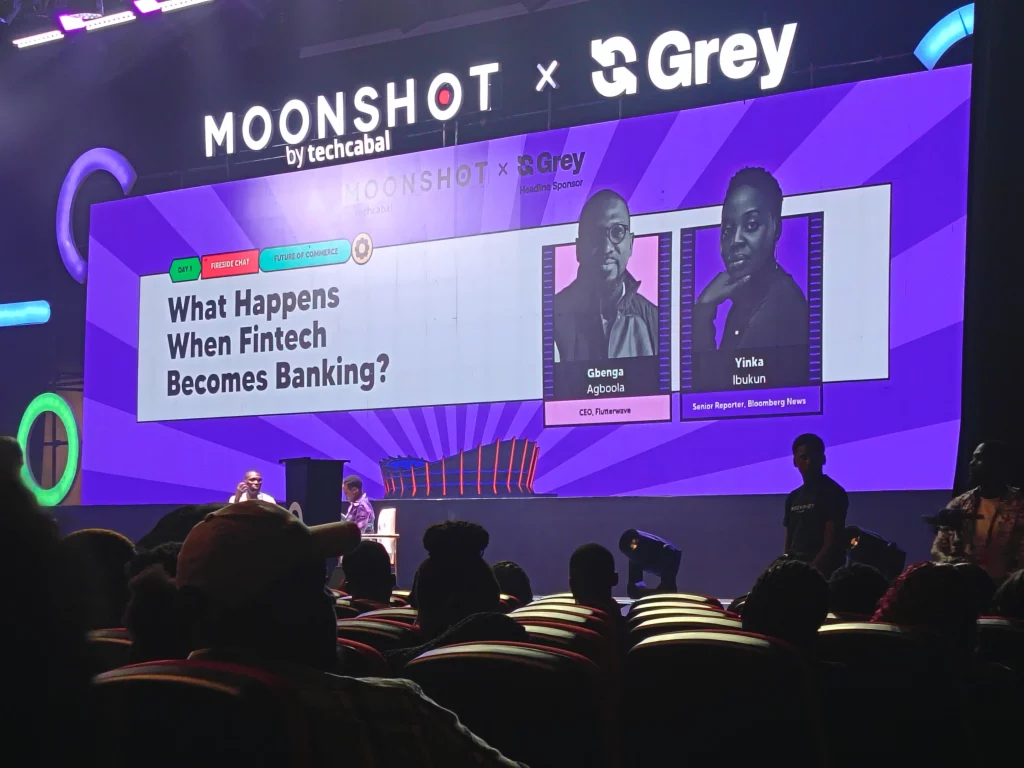
Paystack will look beyond payment acceptance to address more of businesses’ financial needs as it enters its second decade, co-founder and chief executive Shola Akinlade said at Moonshot 2026 in Lagos.

Akinlade described how the Nigerian fintech’s payments infrastructure had supported businesses across other sectors, arguing that its next phase would build on the same premise: enabling entrepreneurs to concentrate on their products.

The discussion traced Paystack’s development from a company helping Nigerian merchants collect payments online to a broader financial services group with operations across several African markets.

“I feel very qualified to talk about ambition because a lot of my ambitions over the last 10 years have been realised,” he said. “If you know anything about the Paystack story, we had a simple ambition to build to help merchants accept payments in Nigeria and then probably Africa.”

Akinlade used PiggyVest, the Nigerian savings platform, to illustrate how the infrastructure Paystack developed had enabled businesses beyond its original ambitions.

He recalled how the founders approached Paystack with an idea to automatically debit users’ accounts so they could save money regularly. Paystack already had the infrastructure to support the idea, even though building a savings business was not its own ambition.

“The most exciting thing about that story is that I didn’t do anything. The founders built the business; they took the risk,” he said. “The only thing we had to do was focus on building our infrastructure.”

The experience, he added, showed why infrastructure businesses could have an influence beyond the services they directly offered.

“That’s what really gets exciting about building infrastructure because you don’t know what people are going to build on it.”

Akinlade said that influence also extended to former employees who had gone on to establish companies of their own. He cited Douglas Kendyson, founder of Selar, which helps creators sell digital products; Femi Aluko and Olumide Ojo, co-founders of food delivery company Chowdeck; and Abdulhamid Hassan, co-founder of financial infrastructure provider Mono.

“One of the things I have learned in the last 10 years is that ambition is contagious,” he said. “When you achieve the ambition, every other person you engage with, the ambition continues to go round.”

Amandine Lobelle, the company’s chief operating office, outlined the company’s geographical expansion, saying Paystack had grown its footprint across Ghana, Kenya, Côte d’Ivoire and South Africa, while securing regulatory licences for Egypt and Rwanda.

The discussion comes as Paystack broadens its corporate structure and product offering. In January, it announced The Stack Group, a parent company encompassing Paystack, consumer payments app Zap, Paystack Microfinance Bank and venture studio TSG Labs.

Akinlade said the company was expanding its view of the problems it could solve as customers’ needs developed beyond collecting payments.

§

Africa’s creative industries have no shortage of talent or stories to tell. What they lack is the commercial infrastructure to distribute their work, reach audiences and get paid for it.

That was the central argument at a Creative Economy Stage panel at Moonshot by TechCabal on Thursday where executives from film, live entertainment, payments and television production discussed what it will take for African companies to build an economy that allows creators to capture more value. 

“There isn’t a challenge in creativity, and there isn’t a challenge in talent. There’s an abundance of stories that just haven’t even begun to be told,” said Kene Okwuosa, group chief executive officer (CEO) of Filmhouse Group, a cinema operator and film distributor. “But are creators capturing the value that their talent and their creativity should capture? The truth is that we still have quite a way to go.”

Africa’s creator economy is worth about $3 billion and could exceed $17 billion by 2030, according to the Africa Creator Economy Report. But growth in the sector does not automatically translate into better earnings for creators. Distribution channels, access to international payments and the infrastructure needed to produce and monetise content remain critical links in the value chain.

For Okwuosa, one of the biggest gaps is distribution. With relatively few streaming platforms and other buyers competing for African content, creators have limited options for selling their work. More distribution channels could give them greater bargaining power and help keep more revenue within the continent’s creative industries.

Filmhouse has sought to address that gap by expanding across the film value chain. The company produces films, operates what Okwuosa described as the largest cinema chain in the market and distributes content to 26 or 27 airlines. It also supplies streaming platforms including Netflix and Amazon. In 2025, it launched Kava, a subscription streaming service, in partnership with Inkblot Studios.

The strategy comes as the West African cinema market records growth. Cinemas in the region generated a record ₦15.6 billion ($11.6 million) in revenue in 2025, while Nollywood films outsold Hollywood titles at the box office for the first time, according to FilmOne’s annual scorecard.

While Filmhouse is building routes to audiences, Darey Art Alade, co-founder and chief creative officer of live entertainment company Livespot360, said his business emerged from a different infrastructure gap: the technical capacity to stage large-scale productions.

When the team first attempted to organise a major live show, it struggled to find local providers capable of delivering the production it envisioned. Rather than abandon the idea, Livespot360 built the lighting, staging and technical capabilities it needed. That infrastructure now supports platforms such as the Born in Africa Festival and Detty December.

“Those problems have given birth to solutions,” Alade said.

For creators working across borders, however, even a successful project can fall apart if they cannot receive their earnings.

Richard Oyome, co-founder and chief operating officer of cross-border payments company Raenest, recalled a creator who lost an international job because he did not have a bank account capable of receiving the payment. The example illustrated how gaps in financial infrastructure can prevent African talent from participating in a global market, regardless of the quality of their work.

Raenest, which has processed more than $1 billion for over 700,000 users, connects creators in Nigeria, Kenya and Ghana to payment partners in the United States, the United Kingdom and Europe.

“If you do not have access, you are locked out of the economy,” Oyome said.

Kopano Cowen, CEO of South African television production company Connect Channel, also participated in the discussion, which examined how businesses can build the systems creators need to produce, distribute and monetise their work.

Taken together, the discussion pointed to an infrastructure problem that extends well beyond any single platform or service. Creators need buyers willing to pay for their work, venues and production capabilities to bring it to life, distribution channels to reach audiences, and payment systems that allow them to collect their earnings.

Oyome highlighted another part of that equation: the relationship between creators and their audiences. He said brands increasingly value genuine audience relationships over follower counts alone, making audience trust and engagement important assets for creators seeking commercial partnerships.

Africa’s creative infrastructure is taking shape, from cinema screens and live stages to streaming platforms and payment rails. The question is whether creators will finally see more money reach their pockets when the curtain falls. 

§

Africa’s artificial intelligence developers should measure success by improvements in healthcare, education and incomes rather than the number of products they launch, the Gates Foundation’s Nigeria director told Moonshot by TechCabal in Lagos.

Uche Amaonwu said AI could widen access to knowledge, services and economic opportunity, but warned that its benefits would depend on deliberate choices about how the technology was developed, financed and deployed.

“For a technology to really be impactful, it has to touch the lives of people,” he said during a keynote address.

His remarks set out a challenge for developers and investors seeking applications for AI across the continent: moving promising tools beyond trials and into the institutions and communities expected to use them.

Amaonwu pointed to the foundation’s Goalkeepers report on AI and equity, released around the UN General Assembly, describing its message as “exciting, but also cautionary”. AI could become “a powerful equaliser”, he said, but that outcome was far from assured.

“If we are not deliberate about how AI is developed and deployed, we could end up widening the very inequalities that we’re actually trying to close.”

The foundation’s approach, he said, starts with three objectives: preventing avoidable maternal and child deaths, protecting the next generation from deadly infectious diseases, and helping hundreds of millions of people escape poverty.

These were “human condition goals”, he said. AI’s value would lie in whether it accelerated progress towards them.

A central part of that effort is the Nigeria AI Scaling Hub, hosted by Lagos Business School in partnership with the Federal Ministry of Communications, Innovation and Digital Economy. Backed by up to $7.5mn from the foundation over three years, the hub aims to expand the use of proven AI tools in health, agriculture and education.

Its focus is the difficult transition from a successful pilot to sustained adoption. A tool that works in a trial still needs infrastructure, institutional support and a viable funding model before it can reach people consistently.

Amaonwu identified four requirements for making that transition.

Developers needed shared infrastructure, including connectivity, trusted data, and systems capable of exchanging information, so that each company did not have to build the same foundations independently.

Tools also needed to reflect Nigerian conditions and languages, earn users’ trust from the outset, and have a clear route to adoption and payment. Identifying who would use a product — and who would finance its continued use — was as important as developing it.

The argument places responsibility beyond technology companies. Governments shape the conditions for adoption through regulation and public systems, while investors determine which businesses receive the capital to expand.

Amaonwu urged the Moonshot audience to return the following year with evidence of practical results like clinics where patients had received care, classrooms where children had caught up, and farmers who had secured better prices for their harvests.

“No one in this room can do all of this alone,” he said. The future worth building was “the one that we must build together”.

Web hosting by Somee.com