Airtel Mobile Commerce N.V., the Netherlands-based fintech arm of Airtel Africa, plans to launch a virtual payment card in Kenya, setting up a new contest with Safaricom over international online spending.
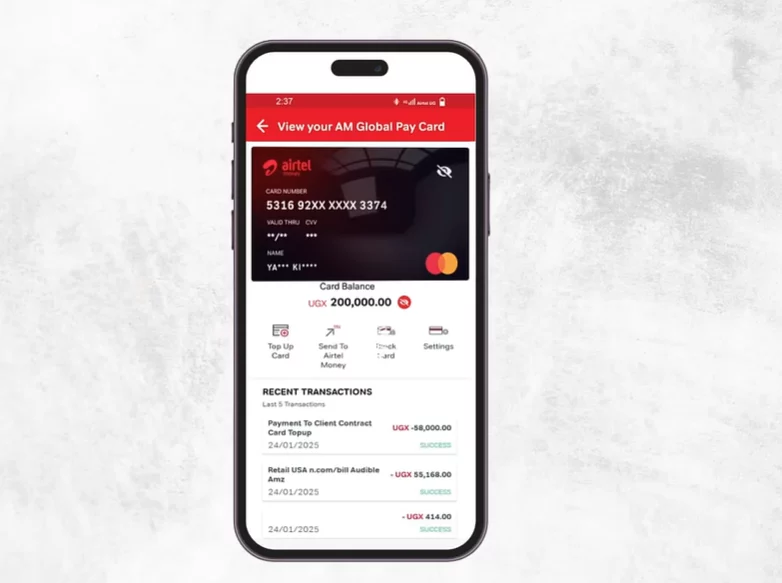
Developed with Mastercard, the Virtual Card Number (VCN) will integrate with Airtel Money wallets, enabling customers to pay for services on global platforms such as Amazon and Netflix without a traditional bank account.
The launch puts Airtel Money Global Pay in direct competition with M-PESA GlobalPay, Safaricom’s virtual Visa card introduced in 2022. Airtel is entering a market where Safaricom has an established lead, but the contest is about more than the payment networks behind the cards. It also concerns how customers fund transactions, manage online spending, and access credit when their wallet balances run low.
The M-PESA GlobalPay card can draw on Fuliza, an overdraft facility that lets eligible customers complete online payments when their M-PESA balance is insufficient. Airtel Money’s prepaid card lacks this feature, requiring customers to fund it before making a purchase.
Data from the Communications Authority of Kenya shows M-PESA’s mobile money market share has slipped to 88.8% in June 2026, down from nearly 95% in 2023. Airtel Money’s share rose to 11.1% over the same period. The figures indicate a gradual shift in the competitive balance, although Safaricom’s lead remains substantial.
Global commerce offers a new revenue stream
Kenya’s growing use of digital services gives both operators a reason to compete for international payments. Streaming subscriptions, software services, and overseas e-commerce platforms allow mobile money providers to reach spending that might otherwise flow through bank cards.
Netflix, which entered Africa in 2016, is one example of how international digital services have become part of everyday spending. Virtual cards let customers without bank accounts pay these merchants via mobile money, extending wallets’ reach beyond domestic transfers and merchant payments.
For operators facing pressure on domestic payment charges, cross-border transactions also offer a way to earn revenue from international commerce. Foreign currency conversion and merchant payments can generate income beyond the core business of moving money between local accounts.
Safaricom’s global payments operation, which includes cross-border transfers, virtual cards, and app store billing, generated KES 4.76 billion ($37.2 million) in the financial year ended March 2026, up 22.3% from the previous year. M-PESA generated KES 182.7 billion (323.1 billion) in transaction value across 46.4 billion transactions.
The figures show why even a relatively small slice of M-PESA’s business is important. Global payments can contribute to revenue growth without requiring Safaricom to win a comparable share of Kenya’s domestic mobile money market. The opportunity for Airtel is to capture a portion of that spending as more customers use its wallet for online purchases.
Across 14 African markets, Airtel’s mobile money operation generated $1.3 billion in revenue, up from $747 million. The company has issued more than 875,000 virtual cards in Uganda, Zambia and Tanzania since 2025 and plans to introduce the service in Kenya, the Democratic Republic of Congo and Gabon.
Credit and security separate the cards
The two products take different approaches to funding online payments. M-PESA GlobalPay links to the customer’s M-PESA wallet. In contrast, Airtel’s VCN model requires customers to transfer funds from their main Airtel Money wallet to the virtual card before making a purchase.
The setup lets Airtel customers ring-fence money for online purchases, keeping the rest of their wallet balance separate from card transactions. It also gives them greater control over subscription payments and their online spending.
Customers still need to protect their account credentials and monitor transactions. The extent of protection also depends on the controls available to freeze or manage the card, to dispute unauthorised payments, and to prevent further charges.
Safaricom’s original virtual Visa card design used a card verification value (CVV) that customers generated through the M-PESA app after entering their PIN. Each code lasted 30 minutes and could be used only once, limiting the window in which it could be used if exposed.
Safaricom announced the overdraft option for GlobalPay in 2026, allowing eligible customers to complete online payments when their wallet balance is insufficient. The feature can help prevent subscription payments from failing, but it also means automated charges may draw on credit, leaving customers with an overdraft to repay.
Airtel’s prepaid model does not offer an equivalent overdraft facility, so customers must have sufficient funds on the virtual card to complete a purchase. This may be less convenient, but it also prevents the card from extending spending through an equivalent credit line.
A challenger still faces a scale problem
Safaricom’s large customer base gives GlobalPay an established audience, while familiarity with M-PESA can make customers less inclined to switch payment methods.
Airtel’s card could appeal to customers who already use Airtel Money and want a direct route to international merchants. Its regional rollout also gives the company experience to draw on as it enters the Kenyan market.
Customers will need to compare foreign exchange charges, transaction limits, acceptance rates, dispute handling and the ease of managing card details. Airtel’s pricing will be particularly important because a lower-cost card could attract price-sensitive users, while unclear fees could blunt the appeal of its prepaid design.
Airtel has yet to disclose all the details Kenyan customers will need to assess the service, including its foreign exchange charges. Safaricom’s GlobalPay applies a foreign exchange markup, making the total cost of a purchase a relevant point of comparison.
The launch will not erase Safaricom’s lead in mobile money. Still, it will give Airtel another way to compete for customer spending, this time at the online checkout rather than through domestic transfers.
True scale demands moving beyond surface-level integrations to robust execution. We’ve filtered the noise out of Moonshot 2026, optimising the conference strictly for high-calibre connections between startup founders, global financial operators, enterprise leaders and individuals rewiring Africa’s technical frameworks. Get 20% off Early Bird tickets for a limited time.