World
Sagar Defence's rise: From 150 sq ft workspace to Navy's swarm boat provider
Reading in data-saving mode. Read full article from Times of India website.
Published 10/26/2026 1:51:01 PM
Success story of startup Sagar Defence: From 150 sq ft workspace to leading provider of swarm boats to Navy
NEW DELHI: A startup that started its operations from a tiny 150 sq ft workspace in Mumbai has now grown into a full-fledged defence company with major R&D and manufacturing campuses in Pune and Andhra Pradesh. The success story of Sagar Defence, which was founded in 2015 by Capt Nikunj Parashar along with co-founders Mridul Babbar, Lakshay Dang, Saurabh Patil, and Ankit Kumar, is replete with failures, hard work and perseverance.
While addressing a gathering at the
Indian Navy’s ‘Swavlamban’ Naval Innovation and Indigenisation Seminar here as a guest speaker on Monday, Capt Parashar disclosed that he survived two heart attacks and a paralytic stroke and faced a lot of setbacks while struggling to make their company witness success. Sagar Defence is now a leading player for swarm boats, autonomous and unmanned weapons systems to the Indian armed forces, especially to the Indian Navy. Similar unmanned or swarm boats have been used by Iran and the US to attack each other and for surveillance purposes during the ongoing West Asia conflict.
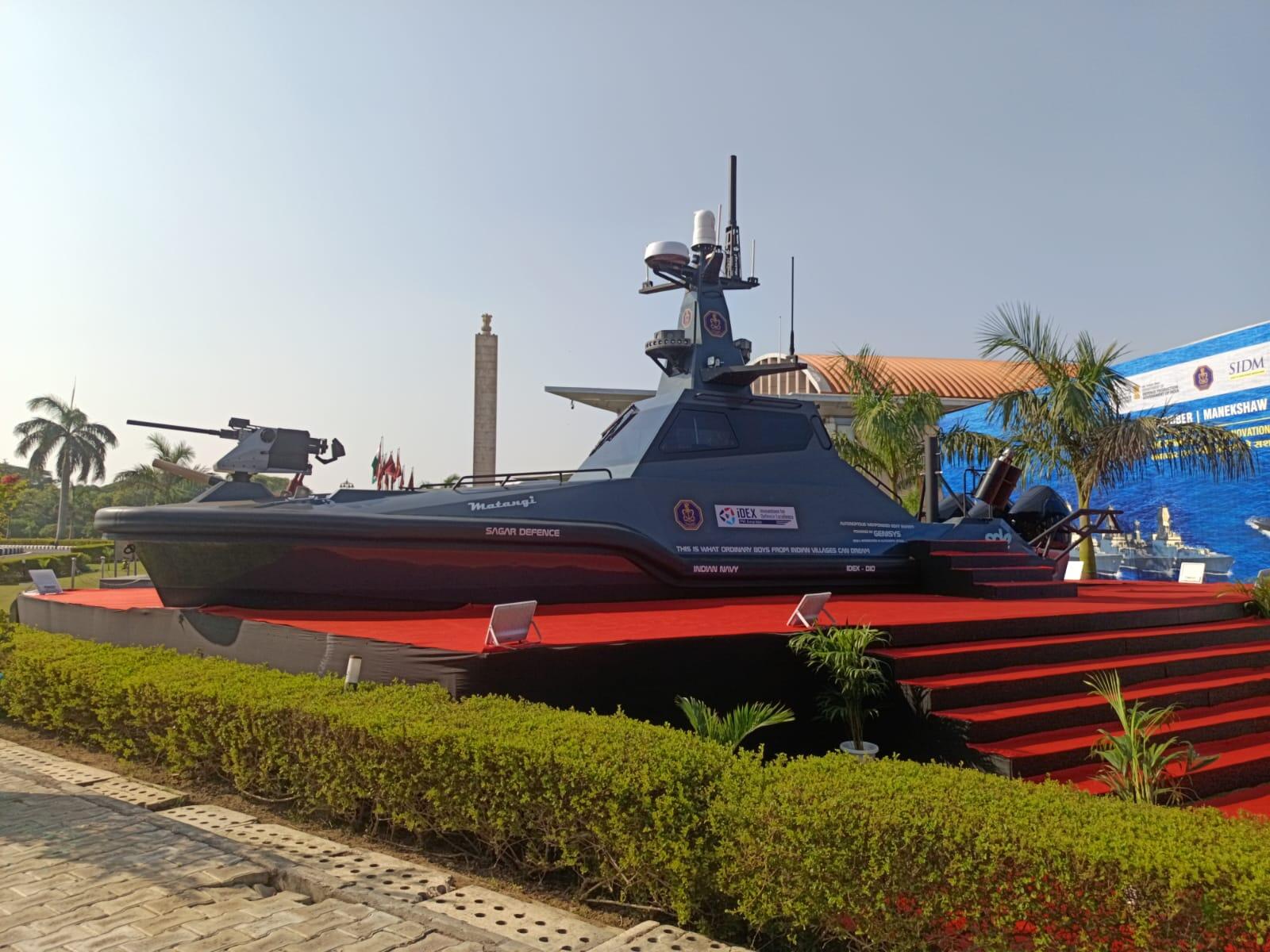
Swarm boat Matangi
Under the Navy’s iDEX ‘SPRINT’ contract, the Pune-based company has now begun supplying 12 armed unmanned surface vessels (USVs)—including their signature ‘Matangi’ craft—to the Indian Navy.
These high-speed, interceptor boats are equipped with 12.7mm stabilised remote-controlled gun stations, advanced electro-optical radar tracking, and anti-jamming GPS navigation to strike targets autonomously. They can be used as an unmanned boat for surveillance and offensive operations in shallow waters or can even carry marine commandos (Marcos) for special operations. Some of these boats have also been deployed at the Pangong Tso lake in eastern Ladakh by the Army for patrolling.
Sagar Defence also produces custom multi-payload quadcopters and hexacopters such as Spectre and Varuna series and Maritime Spotter Drone designed to land on moving warships. The Indian company has also partnered with Israel Aerospace Industries (IAI) to co-develop and introduce the "Point Blank" precision strike missile to India. This is a hand-launched, vertical take-off and landing (VTOL) system that acts as a loitering munition for high-speed precision strikes.
At the ‘Swavlamban’ naval exhibition at Manekshaw Centre, another startup Zen technologies displayed their autonomous surface vessel prototype, which is a multirole and networked unmanned craft that can be used for surveillance, fire support, anti-submarine warfare and for other naval missions. C14 unveiled its Tandav autonomous, modular USV platform and also AquaScan, an AI vision device that can be used by divers for underwater vision. A C14 representative said the Navy has shown interest in its AqaScan and plans to buy it.
Space startup Galaxeye is offering the Navy a satellite-based solution for keeping an eye on hostile or shadow vessels that loiter around in Indian waters. “Besides wide-area monitoring, night-time and adverse weather monitoring, we are ready to offer a solution to the Navy to detect an unknown or unidentified vessel that is loitering around in the Indian waters from space itself. Our satellite-based system can even provide the entire data or history of that shadow vessel with a click of the mouse,” Aarav Saexna, forward deployed engineer of Galaxeye, told TOI.
§
NEW DELHI: Strengthening its maritime surveillance and coastal defence capabilities, the
Indian Navyis set to induct eight Next Generation Corvettes (NGCs) under a project worth over Rs 40,000 crore cleared by the Cabinet Committee on Security (CCS), chaired by Prime Minister Narendra Modi.
The contracts for the warships are expected to be signed in the coming days with Garden Reach Shipbuilders and Engineers (GRSE), Kolkata, and Goa Shipyard Limited, top government officials told ANI.
The Navy is expected to receive the first of the eight warships by 2030, although the shipyards are exploring ways to accelerate construction and advance delivery timelines.
The corvettes, weighing around 2,000 tonnes and capable of speeds of nearly 30 knots, will be designed for a range of maritime operations, including surveillance missions, escort operations, deterrence, Surface Action Group (SAG) operations, search and attack missions, and coastal defence.
The addition of these versatile warships is expected to enhance the Navy's ability to monitor maritime areas, respond to emerging threats and protect India's interests at sea. Their multiple operational roles will allow the Navy to deploy them across different maritime security requirements.
The project is also significant for its focus on indigenous warship design. According to the Defence Ministry, the NGCs will be built using a new in-house design developed by the Indian Navy and incorporating the latest shipbuilding technologies.
The project is expected to strengthen domestic warship-building capabilities and contribute to the government's SAGAR (Security and Growth for All in the Region) initiative.