×
Tech

South Africa’s AGOA troubles could reach beyond exporters to its startups

Why South Africa's AGOA fallout threatens its startups

South Africa’s planned removal from the African Growth and Opportunity Act (AGOA) won’t only affect exporters, but also raise questions about how the country’s worsening relations with the United States (US) might affect investment into its technology sector.

While AGOA is a trade preference programme covering goods exports, the fallout from the decision could reach businesses that have little direct exposure to the programme. For South African startups, one concern is whether deteriorating diplomatic and trade relations could influence the appetite of American venture capital investors.

US venture capital firms are among the international investors backing African startups, with the United States remaining the continent’s largest source of foreign venture investors in 2024, according to the African Private Capital Association (AVCA), a trade body for African investors. 

In 2022, South African gaming startup Carry1st raised a $20 million Series A extension led by US venture capital firm Andreessen Horowitz. 

Jeff Miller, chief executive (CEO) of Grovest Investment Holdings, a South African investment and venture capital firm, warned that the diplomatic fallout could make US investors more cautious about backing South African startups, even without any direct restrictions on technology investment.

“My assessment is that the first effect would likely be greater selectivity and slower decisions, as a result of negative sentiment that the withdrawal of AGOA brings with it,” he told TechCabal in an interview on Tuesday.

Miller said foreign investors weigh a country’s political landscape, capital flows, rule of law, red tape and tax implications. He believes Black Economic Empowerment (B-BBEE) requirements can also present challenges.

“Uncertainty about these pathways can make an otherwise attractive investment harder to approve,” he said.

He cautioned that worsening relations with Washington could add to the risks American investors associate with South Africa. Negative sentiment in the US could also affect international investor confidence, potentially influencing investors from other markets.

The warning comes after US President Donald Trump notified Congress and the governments of South Africa and Rwanda of his intention to terminate their AGOA eligibility from January 1, 2027. The notification, announced on November 2, gives the countries 60 days’ advance notice of the planned withdrawal.

In a statement, US Trade Representative Jamieson Greer said the Trump administration was concerned about “barriers to U.S. trade and investment, corruption, and threats to US national security and foreign policy interests.”

The statement said an annual interagency review had found practices by South Africa and Rwanda inconsistent with AGOA’s eligibility criteria. It did not announce restrictions on venture capital, technology partnerships, or digital services.

AGOA provides eligible sub-Saharan African countries with preferential access to the US market for thousands of products. Its withdrawal directly affects trade in goods, not the flow of venture capital into technology companies. Any effect on startup funding would be indirect, through the broader investment climate and how investors interpret the diplomatic fallout.

South Africa’s automotive industry is among the sectors most exposed to the loss of AGOA benefits. TechCabal reported in February that vehicles and automotive components accounted for more than half of the country’s $4 billion in AGOA-qualifying exports to the US in 2024, generating about $1.6 billion in export revenue.

The sector was already under pressure from US tariffs, with the uncertainty around AGOA threatening export competitiveness and long-term investment planning. South Africa’s Department of Trade, Industry and Competition says the country’s wider economic relationship with the US remains significant.

According to the Department, 89% of South African exports to the US entered under ordinary World Trade Organization most-favoured-nation terms in 2025, while about 10% entered under AGOA. The value of AGOA exports fell from $4 billion in 2024 to $1.7 billion in 2025, representing about 1% of South Africa’s total global exports.

Bilateral trade reached $28.8 billion in 2025, while more than 600 American companies operate in South Africa, supporting approximately 134,600 jobs.

Parks Tau, South Africa’s Trade, Industry and Competition Minister, sought to separate the AGOA decision from the wider economic and diplomatic ties between the two countries.

“This decision does not define the broader relationship between South Africa and the United States, however a solution depends on the willingness of both Parties to find solutions,” he said in the same statement on Tuesday.

The government said it will continue pursuing US trade and investment while diversifying export markets through the African Continental Free Trade Area, the European Union, the United Kingdom and Asia.

For South African startups, however, finding alternative sources of capital may be more difficult than diversifying export destinations. Miller said the US venture capital market has substantial capital and a greater appetite for risk than other markets, making it an important source of funding for companies seeking to scale.

“Whilst a good business should always find funding, the US market is a low-hanging fruit,” he stated.
§

Airtel Nigeria generated $1.01 billion in revenue between April and September 2026, crossing the $1 billion mark for the first time since the same period in 2022, when it recorded $1.04 billion, according to the company’s financial statements.

Its mobile money subsidiary, SmartCash PSB, also recorded its highest-ever half-year revenue of $10 million, as efforts to grow its banking business through a zero-fee model and a 15% annual interest rate on savings deposits begin to gain traction.

The results show Airtel Nigeria, with 61.7 million subscribers, recovering from the currency volatility that weighed on its earnings after the naira was devalued in 2023. Since 2025, improved macroeconomic conditions, including a more stable naira and regulatory approval for market-reflective telecom tariffs, have supported revenue growth across the sector. MTN Nigeria, for instance, reported a 23.6% jump in nine-month revenue to ₦4.61 trillion ($3.42 billion) in 2025.

“Higher reported currency growth compared to constant currency growth was due to the appreciation in the Nigerian naira from a weighted average NGN/USD rate of 1,553 in prior period to NGN/USD 1,360 in current period,” Airtel Africa said about its Nigerian unit.  

Airtel Nigeria’s revenue growth of 44.62% helped push its average revenue per user up by 27.27%.

Beyond currency growth, data consumption also supported the growth. Airtel Nigeria’s smartphone penetration reached 56.8%, while monthly smartphone data usage per customer increased to 16.7GB from 12.7GB in the corresponding period.

The improved performance in Nigeria contributed to Airtel Africa’s overall revenue, which rose by 28.20% to $3.82 billion. The group’s profit for the period also increased by 20.21% to $452 million.

“Reported currency revenue growth was higher than constant currency growth reflecting currency appreciation in Nigeria and Zambia,” Airtel Africa said.

However, rising operating costs are beginning to weigh on margins. Airtel Africa said recent geopolitical developments, which have resulted in a doubling of fuel prices in Nigeria, are putting pressure on its earnings.

“Our cost efficiency programme mitigated these pressures, limiting the sequential margin decline to approximately 130 bps, from 58.8% in Q1’27 to 57.5% in Q2’27. Operating free cash flow increased by 28.2% to $409m driven by strong underlying EBITDA growth, despite significantly higher capex during the period,” the company said.

SmartCash PSB, Airtel Nigeria’s mobile money subsidiary, saw its customer base increase by 110% to 4.2 million, while revenue grew by 150% to $10 million during the six-month period.

Despite the growth, SmartCash remains the smallest of Airtel Africa’s mobile money operations, contributing just 1.19% of the group’s revenue. Its latest performance, however, suggests that Airtel Nigeria’s efforts to build a more competitive mobile money business are beginning to produce results.

In March 2026, SmartCash said it had crossed nearly three million active users as it doubled down on a zero-fee banking model and a 15% annual interest rate on savings deposits.

SmartCash generated just $6 million in revenue as of December 2025, according to Airtel Africa’s nine-month financial statements. Its latest $10 million revenue represents a 66.67% increase over that figure.

The growth comes as Nigerian telecom operators seek to strengthen their mobile money businesses and capture a larger share of the country’s digital financial services market.

In August 2026, MoMo PSB, MTN Nigeria’s mobile money subsidiary, migrated to a new platform powered by Alipay+, upgrading its fintech infrastructure. Revenue from its core mobile money business subsequently increased by 102.2%, while wallet balances more than quadrupled to ₦43.8 billion ($32.54 million).

But SmartCash still has considerable ground to cover to catch up with established players. OPay, Nigeria’s mobile money market leader, generated $467.06 million in revenue in the first half of 2026.

§

MTN Nigeria is earning more and generating stronger cash flows, but retaining less cash. Its nine-month results show how dividend payouts, network investments, and debt repayments are drawing on the financial buffer of Nigeria’s largest mobile operator.

Profit after tax rose 55.3% to ₦1.17 trillion ($869.9 million) in the nine months ended 30 September 2026, while service revenue increased 23.7% to ₦4.59 trillion ($3.41 billion). Yet cash and cash equivalents on its balance sheet fell nearly 40%, from ₦632.5 billion ($470.3 million) in December 2025 to ₦381.0 billion ($283.3 million).

The decline does not mean MTN Nigeria is struggling to convert profits into cash. Net operating cash flow increased 48.2% to ₦2.31 trillion ($1.72 billion). Instead, the results reveal a growing capital-allocation trade-off as the company balances investment, debt repayment, and shareholder distributions against the need to maintain sufficient liquidity to absorb unexpected costs and economic shocks.

As Nigeria’s largest telecom operator invests to meet surging data demand, expand network capacity, and sustain service quality, its shrinking cash reserves could limit its flexibility to respond to rising operating costs, regulatory pressures, or economic shocks. The challenge is to sustain growth and reward shareholders without weakening the financial cushion needed to protect its operations and fund future expansion.

Data growth strengthens earnings

An MTN official registering a subscriber. Image source: MTN Nigeria

Demand for mobile internet remains MTN Nigeria’s biggest growth engine. Data revenue climbed 35.8% to ₦2.68 trillion ($1.99 billion), driven by a 12% increase in active data users to 57.2 million. Its total subscriber base also expanded 10.9% to 94.7 million, underscoring the growing scale of its connectivity business.

“Growth is increasingly volume-led, driven by more users, deeper data adoption, higher usage, and rising demand for home broadband, supported by continued investment in network coverage, capacity, and quality,” said Karl Toriola, CEO of MTN Nigeria. The company’s fintech business is also gaining traction, with core mobile money revenue up 102.2%. Revenue from its airtime and data credit service rose 78.5% quarter-on-quarter following its resumption under a multi-partner model.

The third quarter showed signs of renewed momentum after slower growth in Q2. Service revenue rose 19.7% year-on-year and 8.4% quarter-on-quarter to ₦1.61 trillion ($1.20 billion). Management said that monthly year-on-year growth accelerated to 21.6% in September, reflecting increases in subscribers and usage.

MTN Nigeria also kept operating expenses growing slower than revenue, allowing earnings before interest, tax, depreciation, and amortisation (EBITDA) to rise by 36.8% to ₦2.62 trillion ($1.95 billion). Its nine-month EBITDA margin widened from 51.4% to 56.9%, reaching 58.7% in the third quarter as revenue growth translated into stronger operating profitability.

Lower financing costs provided an additional boost. Net finance costs declined 25.3% to ₦277.0 billion ($205.9 million), while naira appreciation contributed an ₦80.1 billion ($59.6 million) foreign-exchange gain. Although these gains supported earnings, their contribution may fluctuate with exchange-rate movements, making them a less dependable source of growth than underlying operating performance.

Where did the cash go?

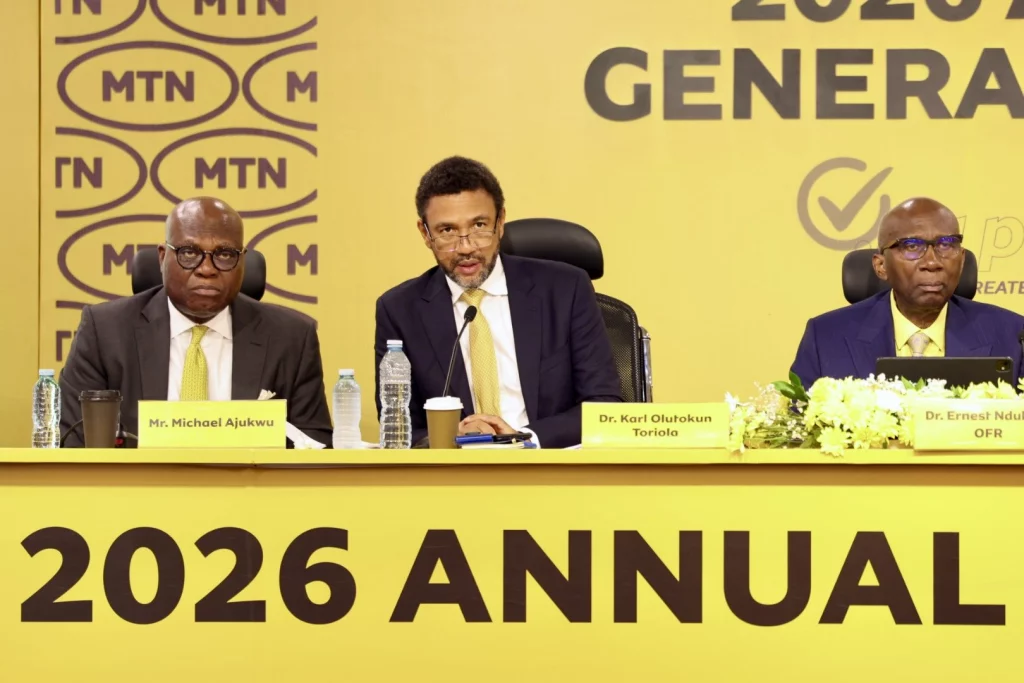
Michael Ajukwu, a member of the board, Karl Toriola, CEO of MTN Nigeria, and Ernest Ndukwe, Chairman of MTN Nigeria at the company’s annual general meeting this year. Image source: MTN Nigeria.

The cash flow statement explains why stronger operating performance did not produce a larger cash balance.

MTN Nigeria generated ₦2.31 trillion ($1.72 billion) in net operating cash flow but used ₦1.33 trillion ($988.8 million) for investing activities and ₦1.22 trillion ($907.1 million) for financing activities. Those combined outflows exceeded operating receipts.

Dividends were the largest financing outflow. The cash flow statement records ₦859.7 billion ($639.2 million) paid to shareholders, ₦188.5 billion ($140.1 million) in borrowings repaid, and ₦158.6 billion ($117.9 million) in lease principal repayments.

Investment also absorbed substantial cash. Payments to acquire property and equipment totalled ₦1.00 trillion ($743.5 million), with an additional ₦78.1 billion ($58.1 million) spent on intangible assets. MTN Nigeria also made net purchases of financial investments and spent ₦76.1 billion ($56.6 million) on prepaid road investment tax credit costs.

These cash payments should not be confused with management’s reported capital expenditure excluding leases of ₦864.8 billion ($643.0 million). The measures differ: the cash-flow statement tracks payments during the period, while the capital-expenditure metric records investment on a different accounting basis.

Nor did all the reduction in cash leave MTN Nigeria’s pool of financial assets. Current investments increased from ₦162.3 billion ($120.7 million) to ₦330.7 billion ($245.9 million). Combined cash and current investments therefore fell from approximately ₦794.8 billion ($590.9 million) to ₦711.7 billion ($529.1 million)—a decline of about 10.5%, substantially less than the decline in cash alone. These investments are not the same as immediately available cash, but they matter when assessing liquidity.

The company also reported free cash flow of ₦1.17 trillion ($869.9 million), up 57.5%. That is its defined performance measure, not the amount left after dividends, debt repayments, and other financing outflows.

A smaller buffer, not a funding crisis

MTN Nigeria’s balance sheet contains clear signs of improvement. Total borrowings declined from ₦527.7 billion ($392.3 million) in December to ₦333.3 billion ($247.8 million) in September, while shareholders’ equity increased 53.8% to ₦843.9 billion ($627.4 million). Management says borrowings are entirely naira-denominated and fixed-rate, reducing currency and floating-interest-rate exposure on that debt.

However, its reported net-cash position narrowed from ₦104.8 billion ($77.9 million) to ₦47.7 billion ($35.5 million). Short-term obligations also increased: current liabilities reached ₦2.64 trillion ($1.96 billion), while current assets stood at ₦1.19 trillion ($884.8 million), widening the working-capital deficit to approximately ₦1.46 trillion ($1.09 billion).

That gap requires context. Not every current liability represents an immediate cash demand: contract liabilities include payments received for services yet to be delivered. Strong recurring operating receipts also help fund obligations as they fall due. Nevertheless, tax payable rose to ₦710.3 billion ($528.1 million), and current lease liabilities increased to ₦350.7 billion ($260.7 million). Total lease liabilities stood at approximately ₦2.46 trillion ($1.83 billion), a substantial commitment beyond conventional borrowing.

The risk, therefore, is less about weak earnings than about diminishing financial flexibility. MTN Nigeria must continue expanding network capacity while meeting tax and lease obligations and sustaining shareholder returns. Rising energy costs and exchange-rate volatility could make that balancing act more difficult.

The pressure is already evident in Nigeria’s diesel market. A Priceandpromo survey put the average diesel price at ₦1,899 per litre on 22 September, up 91.8% from its 13 January baseline. While this is not a measure of MTN’s contracted fuel costs, it highlights the inflationary pressures facing diesel-dependent telecom infrastructure.

For MTN Nigeria, these costs feed into tower contracts whose energy component is indexed to the previous quarter’s average Lagos ex-depot diesel price. This creates a lag between market price increases and their impact on operating expenses. Energy accounts for an estimated 28–30% of the company’s operating costs, making sustained fuel inflation a significant risk to profitability.

Management estimates that an average ex-depot diesel price of ₦2,000 per litre in the second half of the year could reduce its full-year EBITDA margin by 1.8–2 percentage points. This is a sensitivity estimate, not a reported loss. In Q3, cost efficiencies, Value Added Tax (VAT) input claims, and naira appreciation helped offset higher diesel-linked tower costs. But if fuel prices remain elevated or the naira weakens again, those gains could diminish, putting further pressure on margins and leaving less cash available for network investment and shareholder distributions.

Fintech presents a separate recovery challenge. Although core mobile-money revenue more than doubled, total fintech revenue fell 25.9% following the earlier suspension of airtime-and-data credit services. Rebuilding that revenue stream remains a priority, even as the wider business strengthens.

MTN reaffirmed its medium-term revenue-growth and margin guidance, signalling confidence in its outlook. The next test, however, is not simply whether earnings rise, but whether the company can fund growth, meet its obligations, and reward shareholders while preserving sufficient liquidity to withstand further shocks.

§

Safaricom, Kenya’s largest telecommunications operator, consumed 274,531 megawatt-hours of electricity in the financial year ended March 2026, a 5.7% increase from the previous year.  

Its emissions from electricity purchases, fuel burned in generators and vehicles, and refrigerant gases used in cooling systems rose by 9.1% to 56,354 tonnes of carbon dioxide equivalent. 

The figures, documented in Safaricom’s 2026 Sustainability Report, suggest that the company’s 2030 technology ambitions are becoming more expensive. Its expanding network, data centres, and digital services demand more power, but cleaner sources still cover only a small share of its overall supply. 

The increase came as Safaricom expanded its renewable energy programme. By March 2026, it had installed solar power at 2,028 network sites, up from 1,432 a year earlier. It also upgraded 800 sites with more efficient power systems. Yet solar supplied only 5% of the energy used across its network. The national grid accounted for 78%, while diesel generators supplied the remaining 17%.

“Grid availability and reliability influence our ability to reduce diesel consumption, while physical constraints at some sites can limit the potential for on-site solar generation,” Safaricom said in the report. 

Investment is outpacing the shift in Safaricom’s energy mix. The company is adding solar equipment, yet its overall power demand continues to climb. In its report, Safaricom noted that “network expansion continues to influence our overall energy requirements.”

Managing that demand will get harder as Safaricom moves beyond mobile connectivity into data centres, cloud services and other digital products. Each needs computing equipment, cooling and a steady electricity supply. Intermittent power is not an option without backup systems, and those add their own costs.

Power will take on a larger share of Safaricom’s costs to run the network, data centres, and cloud services in its next phase of growth. Meeting its climate targets is the lesser of the two pressures.

For all its solar ambitions, Safaricom still runs much of its network on diesel. The company burned 10.08 million litres of fuel in FY26, down from 10.47 million litres a year earlier, and diesel accounted for almost 80% of emissions from its direct operations, which also include refrigerant gases. Generators keep network sites running when grid power fails or becomes unreliable. 

The telco cannot simply abandon them, considering its network must remain available to customers, including when the national grid is down. Reducing diesel use will require dependable alternatives at thousands of sites, not just more solar panels.

Safaricom is also combining solar installations with lithium-ion batteries, more efficient power systems, additional grid connections and remote monitoring. It says intelligent shutdown technology can reduce radio network energy consumption by up to 8%. These measures can cut generator use, but their reach depends on the conditions at each site. Some locations have limited space for solar equipment, while an unreliable grid supply makes it harder to rely on national grid electricity.

There is a financial incentive to make the change. Solar installations generated monthly energy cost savings of about KES 16.42 million ($127,000) in FY26. Safaricom estimates that replacing diesel with cleaner energy could save more than KES 500 million ($3.9 million) by 2030. The company’s report says its energy strategy “balances three priorities: power stability, energy cost efficiency and sustainability.” The order reflects the practical challenge that Safaricom must keep its network running while reducing the cost and emissions of doing so.

The company has also raised money for eligible green projects. Its KES 20 billion ($155 million) green bond, issued under a KES 40 billion ($310 million) domestic medium-term note programme, was oversubscribed by 175.7%. The proceeds can support renewable energy and more energy-efficient network infrastructure. But financing does not remove the technical constraints.

Safaricom explored power purchase agreements with independent power producers to supply its power-intensive data centres. It had not concluded by the end of FY26. It also tested a hydrogen fuel cell at one site, but said that wider deployment faced constraints due to fuel and capital costs. Neither option has yet provided a clear route to reducing the company’s dependence on grid electricity and diesel at scale.

A further complication is how Safaricom reports its progress. Its emissions per KES million in revenue fell from 0.144 to 0.14 tonnes in FY26. That suggests the company generated more revenue for each unit of emissions. But its total emissions from electricity purchases and direct operations still rose. Better emissions intensity does not mean the business is producing fewer emissions overall.

The decline in its wider reported carbon footprint also needs context. Emissions from its supply chain and other indirect sources fell to 136,943 tonnes from 226,047 tonnes. Safaricom attributed part of the reduction to changes in reporting methodology and data availability. The fall, therefore, cannot be read as evidence that the company’s overall environmental impact improved by the same margin.

Safaricom has a net-zero emissions target for 2050, and meeting it will become harder if expansion continues to drive up electricity demand and backup power use. Solar-powered sites show progress, but a clearer indicator will be the share of Safaricom’s energy supplied by cleaner sources as the business grows.

Safaricom wants to sell more than connectivity, and its ambitions in data centres, computing capacity, and digital services will require a reliable power supply. The company now has to show it can build that infrastructure without letting energy costs and emissions keep rising.

§

AI-generated photographs in Nigeria’s preliminary voter register raise a question that goes beyond the technology used to create them: how did suspicious entries get into a database meant to establish who can vote? Ahead of the 2027 general election, the controversy puts the Independent National Electoral Commission’s (INEC) verification procedures, access controls, and accountability under scrutiny—not simply its ability to detect synthetic images.

The preliminary register lists more than 103 million voters, up from approximately 93 million in 2023. While INEC attributes this surge to new registrations, persistent questions surrounding anomalous records have intensified demands for a clearer accounting of how raw records are checked—and who bears responsibility when systemic irregularities slip through.

Speaking on ARISE News, Clement Nwankwo, director of the Policy and Legal Advocacy Centre (PLAC), challenged the register’s credibility, pointing to alleged AI-generated photographs and unexplained statistical surges in registered voters. His concerns underscore a broader institutional test for INEC: removing dubious entries is only a starting point; the commission must demonstrate that its entire pipeline for collecting, verifying, and auditing electoral data is robust and trustworthy.

Responding to these criticisms on 30 October, Lawrence Bayode, INEC’s director of information and communication technology (ICT), stated that the commission was working to address irregularities ahead of releasing the final register on 15 December 2026.

However, Bayode’s explanation exposed a deeper operational vulnerability: some suspicious entries were inserted directly by registration officers holding authorised access to INEC’s core database.

Bayode acknowledged that registration officers across multiple states introduced irregularities into the system, encompassing both AI-generated imagery and flawed registration conduct.

“They have access to register people,” Bayode said, noting that the commission flagged these discrepancies during automated biometric identification system (ABIS) checks.

This admission complicates the narrative that generative technology is the primary culprit behind vulnerabilities in voter lists. While generative AI simplifies the creation of synthetic visuals, the core issue identified by INEC stems from insider privileges—the individuals authorised to operate registration terminals and the governance controls surrounding their access.

This breakdown raises critical questions regarding internal oversight: how are registration officers monitored in real time, what validation rules are run before data is committed to the master database, and why were suspicious records not quarantined before reaching the public preliminary register?

The incident also highlights the boundaries of automated safeguards. While biometric algorithms can detect duplicate prints or abnormal features, their efficacy depends on the integrity of the submitted data, effective workflow design, and rigorous follow-through on flagged anomalies.

INEC has yet to specify how many AI-generated photos or invalid entries were detected, how many officers were implicated, or what disciplinary or legal actions have been initiated. Without these details, public stakeholders cannot accurately gauge the scale of the compromise or evaluate whether existing safeguards are sufficient to restore trust.

A bigger register and a transparency problem

INEC reported registering over 11 million individuals during its Continuous Voter Registration (CVR) drive for the 2027 polls. Automated biometric checks subsequently purged roughly 1.2 million invalid entries, thereby adding over 9 million voters to the 93 million recorded in 2023.

A sample of the voter register containing multiple duplicate entries. Image source: INEC website

According to Bayode, the automated filtering yielded the preliminary total of more than 103 million voters.

Yet the significant expansion has fueled public concern, particularly because observers and electors continue to identify glaring errors within the published rolls.

The issue extends beyond numerical growth to whether citizens can independently scrutinise data updates and verify INEC’s methodologies. Public transparency is paramount given statutory publishing mandates and the discrepancies already uncovered.

Under Section 19(1) of the Electoral Act, INEC is required to publish and display the preliminary voter register on its website and at every registration ward and local government office at least 90 days prior to an election. With Presidential and National Assembly elections set for 16 January 2027, the statutory deadline fell on 18 October 2026. Section 20 further obligates the commission to publish the final register at least 30 days before polling, following the claims, objections, and de-duplication process—establishing a mid-December 2026 deadline.

INEC missed the 18 October digital publishing deadline, making the preliminary register available online on 26 October—just 81 days before the election. While the commission argued that physical displays at ward centres from 9 to 15 October satisfied its obligations, physical displays alone fail to fulfil Section 19(1), which explicitly mandates both physical and online availability. This delay compressed the window for public audit and raised valid questions regarding statutory compliance.

The public review phase has further highlighted system discrepancies. Bayode acknowledged receiving complaints concerning missing voter records, clerical errors, and unreflected address transfers. While INEC assured the public that these issues are under review prior to the final publication, resolving individual claims solves only part of the problem. Voters also require transparency around investigation workflows, verification standards, and audit trails.

This scenario illustrates a fundamental principle of digital election management: external crowdsourcing can surface defects, but it cannot replace institutional internal controls. Nor can public scrutiny restore faith without clear visibility into how errors are rectified and prevented.

INEC’s AI ambitions face a governance test

These developments unfold as INEC expands its technological footprint and formulates policies to govern artificial intelligence across its operations.

Bayode stated that the commission currently limits AI deployment to low-risk functions, such as public-query chatbots and logistics planning for election materials, emphasising that these tools do not affect core electoral results.

INEC is also finalising a formal AI governance framework ahead of the 2027 polls to establish operational boundaries for automated tools and ensure human oversight over sensitive decisions.

Additionally, the commission established a specialised AI division within its ICT department and engaged with regional initiatives focused on the responsible deployment of AI in elections.

While these steps indicate awareness of technical risks, the voter register controversy highlights why governance cannot focus exclusively on software tools. Governance must address how human operators interact with systems, how user privileges are audited, and how accountability is enforced when internal controls fail.

Bayode pledged to release the AI policy guidelines publicly. Publishing these rules would enable political parties, civil society organisations, and voters to independently evaluate INEC’s operational safeguards.

Trust will depend on what INEC fixes

INEC’s commitment to purge synthetic imagery and resolve data discrepancies before 15 December represents a critical test of its operational responsiveness ahead of 2027.

Yet cleansing the register addresses only the symptom. To rebuild lasting trust, the commission must disclose how rogue data bypassed system checks, identify the institutional vulnerabilities, and detail the technical mechanisms implemented to prevent recurring compromises.

The ongoing dispute reinforces a key reality of digital governance: digitising processes does not inherently guarantee credibility. While technology can streamline administration and flag anomalies, weak access governance and inadequate oversight risk replicating—and amplifying—the very flaws digital tools were deployed to solve.

For INEC, the imperative ahead of 2027 is not merely deploying sophisticated software but proving that the human and technical systems safeguarding Nigeria’s elections are secure, transparent, and fully accountable.

Ultimately, electoral integrity rests not just on the volume of corrupt entries removed, but on whether citizens can trust the pipeline through which their data is collected, verified, and secured.

Web hosting by Somee.com