“Federal university lecturers rarely repeat exam questions verbatim; what they repeat are core topics.” When Dare Adeola and Olamide Onigbanjo set out to build UniBeta at the University of Lagos, they made the quintessential early-stage mistake: trying to build an “everything app.” They crammed timetable scheduling, street vox pops, peer tutoring, and a campus marketplace hawking thrift streetwear and perfumes into a single platform.The result? The outsourced mobile app arrived riddled with bugs, repeatedly failed Apple App Store and Google Play reviews, and nearly wiped out their savings. Worse still, they ran headfirst into the brutal reality of Nigerian edtech: massive traffic spikes two weeks before exams, followed by total ghost-town churn the second papers are submitted. Instead of shutting down, they stripped away the bloat. Recognising that global chatbots like ChatGPT struggle to make sense of photocopied course packs and idiosyncratic local syllabuses, they rebuilt UniBeta around algorithmic revision—training AI to spot high-yield topic clusters from past papers. For TechCabal, OPEYEMI KAREEM goes inside UniBeta’s bruising journey from a failed campus super-app to a targeted AI study tool.
By their second year, most university students have settled into a rhythm: gauging which lecturers demand the most vigilance, where to unearth past question papers, and how to survive exam seasons.
Dare Oluwayanmife Adeola arrived through a less conventional door. He entered the second-year Urban and Regional Planning class at the University of Lagos (UNILAG) via JUPEB—an intensive foundation programme.
That rigorous preparatory year forced him to engineer a disciplined personal schedule to balance his coursework alongside an active commercial hustle.
“Most students I observed were either sacrificing their grades to make ends meet, or burning out socially just to keep up academically,” Adeola told TechCabal. “University is supposed to be a total experience. You shouldn’t have to compromise your degree to fund your life, or vice versa.”
In 2023, Adeola teamed up with Olamide Onigbanjo, then a Chemical Engineering undergraduate, to build UniBeta.
The initial vision was an ambitious, sprawling student super-app combining timetable scheduling, CGPA trackers, peer tutoring, career advice, and an e-commerce marketplace for student vendors.
Three years, several false starts, and a failed mobile deployment later, UniBeta has stripped away the excess to focus on using artificial intelligence to help undergraduates pass their exams.
Three years and several iterations later, UniBeta now uses artificial intelligence (AI) to help Nigerian university students prepare for exams.
Day 1: The three experiments
UniBeta did not begin as software. It began as an offline study schedule shared among friends.
Encouraged by their response, the founders broke their broader campus ambitions into three low-cost offline experiments.
The first test tackled academics. Adeola recruited first-class students across faculties at UNILAG to run targeted tutorials for junior cohorts.
The premise was straightforward: undergraduates often grasp complex concepts faster when taught by peers who have recently sat the same exams under the same lecturers.
“We started organising tutorials across campus, and I was observing their attendance to see whether people actually wanted to learn,” Adeola recalled.
The second experiment focused on community media. The founders launched Inside Uni, a campus lifestyle channel producing street interviews, vox pops, and relatable video content. It quickly drew an audience, giving student creators an outlet while providing UniBeta with direct, organic campus distribution.
The third pillar was commerce. With student attention secured, UniBeta began monetising by selling promotional slots to undergraduate entrepreneurs running side businesses.
“We had students hawking everything from thrift fashion and streetwear brands to perfumes and jewellery,” Adeola said.
Bolstered by traction across all three channels, the founders made a classic early-stage mistake: attempting to merge disparate products into a single app.
With an assembled team of three software engineers, a presenter, a videographer, and a video editor, they set out to code an all-in-one platform that tried to cater to academics, media, and commerce simultaneously.
Day 500: The app that didn’t work
Translating three distinct experiments into a functional mobile build proved disastrous. Bootstrapping with their own savings, the founders paid external contract developers to engineer the frontend and backend architectures.
Months later, the delivered code was riddled with bugs. The build repeatedly failed App Store and Google Play review guidelines, falling short of basic stability, interface responsiveness, and data compliance standards.
“It was really discouraging to start again from scratch. This incident really made me consider abandoning the idea because I didn’t even know where to start from,” Adeola said.
To keep momentum alive, the founders salvaged the only functional module—the vendor marketplace—releasing it as a lightweight web application while hiring a new engineer to rebuild the underlying code.
The crisis forced a critical product reassessment. The super-app premise had divided user attention and complicated retention: advertisers, lifestyle viewers, and studying undergraduates each operated on entirely different usage cycles.
More fundamentally, the founders ran headfirst into the central structural defect of Nigerian edtech: extreme seasonality.
“The biggest lesson we learned was that the need for edtech platforms, especially for Nigerian university students, is seasonal,” Adeola said. “We noticed a high influx of students when exams were closer and a high churn when exams were over.”
To survive, UniBeta needed a tool compelling enough to deliver concentrated value during those critical exam cycles without requiring excessive operational overhead. That search led to artificial intelligence.
Day 1000: UniBeta bets on AI
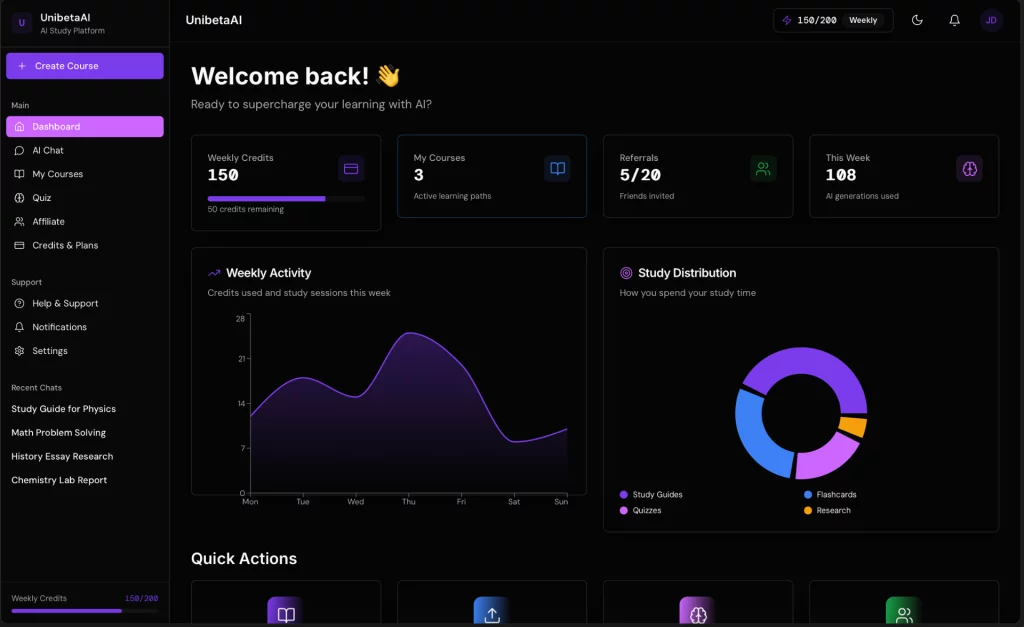
Rather than acting as a static repository of PDF notes and past questions, UniBeta pivoted toward automated syntheses.
In October 2025, the startup launched UniBeta AI.
The tool allows undergraduates to upload unstructured course materials and historical exam papers.
Its model then parses the text to identify syllabus recurring patterns, automatically generating contextual flashcards, multiple-choice quizzes, and modular summaries.
“We noticed that most of the past questions from federal universities don’t repeat the questions; they repeat topics,” Adeola said. “So we’re able to identify those topics and then help students to study those topics.”
The pivot put UniBeta in competition with general-purpose chatbots and AI tools built specifically for education, including Google’s Gemini, Anthropic’s Claude, and OpenAI’s ChatGPT. However, Adeola believes UniBeta’s advantage is in building around the realities of African university students.
“What we’re trying to do is to make it more niche towards Nigerian or African universities rather than what other products would do for a larger share of the market,” Adeola said. “UniBeta AI would be more tailored to what a Nigerian university student actually understands and would actually be of value to them.”
UniBeta has a free tier, and other paid plans cost between ₦2,000 and ₦6,000. The business also generates revenue from events, Inside Uni promotions, and sponsored advertising. The company has also secured an angel investment for an undisclosed amount in September 2025.
UniBeta said its next challenge is distribution, as it is in talked with the National Universities Commission about building a unified data structure for accredited Nigerian universities.
If the plan comes together, the founders hope it will make it possible to take UniBeta to operate across the country without having to build a separate presence from scratch on every campus.
The company also said that the team is working on features including slide creation and voice tutorials that could turn a student’s uploaded materials into what resembles a one-on-one lesson. The longer-term ambition is to build an AI product that understands how Nigerian students study and the academic systems they have to navigate.
“For an edtech platform to succeed, we also need to solve other problems students have outside the classroom so we can be relevant round the clock,” he said.
True scale demands moving beyond surface-level integrations to robust execution. We’ve filtered the noise out of Moonshot 2026, optimising the conference strictly for high-calibre connections between startup founders, global financial operators, enterprise leaders and individuals rewiring Africa’s technical frameworks. Get 20% off Early Bird tickets for a limited time.