×
Tech

Grey launches Paycheck, targets growth beyond three million users

Grey wants 20 million users. Its next bet is salary accounts

Grey, the Y Combinator-backed cross-border payments company, has launched Paycheck, a salary account for professionals earning in United States dollars, British pounds, and euros, as it sets its sights on growing beyond its current base of three million users.

The company, which has processed nearly $5 billion in payments since its inception and recorded a 170% year-on-year increase in total payment volume, announced the new product at Moonshot by TechCabal 2026 in Lagos, Nigeria, on Wednesday.

“After a month of work, employees should have more to look forward to than the additional responsibility of sorting through transactions and keeping track of their earnings,” Idorenyin Obong, Grey’s co-founder and chief executive officer, said during a keynote address at Moonshot.

“A salary is central to how people meet their needs, plan ahead, and build financial security. We believe the financial services they use should reflect that importance.”

Founded in 2020 by Obong and Femi Aghedo, Grey has expanded from a currency exchange platform to a cross-border payments company serving individuals and businesses.

Its latest product, Paycheck, extends that expansion into salary management for professionals earning in foreign currencies.

Paycheck allows users to receive and manage their salaries in foreign currencies, automatically organise salary transactions, and access benefits including higher interest rates on savings, increased transaction limits, and priority customer support.

Existing customers receiving salaries through Grey can activate Paycheck without changing their account details. New users can share their Grey account information with employers or payroll providers, with the service activated after their next qualifying salary payment.

The launch marks another step in Grey’s efforts to move beyond facilitating cross-border transactions into offering financial services built around recurring income.

Grey Business, its multi-currency payment platform for startups and small businesses, has processed nearly $100 million since launching in February 2026. The platform allows businesses to receive international payments, manage foreign currency accounts, and send money across borders.

In June, TechCabal reported that the platform had processed $61.4 million in its first four months, driven partly by demand for stablecoin-based transactions.

The company said African markets, including Kenya, continue to record strong growth, with 30% month-on-month growth.

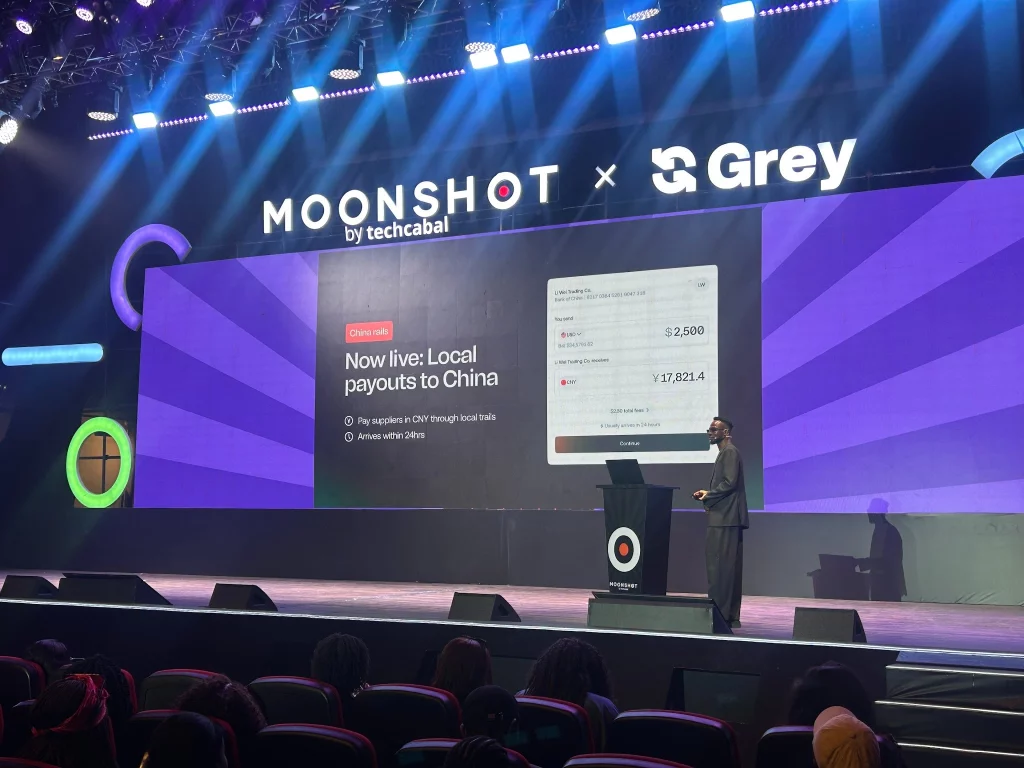
Grey has also introduced Chinese yuan payouts, enabling individuals and businesses to pay suppliers and other recipients in China. The company operates across 70 countries and supports payouts to over 170 destinations worldwide.

During his Moonshot keynote, Obong said the company was looking to expand beyond its current customer base, with ambitions to reach 10 million, and eventually 20 million users.

Grey’s strategy is that customers who come to the platform to collect money from abroad will have more reasons to stay if they can also manage their paychecks there.

With Paycheck, the company wants to turn an occasional transaction into a regular financial habit.

§

Grey is offering businesses direct payments to Chinese bank accounts to reduce currency conversions and intermediaries involved in paying overseas suppliers, co-founder and chief operating officer Femi Aghedo told Moonshot by TechCabal in Lagos.

Demonstrating the service, Aghedo showed how Grey Business customers could convert dollar or stablecoin balances into renminbi and pay suppliers in China. The feature targets businesses whose international payments can pass through several banks and currencies, adding costs and delaying settlement.

For African importers buying from Chinese manufacturers, the service offers a more direct route to suppliers in one of the continent’s most important trading markets.

The expansion comes as Grey builds its business offering alongside its consumer platform. The company says it serves more than 3 million users across 70 countries and supports payouts to more than 170 destinations.

Stablecoins accounted for the largest share of Grey’s cross-border flows. Image source: TechCabal

Grey Business, launched in February, had processed $61.4 million in payment volume by June, according to the company. Stablecoins accounted for the largest share of its cross-border flows.

That mix offers an indication of how customers use digital currencies in their day-to-day financial operations. Grey allows businesses to hold USDC and USDT, transfer them, and convert them into local currencies when needed. The China payment feature extends that offering by allowing customers to convert balances into their suppliers’ required currency.

Aghedo’s demonstration also covered the more routine demands of managing a business account. Companies can hold dollar balances, issue prepaid expense cards to employees and control or freeze their use. They can make bulk payments by uploading a spreadsheet, using the exchange rates available at the time, or connect their own systems to Grey through application programming interfaces that automate payments.

Together, the tools position Grey Business as a service for managing international spending and company payments, as well as moving money across borders.

The commercial case rests on reducing friction in collecting revenue, holding funds, and paying suppliers. For a business earning in one currency and purchasing stock in another, each additional conversion or intermediary can erode its margin.

Aghedo’s presentation put the China service at the centre of that argument: businesses should be able to move from a dollar or stablecoin balance to a supplier’s bank account with fewer steps in between.

§

Payment providers must help businesses manage cash flow, understand customers and reduce fraud as accepting digital payments becomes only the first step in adopting technology, fintech executives told Moonshot by TechCabal 2026.

 Speaking at a panel titled “The Business Behind the Transaction”, executives from Mastercard, Remita and OPay said merchants needed services that connected payments to their wider operations, alongside reliable support and staff training.

“Let’s understand the customer, let’s solve for the customer problem rather than providing a generic product push across the different businesses,” said Shabir Ahmed, Mastercard’s Senior Vice President for Customer Solutions in Central Africa. 

Ahmed identified connectivity, data-driven intelligence and trust as priorities for providers seeking to help businesses operate more effectively. His comments proved that the usefulness of payment technology depends on what businesses can do with it beyond collecting money.

For Remita, that means extending services into financial management, invoicing and statutory compliance, said Abimbola Onyluka, the company’s divisional head for corporate and consumer business.

Businesses need tools that connect their financial information to banks, lenders and regulators, she said. A payment record becomes more useful when it can support borrowing, reporting and decisions about how to manage the business.

But expanding the range of services also requires providers to maintain the reliability of their core payments operations. Onyluka stressed the need for dependable support and the quick resolution of downtime, as payment failures can interrupt sales and affect customer service.

Isimeme Ayobami Owobo, OPay’s director for key account merchants, said businesses that grew faster integrated technology into their operations and trained employees to use it effectively.

Installing a payment terminal was only part of that process, he argued. Merchants also needed to make fuller use of the tools available to them, including QR-code payments that could help speed up transactions.

The discussion highlighted a challenge for payment providers seeking a larger role in merchants’ businesses. Processing a transaction gives them a point of contact with the customer, but turning that relationship into a broader service requires an understanding of how each business operates.

The executives’ argument was that payment acceptance alone offers a limited measure of digital adoption. The greater value comes when businesses can use the information generated by transactions to manage cash, serve customers and plan growth.

§

Paystack will look beyond payment acceptance to address more of businesses’ financial needs as it enters its second decade, co-founder and chief executive Shola Akinlade said at Moonshot 2026 in Lagos.

Akinlade described how the Nigerian fintech’s payments infrastructure had supported businesses across other sectors, arguing that its next phase would build on the same premise: enabling entrepreneurs to concentrate on their products.

The discussion traced Paystack’s development from a company helping Nigerian merchants collect payments online to a broader financial services group with operations across several African markets.

“I feel very qualified to talk about ambition because a lot of my ambitions over the last 10 years have been realised,” he said. “If you know anything about the Paystack story, we had a simple ambition to build to help merchants accept payments in Nigeria and then probably Africa.”

Akinlade used PiggyVest, the Nigerian savings platform, to illustrate how the infrastructure Paystack developed had enabled businesses beyond its original ambitions.

He recalled how the founders approached Paystack with an idea to automatically debit users’ accounts so they could save money regularly. Paystack already had the infrastructure to support the idea, even though building a savings business was not its own ambition.

“The most exciting thing about that story is that I didn’t do anything. The founders built the business; they took the risk,” he said. “The only thing we had to do was focus on building our infrastructure.”

The experience, he added, showed why infrastructure businesses could have an influence beyond the services they directly offered.

“That’s what really gets exciting about building infrastructure because you don’t know what people are going to build on it.”

Akinlade said that influence also extended to former employees who had gone on to establish companies of their own. He cited Douglas Kendyson, founder of Selar, which helps creators sell digital products; Femi Aluko and Olumide Ojo, co-founders of food delivery company Chowdeck; and Abdulhamid Hassan, co-founder of financial infrastructure provider Mono.

“One of the things I have learned in the last 10 years is that ambition is contagious,” he said. “When you achieve the ambition, every other person you engage with, the ambition continues to go round.”

Amandine Lobelle, the company’s chief operating office, outlined the company’s geographical expansion, saying Paystack had grown its footprint across Ghana, Kenya, Côte d’Ivoire and South Africa, while securing regulatory licences for Egypt and Rwanda.

The discussion comes as Paystack broadens its corporate structure and product offering. In January, it announced The Stack Group, a parent company encompassing Paystack, consumer payments app Zap, Paystack Microfinance Bank and venture studio TSG Labs.

Akinlade said the company was expanding its view of the problems it could solve as customers’ needs developed beyond collecting payments.

Web hosting by Somee.com