×
Tech

Nigeria’s identity agency says its database is locally hosted and managed by staff

Nigeria’s national identity database is hosted locally

Nigeria’s National Identity Management Commission (NIMC) says its national identity database is hosted entirely in Nigeria and managed by its own employees, as digital identity verification becomes increasingly important to public services.

Alvan Ikoku, director of NIMC’s Strategic Programme Office, disclosed this during a briefing with journalists on Wednesday, addressing concerns about where Nigerians’ identity data is stored, who controls the infrastructure, and how the commission protects it from leaks.

“It is being managed by Nigerians, not Nigerian vendors, by NIMC employees,” Ikoku said. He maintained that NIMC has never hosted its identity data outside the country, does not use cloud hosting for its core database, and has disaster recovery systems to keep services running when systems fail.

The comments come as data localisation increasingly dominates conversations in Nigeria about control over citizens’ personal information. Keeping data within national borders addresses where it is stored, but protecting it requires effective controls over who can access it and accountability when it is misused.

142 million Nigerians have registered for National Identification Numbers as of September 2026, according to NIMC. A breach could expose millions’ personal data, while an outage could disrupt essential services. Local hosting alone cannot guarantee security; tight access controls, monitoring, and accountability for misuse are also critical.

Ikoku said NIMC maintains its core database internally and subjects employees, particularly those responsible for database management, to ongoing scrutiny by security agencies. He added that staff could face legal consequences for misconduct.

Keeping the central database under internal control does not mean NIMC controls every point through which identity data is accessed. Licenced partners and connected government agencies also play a role in delivering verification services, creating additional points where access to personal information must be managed and secured.

Previous security concerns have centred on access through verification channels, rather than a confirmed compromise of the central database. In March 2024, reports about XpressVerify, a website offering Nigerians’ identity information, raised questions about how the platform obtained access.

NIMC previously said XpressVerify was not a licenced partner and ordered an investigation into whether authorised verification agents or their sublicensees had breached their licensing agreements. The Nigeria Data Protection Commission later said NIMC had suspended database access before restoring limited access to institutions providing essential public services.

The episode highlights a key distinction between data residency and access governance. Storing identity records on infrastructure within Nigeria does not, on its own, prevent exposure through organisations authorised to request verification.

That risk grows as more institutions connect to the identity system. Ikoku said about 63 government agencies had integrated with NIMC, including organisations involved in examinations, student finance, consumer credit and health insurance.

“It is one thing to be ready to integrate with an agency,” Ikoku said. “All we need to do is to offer the application programme interface, which they would use. But what I’ve also discovered working on this harmonisation project is that some of them have not attained—should I call it—the maturity level, the digital maturity level, to be able to even have that handshake in terms of integration.”

For agencies whose systems are ready, connecting through NIMC’s application programming interface (API) can take about 72 hours, Ikoku said. Harmonising records and systems, however, requires more customised work.

Ikoku said the 2026 NIMC Act requires compliance with the Nigeria Data Protection Act and sets conditions for disclosing registered persons’ information. These include consent, legal obligations, public-interest functions, criminal investigations and court proceedings.

He said NIMC’s role is to authenticate identities, not retain the reasons behind verification requests made by other organisations.

“The commission is supposed to coordinate authentication and verification, but the authentication that the commission needs to make may be coming from another entity,” Ikoku said. “It is not the commission’s business to retain the reason for that request or for that authentication. The commission will not do that. Neither will its agents or assignees do that in any way.”

Ikoku said users could manage and withdraw consent through NIMC’s authentication application, subject to legal exceptions. However, the briefing provided no usage figures or demonstration of how citizens could check access records, challenge misuse or file complaints.

NIMC is also developing frameworks for digital credentials, certificates and signatures as it modernises its identity infrastructure, Ikoku said. The technical standards, governance arrangements and implementation regulations are still being developed.

The push to keep sensitive data in Nigeria extends beyond identity management. In June 2026, the Central Bank of Nigeria directed banks and payment companies to store and manage payment transaction data generated in the country locally by January 1, 2027. The government’s National Sovereign Cloud Initiative, formalised in August, similarly aims to expand local cloud infrastructure.

True scale demands moving beyond surface-level integrations to robust execution. We’ve filtered the noise out of Moonshot 2026, optimising the conference strictly for high-calibre connections between startup founders, global financial operators, enterprise leaders and individuals rewiring Africa’s technical frameworks. Get 20% off Early Bird tickets for a limited time.

§

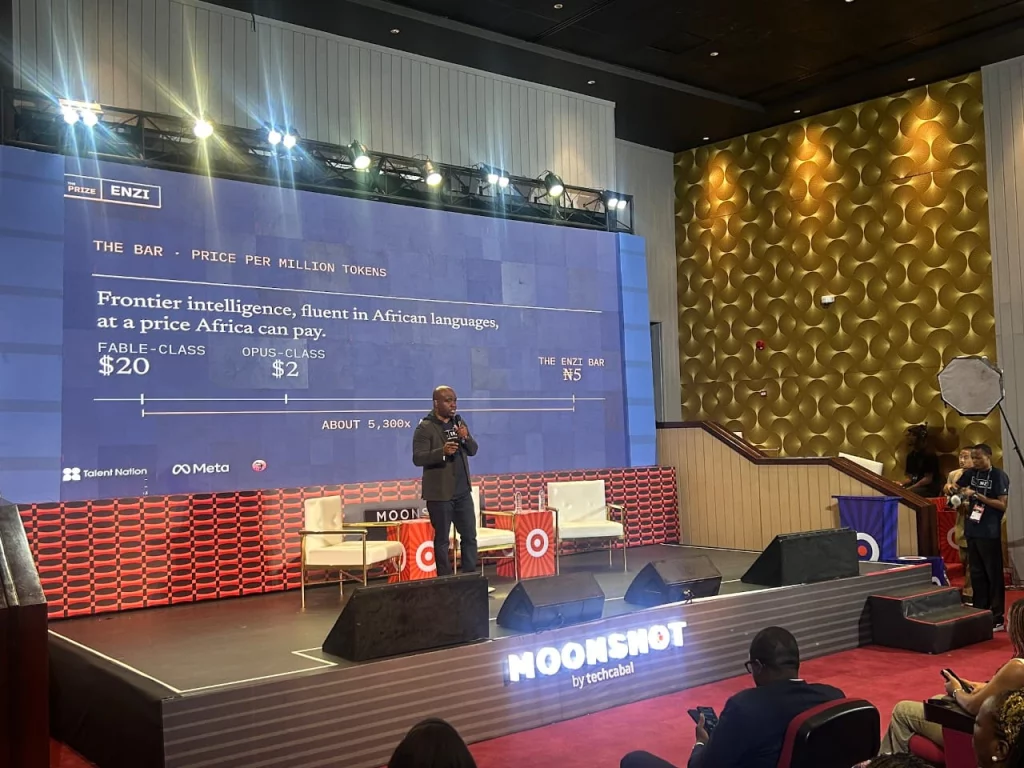
Oji Udezue has built products that made millions in Silicon Valley, serving as chief product officer at Typeform and Calendly, product lead at Twitter, and head of product at Atlassian. On Moonshot’s Emerging Tech stage, he returned to the question he says keeps drawing him back to Africa: who is a technology actually for?

Frontier AI, he argued, is being priced out of reach for most of the continent, and the Enzi Prize is his attempt to change who can afford to use it. “It’s for the person in your village who’s not educated,” he said. “Otherwise, we would be the most selfish generation that ever existed.”

His argument rests on a number. Running a frontier, “Fable-class” model costs roughly $50 per million tokens today, by Udezue’s benchmark. The prize aims to bring that down to about $5, and ideally to a much lower amount. “We say 100x because maybe we’re hedging our bets,” he told the room.

To pursue that goal, the Enzi Prize Foundation, a Delaware non-profit backed by the Africa Deep Tech Foundation, TechCabal, Future Africa and Talent Nation, is offering a $10 million prize purse as part of a roughly $14 million initiative.

The aim is to make AI cheaper and fluent in African languages and contexts. According to Udezue, a cheap model that scores well on standard tests is of little use if it has never heard of a tropical disease or the things “people in my village know that are not anywhere on the internet”. Entries must first meet a minimum standard — what he called “a master’s in intelligence and a PhD in African context and African languages” — before competing on cost.

Submissions, whether cloud systems or models that run on a phone, are ranked on a public, open-source leaderboard, with rotating, sealed questions to prevent teams from gaming it. Winners retain their intellectual property but must publish an open, royalty-free version for use in Africa and the Global South.

The model is the Ansari X-Prize: offer a reward for a desired breakthrough and let competition draw in investment to achieve it. “If I put up $10 for you to chase,” he said, “people will spend $9 to chase 10.” He noted that a $20,000 pilot had already “brought a lot of talented people out of the woodwork”, producing the demos shown earlier that afternoon. “What would $10 million do?”

The purse is not yet fully funded. Udezue said he had spoken with OpenAI and Google that day, and estimated that winning the prize could take three to six years. His closing appeal was less for money than for belief: “Let’s make inference part of African innovation.”

§

Africa’s artificial intelligence developers should measure success by improvements in healthcare, education and incomes rather than the number of products they launch, the Gates Foundation’s Nigeria director told Moonshot by TechCabal in Lagos.

Uche Amaonwu said AI could widen access to knowledge, services and economic opportunity, but warned that its benefits would depend on deliberate choices about how the technology was developed, financed and deployed.

“For a technology to really be impactful, it has to touch the lives of people,” he said during a keynote address.

His remarks set out a challenge for developers and investors seeking applications for AI across the continent: moving promising tools beyond trials and into the institutions and communities expected to use them.

Amaonwu pointed to the foundation’s Goalkeepers report on AI and equity, released around the UN General Assembly, describing its message as “exciting, but also cautionary”. AI could become “a powerful equaliser”, he said, but that outcome was far from assured.

“If we are not deliberate about how AI is developed and deployed, we could end up widening the very inequalities that we’re actually trying to close.”

The foundation’s approach, he said, starts with three objectives: preventing avoidable maternal and child deaths, protecting the next generation from deadly infectious diseases, and helping hundreds of millions of people escape poverty.

These were “human condition goals”, he said. AI’s value would lie in whether it accelerated progress towards them.

A central part of that effort is the Nigeria AI Scaling Hub, hosted by Lagos Business School in partnership with the Federal Ministry of Communications, Innovation and Digital Economy. Backed by up to $7.5mn from the foundation over three years, the hub aims to expand the use of proven AI tools in health, agriculture and education.

Its focus is the difficult transition from a successful pilot to sustained adoption. A tool that works in a trial still needs infrastructure, institutional support and a viable funding model before it can reach people consistently.

Amaonwu identified four requirements for making that transition.

Developers needed shared infrastructure, including connectivity, trusted data, and systems capable of exchanging information, so that each company did not have to build the same foundations independently.

Tools also needed to reflect Nigerian conditions and languages, earn users’ trust from the outset, and have a clear route to adoption and payment. Identifying who would use a product — and who would finance its continued use — was as important as developing it.

The argument places responsibility beyond technology companies. Governments shape the conditions for adoption through regulation and public systems, while investors determine which businesses receive the capital to expand.

Amaonwu urged the Moonshot audience to return the following year with evidence of practical results like clinics where patients had received care, classrooms where children had caught up, and farmers who had secured better prices for their harvests.

“No one in this room can do all of this alone,” he said. The future worth building was “the one that we must build together”.

Web hosting by Somee.com