×
Tech

What a banker discovered when he started listening to farmers

What Watson Matsa discovered when he started listening to farmers

Don’t get Watson Matsa started on farmers and banks, as we did. By the swimming pool at Somerset Westview Hotel in Nairobi, he talks about both with the conviction of a man who has spent enough time inside a bank to know why banks don’t understand farmers.

It is a Friday evening, July 26. Around us, Nairobi is warming up for the weekend. There is coffee on one table, tea on another, and every so often someone reaches into their pocket for a cigarette. Matsa, meanwhile, is talking about soil, rainfall, and credit scores.

The founder of eSusFarm Africa wasn’t always an agriculture man. He studied economics and accounting at Rhodes University in South Africa and later worked in credit analytics at FNB. Finance was supposed to be the thing. Then an idea he encountered at university got him thinking: information unlocks capital. His problem with that idea was Africa. What happens when the information needed to unlock capital simply isn’t there?

That question eventually led him to smallholder farmers and eSusFarm Africa.

Matsa still talks like a banker—risk, underwriting, cash flows—but increasingly thinks like a farmer. Banks, he says, are built around the neatness of a salary arriving every month. Farmers earn seasonally, save for the unexpected, and wait. Perhaps, he suggests, farmers are not the problem. Banking is simply too rigid.

He misses one thing about his old life.

“The SMS that comes on the 24th of the month,” he says, laughing about what he misses most from corporate life. “The SMS saying the money has arrived—on time. A good credit score. Being able to plan trips with my family.”

Now, there is payroll to worry about, farmers to convince, and a continent’s financial assumptions to challenge.

This interview has been edited for length and clarity.

You grew up fascinated by financial systems, not farming. How did a banker end up spending his days thinking about soil, weather, and smallholder farmers?

It goes back to when I was studying at Rhodes University. I was double-majoring in economics and accounting, and there was one book that really had me in a chokehold. It said that information unlocks capital, and that capital markets have enough information to do so.

I thought: in Africa, that’s not true. There isn’t enough information flowing fairly for capital to flow.

Initially, I was thinking about small businesses: how do we get data on them that can facilitate capital flows? I took the idea to my co-founder, who has a PhD in agricultural economics. He said, “What if this applies to agriculture? Money isn’t flowing to small farmers because there isn’t enough information.”

I asked him what data we would need. He said soil, climate, farmer-reported, and crop information. Those are some of the pillars you need when assessing risk. You can look at the soil and say: this farmer needs a certain fertiliser, so let’s finance that. You can look at the weather and determine that the farmer needs insurance.

We started mapping the data points that affect financial decisions.

I also worked at FNB in the credit analytics space as a project manager on projects aimed at improving credit scoring. That helped me understand how banks think.

Take ongoing risk management: even if I vet and qualify you for a loan, I still need to monitor you until it is repaid. That kind of ongoing risk-management system doesn’t really exist for smallholder farmers.

We took on the task of building it.
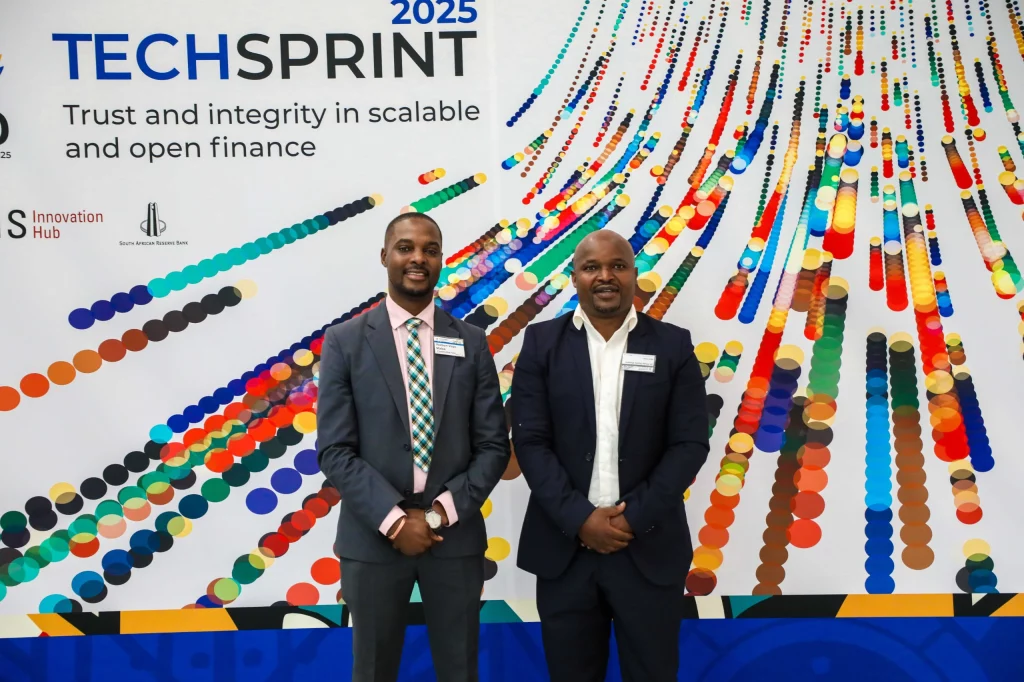
Matsa (left) and a colleague at a conference in 2025. Image source: eSusFarm

If we spoke to your younger self in South Africa, what career would he swear he’d never end up pursuing?

I always wanted to be in finance. It’s my skill set; it’s my thing.

I would advise my younger self not to pursue anything unrelated to STEM—science, technology, engineering, or mathematics. When we were growing up, the question was: how do you put food on the table? STEM was where a lot of employment was happening.

For me, mathematics could mean accounting, economics, or banking. Engineering was a good space. Technology was a good space. Science was a good space.

I still think STEM is important in Africa. We’re still trying to master how we compete in science, technology, engineering, and mathematics.

You’ve lived in boardrooms and on farms. Which world has taught you more about human behaviour?

They’ve taught me different sides of human behaviour.

The boardroom taught me about governance and how to implement policies and procedures so that, when you’re doing something, you can replicate it.

The ground taught me that interpersonal relationships are more important than almost anything else. You may be a smart guy, but if you don’t know how to relate to the person opposite you and communicate in an easy, simple, and articulate way, you won’t get their buy-in.

The ground taught me how to simplify complex concepts. On one side, I’m very technical. The other side is: how do you communicate that technicality so that someone with a Grade Seven education can understand what you’re saying and the value you’re bringing?

It has made me a much better communicator. Working on the ground has also taught me empathy and how to relate to people. Those skills transfer back into the boardroom.

You often describe finance as infrastructure. What’s one lesson from banking that agriculture desperately needs, and one thing banking could learn from farmers?

One thing banking could learn from farmers is that incomes aren’t earned in the same way.

Banking tries to structure things around very rigid rules: you get paid monthly, so I’ll charge you monthly. Farming is seasonal. You receive money and then have to preserve it for a much longer period until the next tranche comes in.

Banking has been too rigid. Income flows aren’t always monthly. They can be daily, weekly or every four months. Banks need to start adapting to people’s income cycles rather than dictating them.

Farmers also understand how to use money prudently because they’re constantly preparing for eventualities. It could be a weather event or a disease outbreak. They develop a resilient mindset around preserving cash so they can survive those events.

That’s something banking can learn from farming.

People often assume farmers are poor because they lack money. Do you think the bigger problem is that financial systems have never really been designed for them?

Absolutely. The financial system was designed around salaried people—monthly earners.

But farmers and people in the informal economy can earn daily. They are micro daily earners. You may not be earning $2,000 every month, but you could be earning $20 a day.

Small farmers and small businesses are earning money, but they’re earning smaller amounts consistently.

If banks understood this better, they could tap into this class of daily earners rather than focusing almost exclusively on monthly earners.

The financial system has been designed around formal employment rather than people’s actual income potential and earning patterns.

Every founder has one meeting that changed everything. Which conversation altered the direction of eSusFarm more than any funding round ever could?

We always wanted to get into finance, but we didn’t know where to start. Was it credit? Was it insurance?

Then we had a conversation with Benny van Rooy, the former CEO of Grobank. He said, “Watson, you’ve got enough data, and I like calling you a data company. But what you need to understand is that banks can’t lend if there is no insurance.”

That conversation was the beginning of our understanding that banks come after insurance; they don’t come before.

Banks want assurance. If you cannot assure a bank of some stability in earnings, you’re going to struggle to unlock finance.

Farmers are largely an unsecured portfolio, so insurance—or assurance—becomes important. The assurance comes from data; the insurance comes from underwriting. Without those two things, banking won’t come in.

That insight changed the way we thought about penetrating the market.

Your platform combines AI, mobile money, blockchain, and insurance. How do you stop yourself from falling in love with technology instead of the problem you’re trying to solve?

For us, it has always been about not letting the small farmer fall behind.

The back end of the system can be sophisticated. It can use AI, blockchain, credit scoring and insurance. But we still make sure the delivery model can come through something as simple as USSD, so it’s accessible through a device the farmer already has.

We’ve learned that even if you’ve got complex technology in the background, you still have to deliver it simply at the last mile.

We don’t allow technology to override the mission of supporting the farmer. Technology is there to help us do that better.

If I spent a week shadowing you, what would surprise me most? Would I find you writing code, negotiating partnerships, visiting farms, or worrying about payroll?

Everything.

But you’d probably see a lot of partnership work. We have a partnership-led growth strategy. We believe in embedding our technology within existing systems.

People ask me, “Where is your app?” I tell them we don’t want to build an app. We want to be involved in what people are already using.

If you’re in Kenya and using mobile money, let me provide the solution through that ecosystem. If you’re using WhatsApp, let me provide the solution on WhatsApp.

We have MTN as a partner. We have Sanlam as an insurance partner. We also have Microsoft as a technology partner helping us scale.

Building standalone apps and systems doesn’t always make sense. I’d rather integrate our technology into existing infrastructure with a captive market than go door-to-door to acquire every user ourselves.

The second thing you’d see me worrying about is payroll. As we expand into more countries, we need larger teams, and funding in Africa remains limited.

What we’ve found is that many African investors want to invest in profitability, whereas American investors are often more willing to invest in technology for the future before profitability. They’re willing to lose money in the short term to jump the next curve.

That affects us. We have to find capital elsewhere, including grants, to help us build for that future.

When was the last time a farmer challenged an assumption you’d made and forced you to rethink the business?

We assumed farmers would willingly report information about their operations.

We built technology to collect information, and part of it depended on farmers’ self-reporting. We thought they would do it because they understood that reporting was necessary to access finance.

That was one of the biggest lessons we learned: many farmers don’t understand why they need to report. They don’t necessarily care about reporting.

We call some of them “sceptical survivors”. These are farmers between roughly 45 and 65 who have been farming for years. They’ve taken their children to school through farming. They have no appetite for a 35-year-old Watson coming to tell them to report information when there’s no clear incentive.

Why should I report? If I report, what’s the immediate benefit?

We’ve had to connect reporting directly to finance. The more information you provide, the better we can monitor and understand your risk. Then we can score that risk and potentially finance it.

We had to create an incentive structure for farmers to start reporting.

Founders often say they “empower” communities. Was there a moment when you realised the community was actually empowering you?

Yes.

We’ve profiled about 380,000 smallholder farmers across Uganda, South Africa, Zimbabwe, and Eswatini. From that pool, we had about 20,000 smallholder farmers actively using our solution.

What we didn’t predict was that those 20,000 farmers would become our ambassadors in their communities.

The farmers we’d met and trained in person started onboarding thousands of others through word of mouth.

It taught us something very important about rural communities: word of mouth is incredibly powerful.

Start with a small group and make sure you do a damn good job with that group. They’ll tell the rest of the community, and other people will follow.

That’s also how the technology can scale. Don’t worry about trying to get all 380,000 people yourself. Get the 20,000 right, and they’ll help bring the rest.

You left the predictability of banking for entrepreneurship. What luxury from your corporate life do you still secretly miss?

The SMS that comes on the 24th of the month.

That SMS says the money has arrived on time. A good credit score. Being able to plan trips with my family.

I can’t plan like that now because I’m reinvesting whatever money I get into this baby. I miss the predictability of income.

What I don’t miss is the ceiling on how much I could earn.

What I love now is that there’s no ceiling. It’s an open canvas. If we work hard enough, do the right things, and execute the right strategy, the earning potential can become bigger than I could ever have imagined.
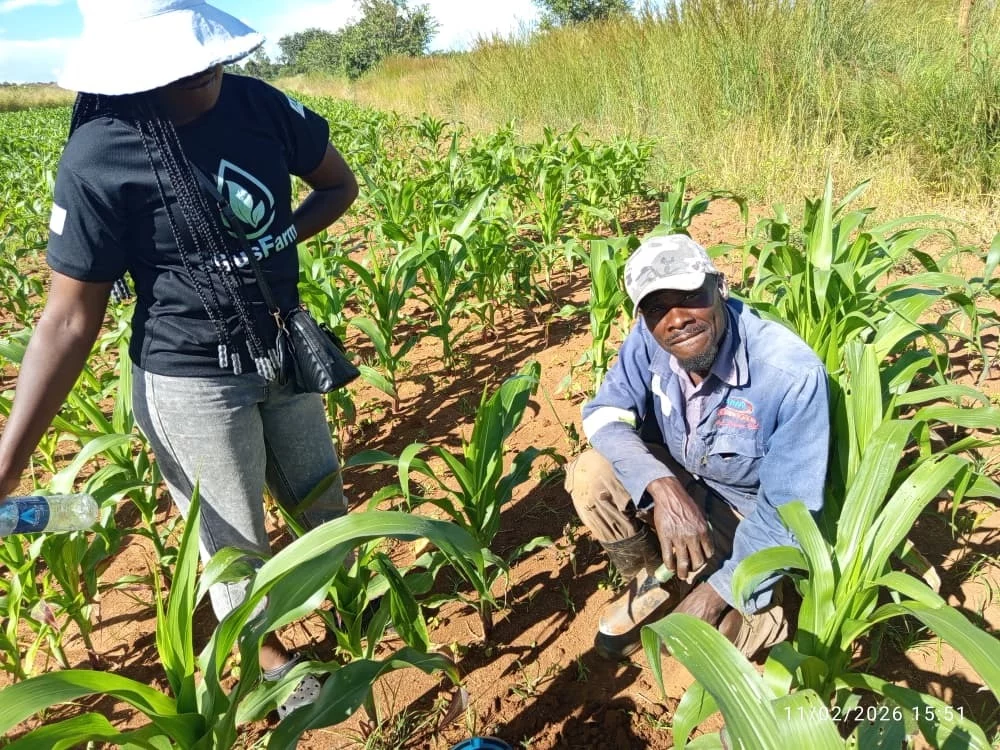
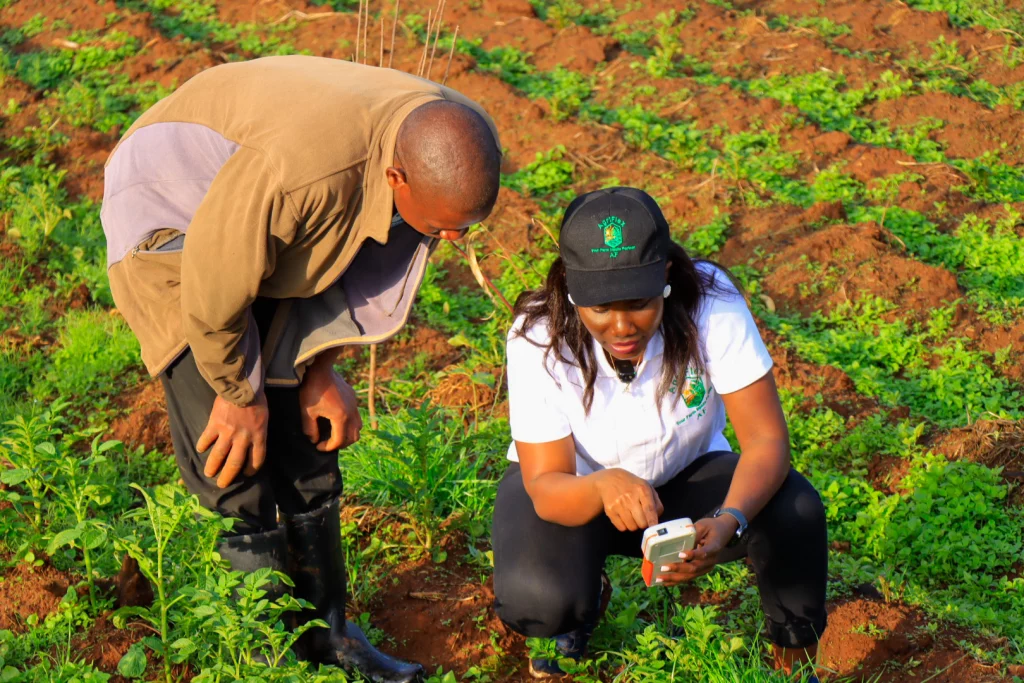
eSusFarm field staff (left) and a farmer inspecting crops. Image source: eSusFarm

What’s the most uncomfortable truth you’ve learned about African agriculture that investors and policymakers rarely acknowledge?

They misunderstand the multiplier effect of agriculture.

We’ve analysed this and found that a single farmer who does well can create jobs throughout the value chain.

Think about a farmer buying the right seed. The seed provider may need to hire someone due to increased demand. Then there are transporters. There’s the fertiliser company. When production increases, you need more workers and perhaps tractors.

When the crop is ready to be harvested, you need people to do so. Then it needs to be packaged, transported, exported, or distributed. Eventually, it reaches shops and the end consumer.

The multiplier effect of agriculture in Africa is enormous. One successful farmer on one hectare can create jobs across the value chain.

Policymakers and investors don’t fully understand that. Not focusing on agriculture in Africa is almost a sin, given its economic multiplier effect. There are very few sectors capable of creating jobs across so many different parts of the economy.

Imagine you’re appointed Finance Minister for a day—not Agriculture Minister. What’s the first financial rule you’d change to make farming a genuinely attractive business for young Africans?

One of my dreams is actually to become AU president, so I’ve thought about these things a lot.

If I were Finance Minister, I would provide better financing solutions for young people—a combination of grants and debt—and direct that financing towards crops that can substitute imports.

If your country has a huge rice import bill, finance young people to grow rice.

If we’re importing a million tonnes of rice and want to reduce the import bill, let’s finance young farmers to produce part of what we import.

I would focus heavily on import substitution and financing young people to produce in those value chains. It would help us become more self-sustaining in areas where we currently depend heavily on imports.

What part of success worries you most: the expectations, the visibility, the responsibility, or something else entirely?

Visibility is a big one for me.

Even as an organisation, we’re an embedded solution. We like working in the background.

Too much visibility brings too many eyes and can create enemies. I try not to be too visible personally. The company can be visible, but I don’t necessarily need to be.

I think Africans are still getting used to seeing success stories from within our own communities, and sometimes success can attract jealousy. For now, I’d rather keep myself away from too much of that.

So visibility is probably the thing that worries me most.

Complete this sentence: “The biggest lie we’ve told ourselves about African agriculture is…”

That there’s more money than you can ever imagine—and that it’s easy to get.

There is money in agriculture, but it’s not what people think. It takes time. It’s not fast. Agriculture is a slow industry.

It’s different from the financial sector I come from, where you can launch a lending product and potentially acquire customers very quickly.

In agriculture, you have to go out and train people. Then people have to understand the product. Eventually, the income starts coming in.

There’s a huge amount of training and change management that have to happen before the money comes in. That means you need a much longer runway. You have to sink money into the business before you see results.

But when the volumes eventually come, they can come in huge chunks.

We’ve done case studies where farming one hectare can involve about $3,000. Multiply that across a million people, and you’re talking about a lot of money.

The quantum can be enormous. But unlocking it requires learning, training, and ecosystem development.

A lot of investors, financiers, and bankers don’t understand that. You have to invest heavily in training and change management before you see the results.

Finally, if your children asked, “What exactly were you trying to fix?” what answer would you give that has nothing to do with AI, blockchain, or fintech?

My son actually asked me this.

I told him, “I help make food. You’re eating today, aren’t you?”

He said, “Yes.”

I asked him, “Where does the food come from?”

He said, “I don’t know, Dad.”

I told him, “It comes from a farmer. If there are no farmers, you don’t have food. So I’m trying to help farmers make more food so that you can eat.”

That’s what I told my child, and it’s probably the simplest way I can explain what I’m trying to do.

True scale demands moving beyond surface-level integrations to robust execution. We’ve filtered the noise out of Moonshot 2026, optimising the conference strictly for high-calibre connections between startup founders, global financial operators, enterprise leaders and individuals rewiring Africa’s technical frameworks. Get 20% off Early Bird tickets for a limited time.

§

Millicent Okumu doesn’t leave you wondering whether she believes what she is saying. She speaks with energy, with clarity about whom she is building for. Ask where the company is heading, and there is little hesitation; ask whether she will still be running it in ten years, and the answer is no.

By then, she expects Agriflex, the Kenyan agricultural business she co-founded, to be operating in at least five African countries, to be sustainably profitable, and to be led by somebody else. She might take an advisory role. For now, however, the company occupies even the hours she supposedly spends away from it. At family gatherings, unfinished tasks follow her into the room. 

Her father, a civil servant and farmer, raised cattle and grew enough food to support relatives beyond his household. She was close to him, but less enthusiastic about the farm. She avoided agriculture at school and university, only to find herself back in it through a logistics job at iProcure in 2017.

Now she sells farm inputs, deploys spraying drones and listens to farmers explain why a clever piece of technology might be of little use to them. That last part has meant slowing down plans and turning away investors.

“We are in 2026,” she says. “We are no longer in 2006.”

She is impatient for progress, but increasingly particular about what counts as progress, and who benefits.

This interview has been edited for length and clarity.

If I had met you at ten years old and asked what you wanted to become, what would you have said? Would that girl recognise the woman sitting here today?

I wouldn’t have known exactly what I wanted to become, but I was already very determined and ambitious.

I was a daddy’s girl, always following my father around and taking an interest in whatever he was doing. Even when he was discussing serious matters, I wanted to be there. Although I wasn’t the firstborn, I was often the person he delegated tasks to.

I couldn’t have told you that I would end up doing what I do today, but I knew I would be powerful in one way or another.

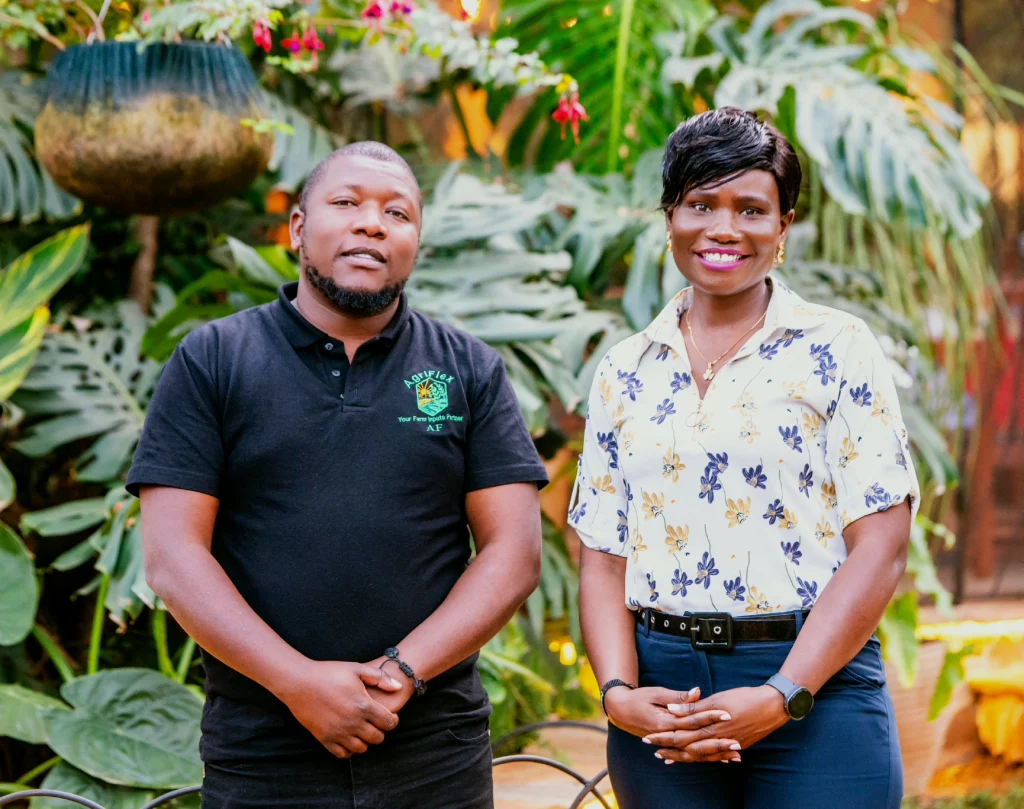
Okumu and her co-founder Isaac Nyawira. Image source: Agriflex

What did money look like in the home you grew up in? Was it something people discussed openly, worried about quietly, or expected you to go out and find?

Money wasn’t something we discussed openly, but we didn’t have to go out looking for it either. My father was a civil servant who also loved farming. There was enough to take care of us.

That changed when he died, just after I had finished Form Four. Suddenly, I had to go out and find money. I started working at a young age and figuring out how to take care of everybody, including myself.

Money then became something we discussed openly because we had to work out how to make do with the little I was earning.

Your background is in logistics and supply chains. What happened that made agriculture personal enough for you to build a business around it?

Agriculture had always been part of my life. My father had a lot of cattle and land, and farming fed our family, our extended family and even other people in the village.

He was particular about getting certified seeds. He would bring them from Kisumu or travel to Homa Bay town to buy them. We all went to the farm, although I was the one who wasn’t particularly keen on it. My father knew that, but he also recognised that I had other strengths.

In high school, I avoided agriculture. At university, I avoided it again. Then, in 2017, agriculture came calling.

I had been working in logistics when iProcure approached me. The company had raised funding and needed someone to set up its logistics department. I joined in October 2017, and that changed everything.

The work exposed me to so much, and I grew to love it. By the time I decided to leave, I knew I wanted to continue working in agriculture.

Take me back to the first farmer you tried to persuade to work with Agriflex. What did they ask that your business plan hadn’t prepared you for?

To be honest, recruiting farmers and agro-dealers wasn’t particularly difficult because of the relationships we had built at iProcure. People knew us and understood what we could do for them.

But one farmer asked a question that stayed with us: “Millicent and Isaac, you know we need inputs, and you are giving us access to them and advice. But what happens after that?”

Isaac is my co-founder and handles commercial activities and operations. What the farmer was asking us about was the market for their produce. We were supporting production, but the challenges didn’t end there.

That made us think about how we could help farmers find buyers. We now have a plan to support some of them with that. We don’t want to help them through production and then leave them hanging, even as we continue rolling out other parts of the business.

You work with drones and traceability tools. How do you explain what you do to a relative who interrupts halfway through and asks, “But Millicent, what exactly do you sell?”

I start with what is easiest to understand: I sell seeds to farmers and agro-dealers. I also sell crop-protection products, including agrochemicals and foliar feeds. Those are things people recognise and use, even back at home.

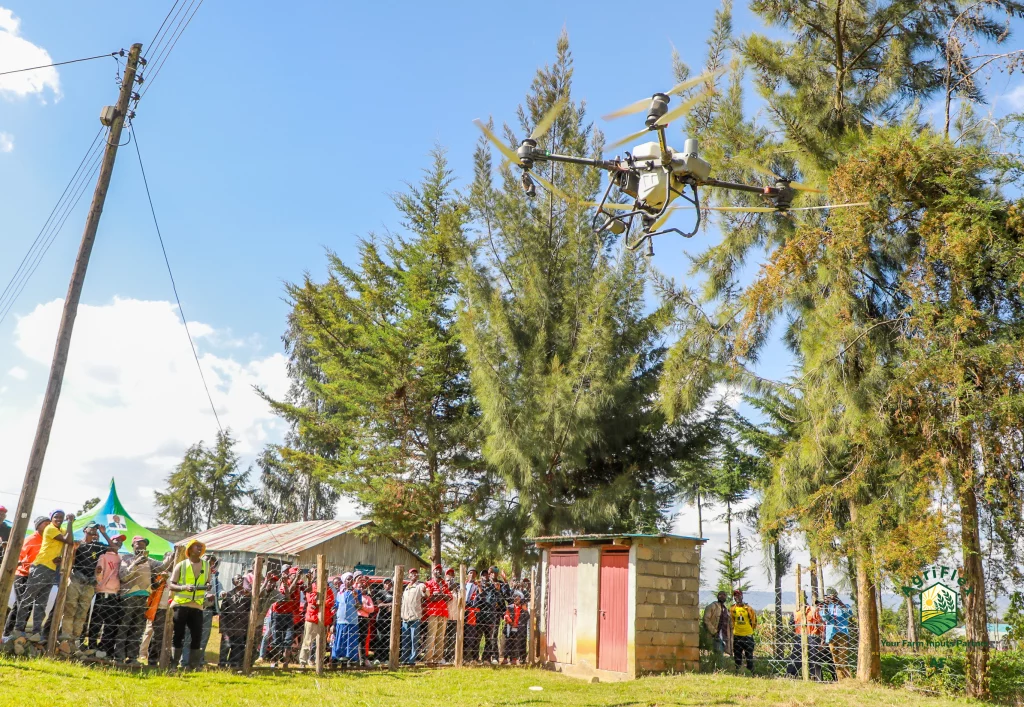
Then I explain that we are helping farmers move away from manually spraying their farms. With a drone, we can spray an acre in a minute. Instead of using 100 litres of water per acre, we can use about 10 litres.

We are making the work easier, reducing the time farmers spend on these tasks and helping them farm more efficiently. We are in 2026. We are no longer in 2006.

Tell me about a time a farmer looked at something you were proud of and effectively said, “That is clever, but it won’t work here.” What did you do next?

That happened with the technology side of the business. Agriflex is technology-enabled, and we have been thinking carefully about how technology can complement our work and improve what we offer farmers.

Initially, we wanted to launch a mobile app with several features, including disease detection and recommendations on which inputs to use.

But when you go out to the farms, you encounter practical problems. The internet connection is poor, or there is no network at all. Many farmers also already recognise the common pests and diseases affecting the crops they grow regularly, such as maize and beans.

They told us: “If this is what your app will do, it won’t solve my immediate problem.”

What they wanted was access to basic, practical information about farming without having to wait for us to organise a training session or demonstration. They were already using WhatsApp. Could we make the information they needed accessible? Could we start there, register them and then build on that relationship?

That feedback made us slow down. We had wanted to introduce the technology immediately, but we listened to farmers and agro-dealers and only rolled it out this year.

It also meant saying no to some investors who wanted technology to be the priority. The feedback from the field was telling us something different, and we decided to follow that.

Farmer watching drone spraying. Image source: Agriflex

Who pays Agriflex, and for what? Where does the farmer’s gain end and your margin begin?

Two groups pay us: agro-dealers and farmers. A large proportion of our revenue comes from agro-dealers, whom we supply in bulk.

We want to reach as many smallholder farmers as possible, but we cannot reach all of them directly. Working through agro-dealers allows us to serve more farmers through businesses they already buy from.

Farmers can also walk into our two outlets, in Molo and Ol Kalou, and buy directly from us. Currently, they pay for inputs and drone services. We also introduced soil testing about a month ago.

We negotiate better trading terms with manufacturers, which allows us to offer affordable prices to farmers and agro-dealers while earning a margin.

Trust, reliability and affordability have been very important to us. Agro-dealers need to know that we will supply them reliably, and both they and the farmers need prices that work for them.

What is the most expensive assumption you have made in this business, and how long did it take you to admit it was wrong?

There was a project we took on early in the business that looked very lucrative. On paper, everything suggested it would work. Based on the information we had received and the assumptions we had made, it looked like a good opportunity.

But it didn’t work out as we expected.

It took us three months to agree that we needed to stop. We had to accept that it wasn’t working, cut it off and move on.

When people talk about empowering women farmers, the language can become very polished. Tell me about one woman whose experience forced you to change how Agriflex operates.

There is a woman farmer with about 50 acres that she plants every season. We were supplying her with inputs, but spending time on her farm showed us how much more support she needed.

Spraying even 20 acres involved several workers over several days. She had to be there supervising, and there was a 2,000-litre water tank on the farm. After all that work, the costs were still very high.

It made us ask what the support offered through empowerment programmes actually changes. Does it reduce the time a woman spends on the farm? Does it reduce the resources she has to put into it?

With the drone, we completed the spraying in about 30 minutes.

That experience made us pause and rethink our priorities. Instead of concentrating only on recruiting more customers, we needed to look more closely at how we supported the ones we already had. That applies to our agro-dealers too.

We have also supported her with finding a market for her produce, even though that is not the core of our business.

For me, empowerment means making someone’s life easier in ways they can actually see and experience.

Have you ever walked into a meeting and realised you would have to prove yourself before anyone would discuss your business? How did you handle the room?

Yes. Sometimes people say: “When you said you were Millicent, and we heard what you were doing, we expected someone older and bigger.”

They knew they were meeting a woman, but I still didn’t look like the person they had imagined. Then comes the question: why should they trust that I understand what I am doing?

What has worked for me is knowing my business inside out. I need to understand every aspect of it, including the numbers.

I also draw on my experience. I have done this work before, and I am proud of what I achieved. I am not going into it blindly. I have a blueprint and some understanding of what will work and what won’t.

When you can explain that clearly, people begin to listen. How you carry yourself into the room matters too. They may have arrived with assumptions, but you can give them reasons to reconsider.

What has been your closest encounter with giving up? What happened, who did you call, and what made you return the next morning?

There have been several moments, but I would focus on fundraising. My co-founder and I have considerable experience in the business itself. We understand the work. Funding has been more challenging.

Sometimes conversations progress very well, and you begin to expect a positive outcome. You have plans ready and are preparing to get things moving. Then the feedback comes: “Let’s pause. Let’s wait.”

You find yourself asking: wait until when?

It can leave you feeling so dejected that you wonder whether to continue and why you are doing it at all.

The person I call is always my co-founder, Isaac. I tell him things aren’t going as I thought they would, and we talk through it.

What brings us back is the people we have served. Despite the challenges, there has been so much joy in the journey.

One woman told us that previously, her farm hadn’t produced enough surplus to help with school fees. Last year, after putting aside food for her household, she had enough left to pay school fees for her two children. She was so happy.

Stories like that make us feel we have to keep going.

We also have to remain flexible and adjust quickly when things change. Having a co-founder who understands that we are building for the long term makes the journey easier.

Okumu and a farmer performing a soil test. Image source: Agriflex

What are you like when things go wrong? If I asked your co-founder, would he describe the same person you are about to describe?

Definitely. He would tell you that Millicent is very tough and very strict. But he would also tell you that I am the most positive person.

When something goes wrong, I am usually the one saying there must be a good side to it. We might not see it immediately, but perhaps we will understand it tomorrow.

Then I move quickly to the next question: what do we do now? We cannot stay in the same place, going over what has happened.

He would tell you I am tough, but also that I am the person who says: “This is temporary. Give it time. Let’s focus on what we can do next.”

What does the business get from you that the people closest to you sometimes have to go without?

My time. The business gets so much of my time.

Even when I am not working, it is at the back of my mind. I can be at a family event and suddenly remember something I was supposed to do.

These days, I keep notes. If something occurs to me when I am doing something else, I write it down so I can return to it later.

I might be somewhere doing something completely unrelated to Agriflex, but Agriflex is still there in my thoughts. It takes a lot of my time and mental energy.

You have received recognition for your work. After the photographs and congratulations, which problem is usually still waiting on your desk? Has an award ever helped you solve it?

The problem is always getting the right inputs to our customers at the right time. Whether I am in the field, receiving an award or speaking somewhere, that need remains.

You can never seem to have enough. The more you can supply, the more customers need from you.

Awards have helped by giving us recognition and credibility. Some investors understand how rigorous particular programmes or award processes are. When they know you have gone through those stages, it can make the conversation easier and the process faster, even if you don’t ultimately get the answer you hoped for.

Recognition has also helped us meet investors who are a better fit. One of our biggest fundraising challenges early on was being in the wrong rooms with the wrong investors.

Some awards and programmes provide continuing support. For example, the women entrepreneurs award we received through AGRA last month comes with support that continues beyond the award itself. These programmes can look at different aspects of the business and recommend things that help us improve.

Some awards also come with money, which goes into the business.

So yes, they have helped: through credibility, connections, financial support and ongoing guidance.

Suppose we meet again over lunch in ten years. What would have to be true about Agriflex, and about your life outside it, for you to say, “Adonijah, this was worth it”?

I think about growth differently now. We want controlled growth.

In ten years, I would like us to be operating well in at least five African countries. By then, I don’t expect to be the CEO.

I want the business to be running fully, with someone else leading it while I perhaps serve in an advisory role.

I would like Agriflex to be recognised in Kenya, across Africa and internationally as a company that has been resilient and become sustainably profitable.

That would give me joy: seeing someone else take the reins and continue building a great business.

True scale demands moving beyond surface-level integrations to robust execution. We’ve filtered the noise out of Moonshot 2026, optimising the conference strictly for high-calibre connections between startup founders, global financial operators, enterprise leaders and individuals rewiring Africa’s technical frameworks. Get 20% off Early Bird tickets for a limited time.
§

Isaac Sesi once became so busy winning that he forgot about a deal. There were awards to collect, flights to catch, and people saying wonderful things about him. Then an adviser from Uganda called and asked exactly what he thought he was doing.

“Don’t snatch defeat from the jaws of victory,” the adviser told him.

It is a useful place to begin when we meet in Nairobi on July 26. Some founders tend to attend interviews to shout about their victories. But Sesi is willing to discuss the part where the applause went to his head.

He is the founder and CEO of Sesi Technologies, a Ghanaian agritech company building tools to help farmers reduce post-harvest losses, improve soil health, and increase productivity. Its

There is an explanatory quality to his conversational voice. He takes a problem apart, gives an example, and walks you through his reasoning. 

He grew up farming with his parents. At Kwame Nkrumah University of Science and Technology, a project to measure grain moisture brought agriculture and engineering together. But farmers taught him that a clever invention is not enough. A man could agree that a device would save him money and still have no money to buy it.

So, he had to learn to listen and revise his ambitions. The young founder who imagined billion-dollar valuations now talks about useful work, family, and enjoying his life. 

But he remains a demanding boss to himself. Asked whom he still wants to impress, he answers, “myself.”

This interview has been edited for length and clarity.

You grew up as the son of a farmer but trained as an engineer. At what point did you stop seeing those as two different worlds?

Growing up, I farmed with my parents, but I was also interested in electronics and technology. I liked taking things apart and putting them back together, and getting a beating from my dad for destroying his radio. At the time, I couldn’t connect those interests.

By high school, I knew I wanted to improve people’s lives through technology. I had come to see it as a way to bring about positive change, and I carried that thought into university.

While there, I was invited to join a project in the agricultural engineering department because of my skills in electronics and building things. The team was developing ways to help farmers measure the moisture content of their grains more effectively.

That was when the connection became clear. I had skills in technology, a passion for solving problems, and a farming background that helped me relate to the people we were building for. If I could bring those together and create something people were willing to pay for, there could be a business behind it.

It felt like something I could commit five, ten, or fifteen years of my life to and remain passionate about. University was where I began to put all of that together.

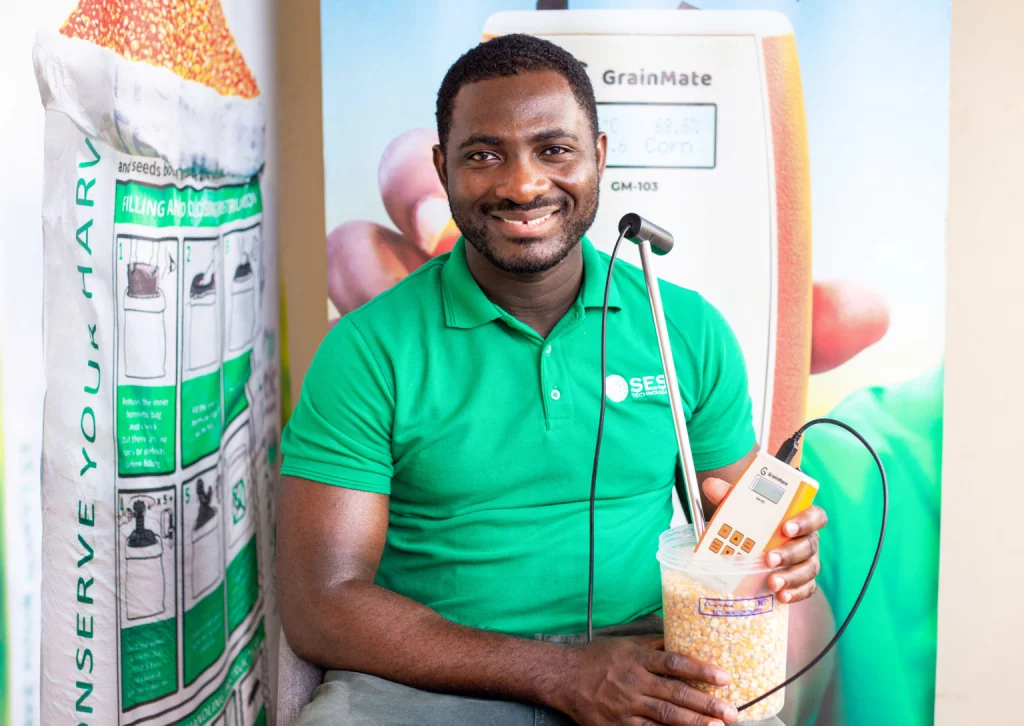
Isaac Sesi posing for a picture while holding the GrainMate moisture meter in Accra Ghana. Image source: Richard Akakpo

If I asked your parents what they hoped you’d become when you were ten years old, would entrepreneurship have made the list?

Probably not. They always saw me as the smart kid, but my parents didn’t have much formal education, and I don’t think they would have considered entrepreneurship a viable career path. They would probably have said a doctor, an engineer or a lawyer, like many African parents.

But I like to think they’re proud of me and what I’ve been able to do. Sometimes my dad calls to tell me that a friend saw me on television. You can tell he feels proud. So, although this might not have been what they imagined, I like to think they’re happy with how I’ve turned out.

You’ve spent years building tools that farmers may never notice unless they fail. Do you enjoy creating things that work quietly rather than attract attention?

I don’t particularly like a lot of attention. My satisfaction comes from building something people find useful.

Many of the people who use our products directly are agribusinesses rather than smallholder farmers. But the impact reaches the farmer. That farmer may never know I exist or even know about the product, yet still benefit from it.

For me, there’s enough satisfaction in seeing people use a solution and get value from it. This was something I conceived in my head, created with my hands, and built a business model around so we could deliver it, earn revenue and pay our employees.

All of that together is enough for me. I don’t need the fame or publicity, although it helps.

What’s the hardest lesson farming has taught you about human nature?

That you can’t rely on logic alone to sell something.

One challenge with deploying agricultural technology is that, however useful a solution might be, if a farmer cannot afford it, they cannot afford it.

You can explain that they’re losing 30% of their produce and that your solution could help recover those losses. You might say: “Instead of buying a normal bag for $1, buy this hermetic bag for $5, and you could earn $50 more.”

Logically, that sounds reasonable. But if the farmer doesn’t have the $5, no amount of logic changes that.

In the beginning, we thought that once we made a convincing argument, farmers would buy from us. Learning otherwise was painful. We spent time and money building something smallholder farmers might never be able to afford. We realised that the business model and how we took the product to market were even more important than we had understood.

But you can’t simply say, “They can’t afford it, so we’re done.” You have to find another way for them to benefit.

The farmer doesn’t necessarily care about the technology. They care about having more money in their pocket, keeping their grain from going bad and getting more from their land. If we can deliver those outcomes, whether or not the farmer pays directly for the technology, then we’ve done our work.

Every entrepreneur has one habit they wish they could get rid of. What’s yours?

I can be quite indecisive.

I work in a space where the answers to everyday problems aren’t obvious. There’s a lot of thinking, brainstorming and guessing, which can be mentally draining. Sometimes I would rather do something with a definite answer than work through uncertainty, even when decisions are waiting to be made.

I wish I were better at navigating that uncertainty and making decisions.

You might invest in an area that isn’t working and know you need to pull the plug. But then you think about the three people you hired who might lose their jobs, or the hundred farmers using the service whom you’ll no longer be able to support.

You worry about the disruption. But sometimes you have to accept that you tried something and it didn’t work. You need to make a decision. I don’t always do that well, and I wish I could change it.

You’ve spoken at major events, met influential people and won international awards. What’s the one conversation, away from the spotlight, that changed you the most?

We had an adviser from Uganda who spoke to me at a time when it felt as though we were winning everything we applied for. Those were exciting days, but the recognition wasn’t really translating into business results. How much were we selling? What partnerships were we developing? What progress were we making?

He could see beyond the outward wins and was concerned about the business. I had become a little complacent, caught up in the excitement of travelling and winning things as a young entrepreneur. At one point, I had actually forgotten about a major deal.

He called me and really gave it to me. He was one of the most honest people I’ve had in my life. Some people tell you things to make you feel good: “You’re doing well.” He wasn’t like that.

He asked why I had started the business. Was I doing it for the accolades, the money, or the travel? Then he told me: “Don’t snatch defeat from the jaws of victory.”

That has stayed with me. It helped me become more grounded. People will write about you and say nice things, but when you come back, it’s you and the business. You know the reality. You can’t let the praise get to your head.

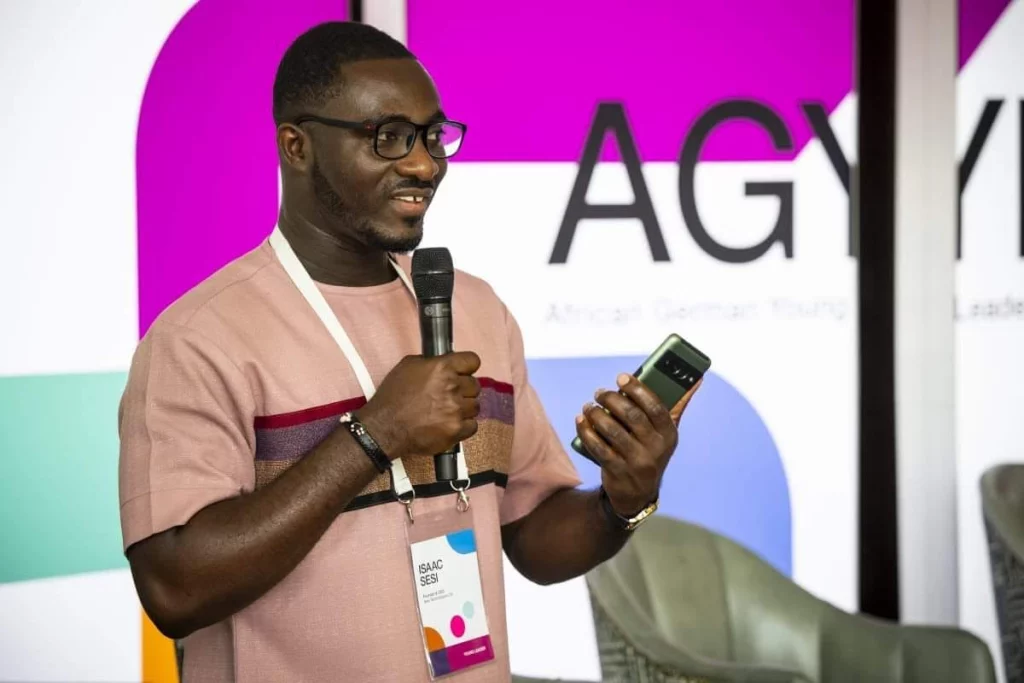
Sesi at a past conference. Image source: Seisi Technologies

When people say Africa should “feed the world”, do you find that inspiring, or does it oversimplify the continent’s challenges?

I think it has become rhetoric. That doesn’t mean it cannot happen, but systemic problems make it difficult. Some are self-inflicted; others involve people with an interest in maintaining the status quo.

I don’t think the model of smallholder farming we currently practise is scalable. We have farmers working small plots with low productivity. We have food going bad in Ghana while we’re importing maize from Ukraine.

But consider the economics. If I’m a grain trader and importing maize from Ukraine is cheaper than buying it locally, where am I going to buy it? Ukraine.

Do we have the potential? Absolutely. Will the way we currently do things unlock that potential? Probably not.

Africa can and should feed the world, but we have to take practical action. If Israel can grow and export vegetables despite its desert conditions, we should be asking what we can do with the resources available to us.

I’ve heard about efforts in Tanzania and Uganda to strengthen their grain value chains and export to Kenya. That kind of deliberate effort matters.

The statement has to move beyond something we say at conferences to inspire people. Governments and businesses have to take the actions that make it possible.

If you weren’t allowed to build another startup, what career would genuinely make you happy?

I would still want to do something in engineering. I’d probably work for an engineering company, building technology solutions.

I would still be building things, just for somebody else rather than for my own business.

You work with data, sensors and algorithms, but farming is deeply emotional. Has a farmer ever challenged your assumptions in a way no spreadsheet ever could?

Yes, all the time.

One of our products is a soil intelligence solution. We map the farm, obtain its coordinates and reference satellite data and soil maps to produce information about the soil.

We would do this in front of farmers, and some would say: “You are lying. There is no way you can walk around my farm and tell me what is in the soil.”

That surprised us. But when we paired the solution with a physical sensor, farmers trusted it more. The sensor might measure only three of the twenty or twenty-five parameters we were showing them. But as long as they could see us collecting soil and putting a sensor into it, the process was more believable.

You go in thinking you’ve built something scalable: all you need is a phone to generate a soil report. But the farmer may send you away. “You’re telling me you can walk around my farm and know what’s in my soil?”

We had a similar experience with our grain moisture meter. You insert a probe into the grain, and it gives you a moisture reading. A farmer might look at the 13% on the screen and tell you it’s wrong: “I can pick up the maize, toss it and listen to the sound to know whether it’s ready. What you’re telling me is garbage.”

Some people approach farmers with the attitude that they’ve been to university, built a product and come to teach them the right way to do things. Farmers find that insulting.

In Ghana, people talk about “home sense”. You might have book knowledge but lack practical understanding.

If you acknowledge that farmers have indigenous knowledge that has served them for generations, and explain how your solution can improve what they already do, you can work together.

You respect the farmers; they respect you back. You think they’re idiots; they’ll think you’re an idiot.

What’s something you’ve become less ambitious about as you’ve grown older, and something you’ve become far more ambitious about?

As a young entrepreneur, I was fascinated by startups raising tens or hundreds of millions of dollars and becoming billion-dollar companies. You’d see someone described as a self-made billionaire at twenty-two, and I wanted that too.

I imagined building a company, raising money and becoming wealthy. The typical Silicon Valley story was very appealing.

As I’ve grown older, my view of life has changed. I want to contribute my talents and skills in a field I enjoy, in a way that improves the lives of as many people as I can reach.

I also want to take care of myself and my family, and remember to enjoy life.

I’ve become less ambitious about personal glory and more ambitious about making people’s lives better through work that is rewarding to me and the people I care about.

Founders spend years trying to convince investors. Who do you still find yourself trying to impress?

Myself. I can be very hard on myself.

Other people will say, “You’ve done well. You built this from scratch, starting in school without much knowledge.” And I’m thinking, “Bruh, I don’t see any of that.”

Perhaps it’s less about impressing myself than becoming better every day. When I make a bad decision that I think I could have avoided, it gets to me. I think about the progress I could have made if I hadn’t done that.

I have high standards for myself, and falling short of my own expectations bothers me.

But I don’t think there’s anyone else I’m trying to impress. Everybody has their own journey. When you see someone running, you don’t necessarily see how long they spent walking before they got there. You might think they appeared overnight, but that isn’t the case.

My journey is my own. I want to be better today than I was yesterday. Five years from now, I want to look back and say, “Wow, I’ve really done well. I’ve come a long way.”

Suppose I handed you Ghana’s agriculture budget for one year, with complete political backing. What’s the first thing you’d stop funding, and what would you invest in instead?

I would stop funding imports of things we can produce in Ghana. For instance, I would stop funding poultry imports and strengthen domestic poultry production. I would do the same with grains.

I would invest heavily in irrigation so we could produce seasonal crops throughout the year, and in technology to reduce losses.

I would also develop a model that clusters and aggregates smallholder farmers. Instead of each farmer working separately on a small plot, you could have fifty farmers working together on a much larger area, with shared ownership.

Those are some of the things I think could transform our agriculture.

You’re mentoring younger entrepreneurs today. What’s the worst advice founders keep giving one another?

There is still too much emphasis on shaping a business around what investors want, rather than building a solid business that generates revenue.

Everybody wants an investor to put in $5 million for 10% of their company. But I would argue that the overwhelming majority of African businesses won’t be a good fit for the kind of investors those founders are pursuing.

You could build a solid business that never becomes a $100 million company. Perhaps it becomes a $5 million company that makes a profit, pays taxes, employs people and contributes to national development. That is valuable.

Instead, founders contort themselves to appeal to investors. There’s this idea that investors are up here and founders are down here, and we have to make ourselves small and be nice so they’ll introduce us to somebody.

I find that demeaning. You’re doing all this hard work, but you don’t recognise the value you bring. You’re trying to please somebody who may not care about you.

The conversations are always: “Have you spoken to this investor? Have you spoken to that investor?” I hear far more advice about appealing to investors than about building a solid business.

If your closest friends described you in private, what would they say that never appears in conference introductions or award citations?

They would say I’m not as serious as I come across. I’m goofy and jovial. I like doing silly things: jumping on the couch, playing video games and screaming at the top of my voice. Things a little child would enjoy.

Outside, I might appear organised, polished, very put together and serious about everything I’m doing.

But I like the simple things in life, and I try to enjoy them with the people I care about.

Complete this sentence: “The biggest myth about innovation in Africa is…”

That innovation is suddenly going to take off and transform everything.

What would make you feel your career was worthwhile: creating a billion-dollar company, changing agricultural policy, or inspiring thousands of young African inventors? And why?

Inspiring thousands of young African inventors.

If I find success but it doesn’t inspire other people to do something, the impact is limited. I might make a difference and earn good money, but it ends with me.

Now imagine that my business fails, but while it exists, it inspires a thousand people to build things and start businesses. Some succeed, employ people and change things. I think that impact would be more profound than being the only person who succeeded.

Of course, if I had a billion dollars, I could buy a yacht, get a private jet and fly around the world. I could make a nice life for myself. But what legacy would I leave?

I would love to inspire people who go on to do bigger things than I ever did. Someone might interview them one day, and they would say: “I wasn’t going to do this, but there was this guy called Isaac Sesi who inspired me to start.”

I would take that over individual glory.

True scale demands moving beyond surface-level integrations to robust execution. We’ve filtered the noise out of Moonshot 2026, optimising the conference strictly for high-calibre connections between startup founders, global financial operators, enterprise leaders and individuals rewiring Africa’s technical frameworks. Get 20% off Early Bird tickets for a limited time.
Web hosting by Somee.com