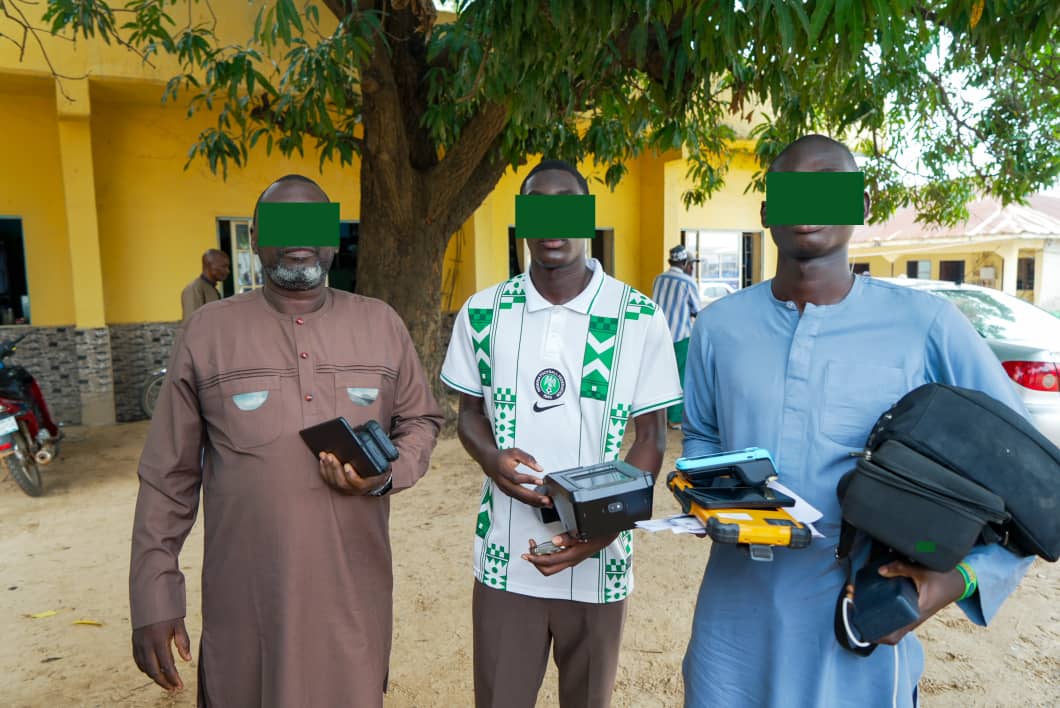
Philip Agaga, the Vice Chancellor of the Akwa Ibom State University of Education (AUE), Afaha Nsit, has announced plans to provide free Computer-Based Test (CBT) preparation and Information and Communication Technology (ICT) skills training for Senior Secondary School Three (SS3) students in public schools across Akwa Ibom State.
He said the programme, which is to be implemented under the University’s Mobile Digital Training Clinic (MDTC) Initiative, is expected to commence in a few days.
Afaha disclosed this during an interactive meeting with the University’s teaching staff, explaining that the initiative would leverage the institution’s existing ICT infrastructure to support public school students and improve their readiness for computer-based examinations.
According to the Vice-Chancellor, the University possesses state-of-the-art ICT facilities that should not remain underutilised when they can be deployed to address critical educational needs and benefit students across the state.
He stressed the need for the institution to maximise its available resources to expand digital learning opportunities, particularly for students preparing for the Senior School Certificate Examination (SSCE), NECO, NABTEB and Joint Admissions and Matriculation Board (JAMB) examinations.
“A few days from today, we will launch our Mobile Digital Training Clinics. This initiative seeks to leverage this university’s massive ICT infrastructure and capacity to train SS3 students, Computer Science teachers and CBT operators on hands-on solutions to computer-based examinations in our state,” he said.
Afaha disclosed that he had directed the University’s ICT team to develop a template for the programme, which will commence in secondary schools within Afaha Nsit and its environs.
He described the initiative as part of the University’s community service mandate, aimed at improving students’ performance in major external examinations and addressing educational challenges through practical interventions.
The Vice Chancellor also disclosed that the University’s Research Group and Teaching Practice Group had been directed to submit briefs on functional methods and methodologies for strengthening their respective areas of operation and achieving optimal impact, adding that the University would continue to identify other areas requiring improvement as it progresses.
He announced plans to commence operations with 34 academic departments organised into nine faculties, including a newly established Faculty of Computing.
He explained that the new academic structure comprises eight Education-related faculties derived from the schools and programmes inherited from the former College of Education system, alongside the Faculty of Computing as the University’s only non-Education faculty, with three departments.
According to him, the restructuring is designed to consolidate the institution’s heritage in teacher education, while expanding its capacity to respond to emerging demands in computing and digital technology.
“A few days ago, members of the Transition Implementation Committee, alongside the Deans, had a meeting in my office and resolved to float 34 academic departments compressed into nine faculties.
“The new arrangement has eight Education faculties derived from the schools and programmes inherited from the defunct College of Education system, and a new Faculty of Computing was added as the only non-Education faculty, with a complement of three departments,” he stated.
Professor Afaha said the arrangement would enable the University to leverage its comparative advantage and build on its longstanding experience in teacher education while utilising its ICT infrastructure to strengthen its academic offerings.
He further noted that the institution was making progress towards obtaining the necessary approvals from the National Universities Commission (NUC), alongside other required verifications and accreditation processes.