In a hospital emergency ward, a three-hour delay searching for prescribed medication is not an inconvenience—it can be fatal. In 2020, while working in an Ethiopian public emergency room, nurse and social worker Beamlak Alemayehu watched patients lose critical hours moving from pharmacy to pharmacy just to locate essential drugs and tests. Some never survived the wait. Determined to fix the fragmentation, she set out to build Medanit in 2022 as a clean digital directory. But when she approached clinics and pharmacies, she hit a wall: between 80% and 90% of them still ran entirely on manual paper ledgers. There were simply no digital records to plug into. Realising she could not just be a consumer-facing middleman, Alemayehu took on the heavy lifting: writing hospital management software, building electronic medical records (EMR), setting up pharmacy delivery logistics, and launching a dedicated call centre to ensure rural farmers and mothers without smartphones were not left behind. Today, Medanit has onboarded over 520 doctors, logged 1.2 million platform visitors, and secured backing from the Bayer Foundation as it prepares to expand into Rwanda and Zambia. In this feature, JOHN ADOYI tells the story of an Ethiopian nurse who stopped waiting for healthcare infrastructure to arrive—and built it herself.
In healthcare, every minute can make a difference. Beamlak Alemayehu, a trained nurse and social worker, saw this firsthand during seven months working in the emergency department of an Ethiopian government hospital in 2020. Patients could spend hours searching for the medication, diagnostic tests, or specialist care they needed.
She watched patients move between hospitals and pharmacies, often losing three or four hours trying to find prescribed medication. Others waited days to find the right specialist. Meanwhile, doctors waited for medication or test results they needed to make decisions about their patients. Some patients lost their lives amid these failures, according to Alemayehu.
“Every minute has a value for the patient and for the physicians. Most of the cases that we treat are life or death issues,” she said.
That experience made her question why patients had to navigate such a fragmented system just to find the care they needed. She saw a need for a straightforward way to find available doctors, locate medication, and identify facilities offering the right diagnostic services.
That thought led Alemayehu to found Medanit in 2022, a digital healthcare platform that is aiming to make healthcare easier to access in Ethiopia. What began as a medical directory has since expanded to include doctor appointments, telemedicine, medication delivery, and digital systems that help healthcare facilities manage their operations.
Today, Alemayehu said Medanit has onboarded 527 doctors and recorded 1.2 million visitors across its channels since January 2026. She has also earned recognition from the Bayer Foundation, which selected her as a recipient of its grant for women entrepreneurs, providing mentorship and business development support to help Medanit scale its operations and expand access to care.
Beyond finding a doctor
Geography remains one barrier to healthcare access in Ethiopia. A 2023 study published in the Journal of Global Health estimated that about 18% of the population lacked access to a public health facility within a two-hour walk, with substantial differences between regions. The study used 2020 population estimates and facility-location data from December 2021.
For those who have access to a facility, waiting can be another obstacle. Ethiopia’s Public Health Institute found that 49% of respondents in its People’s Voice Survey waited more than an hour to see a healthcare provider during their most recent visit. Among rural respondents, the figure was 55%.
But helping patients find healthcare services presented another challenge for Alemayehu: the facilities themselves did not always have the organised information her platform needed.
When she began approaching hospitals, clinics, and pharmacies to establish partnerships, she expected to obtain their digital records and inventory data and integrate them into Medanit. But there was a blocker: approximately 80–90% of the facilities she approached still relied on manual processes, according to Alemayehu.
“We were planning to launch it after we developed our platform,” she said. “All we thought was we would get the data from our partners, and then we would launch our product.”
Her experience reflects a wider challenge in healthcare digitalisation. A 2023 systematic review and meta-analysis of five Ethiopian studies involving 2,439 health professionals estimated electronic medical record utilisation at 51.85%.
The researchers identified training, access to user manuals, and management support as factors associated with adoption.
For Alemayehu, the implications were immediate. A directory could help patients identify a facility, but connecting them to available doctors, medicines, and diagnostic services required reliable information from the providers themselves.
“We cannot digitalise or create easier access to care just from a patient perspective or becoming a middleman,” she said.
Medanit consequently expanded beyond its original directory model to develop hospital management systems, electronic medical records and pharmacy inventory tools.
The company now works not only to help patients find healthcare services but also to help facilities organise the information needed to make those services accessible.

Building more than an app
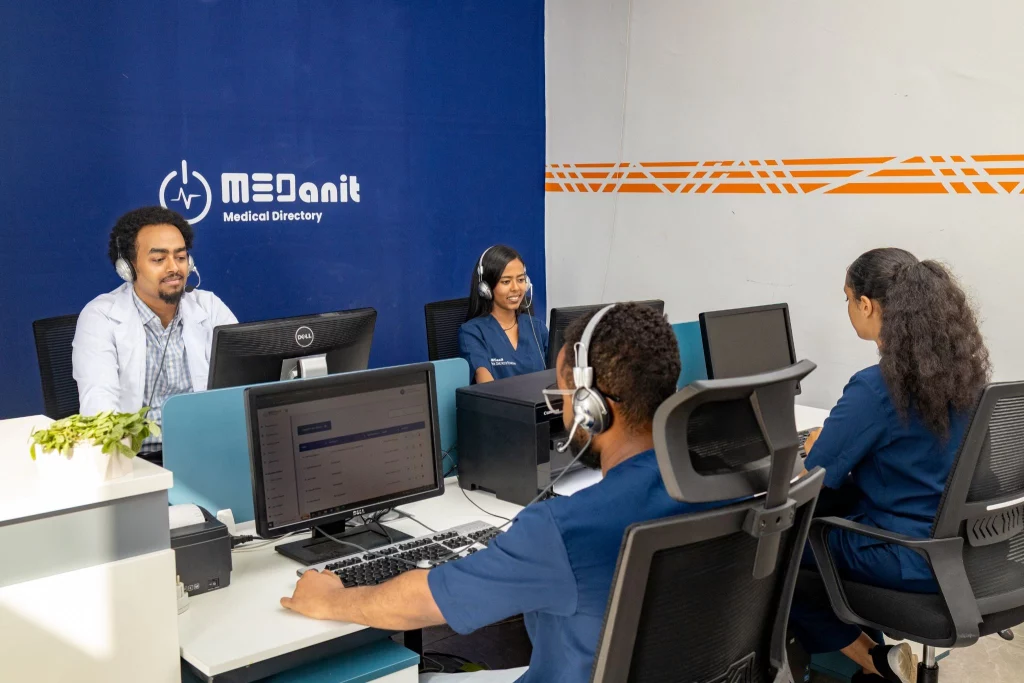
Medanit’s services extend beyond helping patients find doctors. Through its website, mobile app, Telegram service, and a call centre, patients can book appointments, locate prescribed medication, arrange diagnostic investigations, and consult doctors remotely.
The different access channels are designed to accommodate patients with varying levels of access to technology exposure.
Alemayehu said patients can upload a photo of a prescription or enter the name of a medication to find where it is available, then arrange delivery through the platform.
Those seeking diagnostic tests can find facilities offering the required investigations and book appointments, while patients who need medical advice can consult doctors via video calls.
“You can book a doctor, you can take a picture of your prescription and upload it and see where you can find it, and we deliver that medication to you as well,” Alemayehu said.
“The call centre is mainly intended to provide these services for those who do not have access to a smartphone or the internet,” she said, pointing to rural mothers and farmers among the people the service is designed to reach.
On the provider side, Medanit works with partner doctors who offer consultations in areas including paediatrics, cardiology, dermatology, and gynaecology. Alemayehu said the company also has its own team of doctors who help coordinate appointments, consultations, and medication deliveries. Through Medanit Counselling, patients can access virtual therapy from mental health professionals, she added.
Doctors have separate accounts where they manage appointment schedules and connect with patients. But the platform’s work extends beyond facilitating these interactions. Medanit has also developed hospital management systems, electronic medical records, and pharmacy inventory tools to help healthcare facilities organise their operations.
Alemayehu said this expansion followed her discovery that many facilities lacked the digital records and inventory systems she had expected to connect to the original directory.
Medanit began working with providers to digitise their operations, recognising that connecting patients to care also depended on facilities having organised information about their services and resources.
The business of making healthcare accessible
Medanit’s business model spans both sides of healthcare delivery. The company earns revenue from medication delivery fees, commissions on doctors’ appointments, per-minute telemedicine consultations, and counselling sessions. It also sells digital systems to healthcare facilities, including electronic medical records (EMR), inventory management and hospital management software.
But building a platform that addresses multiple gaps in healthcare has not necessarily made it easier to grow the business. Alemayehu said the slow adoption of digital health services and limited revenue have constrained its ability to expand.
“Obviously, funding has been one of the constraints that we face because it’s a very sensitive sector that we are operating in. It grows within a very limited amount of revenue,” she said.
The challenge, according to her, is not simply developing technology that works. Medanit must also build the operational infrastructure needed to deliver its services, particularly medication delivery.
That means securing medication stocks, establishing a reliable supply chain, and developing the logistics needed to reach patients who might otherwise struggle to access medicines.
“Creating an optimised logistics pathway for the medication delivery path has been our bottleneck because of funding issues,” Alemayehu said.
Regulation has added another layer of uncertainty. When Medanit started, there was no clear digital health policy framework for private-sector platforms offering the range of services it provides, Alemayehu noted. The startup’s combination of telemedicine, medication delivery, appointment booking, and digital systems for healthcare facilities has also made it hard to fit the business into a single licencing category.
She said she has continued to engage with the Ethiopian government, demonstrating the platform’s uptake and the potential savings it could offer patients and the wider healthcare system. Alemayehu hopes a proposed startup proclamation will create a regulatory sandbox in which companies such as Medanit can operate while the appropriate frameworks are developed.
These financial and operational constraints informed Alemayehu’s application to the Bayer Foundation Women Entrepreneurs Award. In 2026, she was selected as one of 15 winners. Each winner receives €25,000 ($28,000) in non-dilutive funding and takes part in a six-month accelerator programme offering personalised mentorship, business development support, and access to industry networks.
“We were looking for a way that will help us to scale. We wanted to optimise what we already have and become more innovative,” she said.
The funding is expected to help Medanit optimise its existing systems and strengthen its medication delivery and telemedicine services. Alemayehu hopes the support will help the company address operational constraints that have limited its growth, giving it a stronger foundation to reach more patients.

Looking ahead
Over the next year, Medanit is targeting between 3 million and 4 million people in Ethiopia who lack healthcare access, focusing on rural communities. Beyond that, Alemayehu wants Medanit to reach 100 million people in Ethiopia and expand into at least 20 African countries over the next 5–10 years.
The company is already exploring opportunities in Rwanda and Zambia, with plans to enter those markets by 2027, the founder said.
For Alemayehu, the ambition stems from the patients she encountered as a nurse and the difficulties they faced finding timely care. She hopes Medanit will make healthcare easier to access for people who might otherwise spend hours searching for medication, diagnostic services, or the right doctor.
“What we are building is not a luxury product,” she said. “We are out here saving lives, and the fewer hours people have to spend searching for healthcare, the more I know we are achieving our goal.”
True scale demands moving beyond surface-level integrations to robust execution. We’ve filtered the noise out of Moonshot 2026, optimising the conference strictly for high-calibre connections between startup founders, global financial operators, enterprise leaders and individuals rewiring Africa’s technical frameworks. Get 20% off Early Bird tickets for a limited time.