In 2025, Biodun Ogunleye, the Lagos State Commissioner for Energy and Mineral Resources, said that about 30,000 deaths occur annually in the state due to exposure to carbon monoxide. Growing up, Deborah Fadeyi had seen how generators became part of everyday life, even when their consequences could be fatal. It became personal in 1999 when she lost a friend to carbon monoxide poisoning from generator fumes.
“I was young, but that experience stayed with me, and Nigeria still hasn’t gone past that phase,” she told TechCabal in an interview in September. “We still hear in the news that people are dying from carbon monoxide poisoning. Generators were so normal growing up that nobody really questioned what it meant for people to depend on them for something so fundamental as electricity, until it began to kill them.”
Twenty years later, she founded Vectar Energy, a climate finance company registered and operating in the United Kingdom. Vectar Energy began as a maker of solar-powered portable power stations designed to displace small petrol generators. Today, its core product is ecoWise, a platform that brings small solar projects together into a single portfolio, helping them access carbon markets they could not enter on their own.
Day 1: She wanted to build a better generator
If petrol generators were the problem, Fadeyi wanted to build a better alternative. Before Vectar Energy became a climate finance company, she was experimenting with ways to make solar power practical enough to replace petrol generators.
Her first attempt was in 2019, through an earlier venture called YettyFlames. Fadeyi was building locally fabricated solar-generator systems, drawing on what she was learning about the energy needs of Nigerian households and small businesses. She described the early systems as crude compared with what Vectar would eventually produce, but said they gave her firsthand experience with the people she wanted to serve.
“That part of the business was super important to us because it put us directly in front of the customers, and it helped us to challenge the realities that they were facing,” Fadeyi said.
By 2020, she had decided to turn that work into a more structured business. She founded Vectar Energy and began building it on her own. Its first product was the Vectar Eco, a portable solar power station designed to replace the small petrol generators commonly known as I better pass my neighbour generators.
“The idea was simple: create a practical solar and better battery alternative to the small petrol generators that homes and businesses used every day,” she said. “Getting from that idea to something commercially viable was much less simple.”
Turning that ambition into a product people could buy required money, and Fadeyi said Vectar Energy was raising funds to develop the solar power stations. The team also had to work through the business of making hardware, including choosing the right battery configurations, sizing the solar panels, testing components and designing a unit that was portable and powerful enough for the appliances customers needed. What kept her going, she said, went back to 1999.
“I told myself that I hope this doesn’t happen to someone else,” she said. “I guess this is the part that I’m playing to enable that future that I once dreamed of, where it became a responsibility from my best friend losing her life because of something that could be avoided.”
Day 500: Making solar cheaper and building it are different
Getting the solar power stations into the market meant a rethink of how Vectar produced them. Fadeyi said her team realised that locally fabricated units could end up costing more than their target customers could afford. They took the design to China and then began importing semi-assembled units that would be completed in Nigeria.
By 2023, Vectar was ready for the market. It had paying customers in Nigeria and was generating revenue from its portable power stations. The company developed different capacities, including the Vectar Eco and Vectar Eco Mini, recognising that a household, a trader and a small business did not have the same power needs or ability to pay.
However, as much as its customers recognised the benefits of switching from petrol to solar generators, Fadeyi said they still struggled to afford the upfront cost. She stated that Vectar explored partnerships with lenders such as Credit Direct and AltPower to offer instalment payments, but many prospective customers struggled to meet the credit requirements.
“The credit landscape in Nigeria is still developing. People would go to such platforms in the hope that they would get [credit], but they would be laden with different and stringent requirements that they might not be able to meet,” Fadeyi said.
Vectar then tried to offer its own non-interest instalment plans to customers in Lagos and Abuja. Still, spreading the payments over time did not make the stations affordable enough for many of the people the company wanted to reach, according to Fadeyi.
We realised that we were solving the problem, but not at the scale that it needed to be solved,” she said.
In 2024, Vectar Energy began working on SUNWISE alongside Vectar Eco. SUNWISE was an initiative designed to make portable solar systems more accessible to nano and small businesses without requiring full payment upfront. The company explored rent-to-own arrangements starting at ₦2,000 ($1.49) daily. That year, Habeeb Mustapha formally joined Vectar as chief technology officer in April, strengthening its technical team. He would later become a co-founder.
Fadeyi said she was also beginning to discover if the environmental benefits of the solar systems could generate revenue and help lower the cost of solar.
“We had begun asking whether the environmental value produced by solar systems could itself help solve the affordability problem,” Fadeyi said. “If a solar system displaces petrol or diesel and avoids carbon emissions, could that environmental impact become another revenue stream? Could that revenue lower the cost of the system or help finance additional installations?”
2024 became a year of overlap for Vectar. It was still building and selling physical solar products, but it was also beginning to develop the technology that would eventually take it into climate finance.
Day 1000: Selling the evidence, not the equipment
After years of trying to make clean energy affordable for Nigerian households and small businesses, Fadeyi had come to a realisation that the opportunity might be in making the environmental benefits of solar projects generate money.
“What if the individual installation did not have to be the unit entering the carbon market? What if we aggregated many installations and eventually many independent developers through one common infrastructure?” she said.
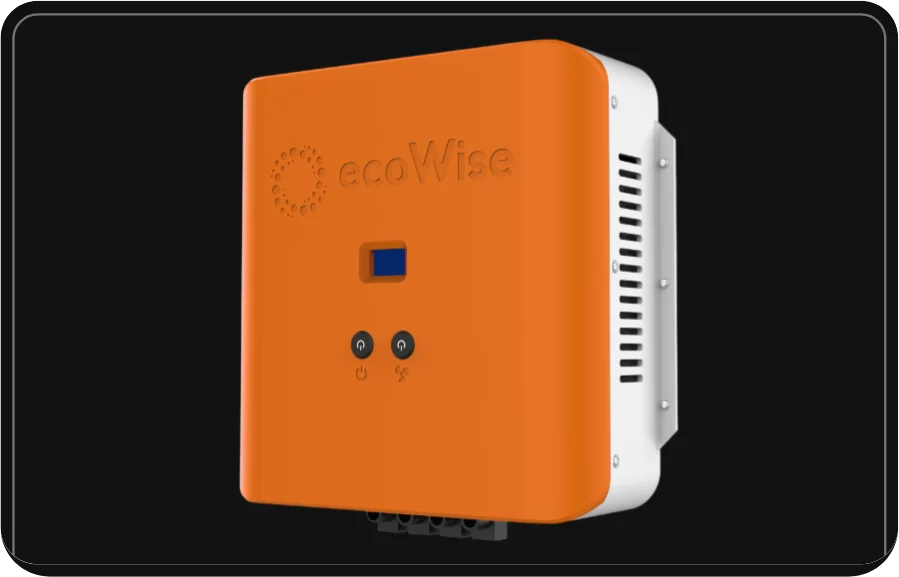
This became ecoWise, Vectar’s carbon-market infrastructure platform. ecoWise brings together smaller solar projects in a single portfolio, monitors the electricity they generate and the emissions they avoid, and helps their developers access carbon markets. ecoWise provides the infrastructure to collectively navigate the process of carbon certification and credit sales. For this to work, Vectar had to produce evidence that carbon-market institutions and buyers could trust. That meant developing the technology to monitor installations and understanding the requirements of carbon standards.
“ecoWise increasingly became about assurance infrastructure rather than simply an emissions calculator,” Fadeyi said. “It was also during this period that we began doing the much less glamorous work required to create an actual carbon programme: methodologies, eligibility criteria, developer agreements, carbon rights, monitoring plans, safeguards, Gold Standard requirements and the programme architecture necessary to aggregate independent developers.”
Fadeyi described 2025 as the year Vectar made the transition from being principally a solar product company to becoming a climate finance and environmental-market infrastructure company. By early 2026, Vectar’s legacy solar product business had served more than 150 customers and generated roughly ₦80 million in cumulative revenue. However, Fadeyi was now focused on helping solar developers earn additional revenue from the electricity they already generated.
Vectar says it has onboarded 35 megawatt-peak (MWp) of distributed solar projects across Nigeria, with a 50 MWp cohort being prepared for validation and verification. Fadeyi expects the first carbon-credit payout to participating solar projects in January 2027. The technology supporting the programme has also evolved. Vectar is developing ecoWise as a hybrid digital measurement, reporting and verification (MRV) system, combining physical Internet of Things (IoT) monitoring with virtual and API-based integrations. This allows the platform to collect data from solar installations using different inverters and monitoring systems.
“We realised quite early that distributed solar is too heterogeneous for a single monitoring approach to work for every developer,” she said. “Different projects have different inverters, monitoring systems, data formats and operating environments, so the infrastructure has to be flexible enough to accommodate that diversity while still producing consistent, auditable evidence.”
Fadeyi said carbon credits from the projects could sell for as much as $50 each, depending on the market and the quality of the credits. She also said Vectar was working with MSCI, a global financial data and research company that provides independent ratings of carbon projects. In 2026, Vectar entered the International Renewable Energy Certificate (I-REC(E)) ecosystem, giving qualifying projects another route to environmental-market revenue, as it allows buyers to substantiate claims about their use of renewable electricity.
Vectar is also working towards setting up in Sierra Leone and Madagascar in 2027, with ambitions to replicate its infrastructure across other African markets. The company has travelled a long way from the portable solar power station it began building in 2020. However, the underlying problem of making clean energy a viable alternative to the generators that power homes and businesses across Nigeria has remained the same.
“Day one, we started with how do we make clean energy affordable enough to replace generators,” Fadey said. “Now we’re asking the question: how do we build the financial infrastructure that makes our energy transition scalable?”