×
Tech

Paga expands Direct Debit access for businesses beyond its network 

Paga expands Direct Debit for businesses beyond its network

Paga, one of Africa’s oldest fintechs, is expanding its Direct Debit access to let businesses using Paga Engine, its payments infrastructure business, collect recurring payments from accounts outside its network. 

The move is part of Paga’s strategy to expand beyond consumer payments and become a financial infrastructure provider for other businesses. In May, TechCabal reported that Paga was positioning Paga Engine to commercialise nearly two decades of payment technology it had developed to support its own operations. 

The company wants businesses to use its infrastructure instead of building their own payment systems. With the Direct Debit expansion, businesses can now collect recurring payments from customers who bank with other Nigerian financial institutions.

“At the core of our business is the infrastructure; everything we build, we build it into that infrastructure, and we’re extending that infrastructure for others to leverage,” Ramon Bello, general manager of Paga Engine, told TechCabal in an interview in September. “In Nigeria, for businesses to enjoy this sort of service (direct debit), they would have to leverage a card infrastructure. There’s really no scale for you to do it across multiple financial infrastructures, and that’s one of the things that we’re changing.”

Paga will compete with payment infrastructure providers such as Paystack, Flutterwave, and Zeeh Africa, which already offer automated bank-account collections. 

Direct Debit remains a small part of Nigeria’s electronic payments landscape, despite the large volume of money moving through the channel. Direct Debit transactions reached 157.4 million in 2024, with a combined value of approximately ₦23.3 trillion ($17 billion), according to the Central Bank of Nigeria (CBN) data, up 17% from the previous year.

Paga’s expanded infrastructure uses existing interbank payment rails, according to Bello. The company is betting that making the infrastructure accessible to businesses collecting from customers across different banks could expand direct debit’s usefulness.

“There is an existing rail that allows you to connect from one bank to about a hundred or more banks,” Bello said. “That same rail is what we have leveraged to provide this similar infrastructure, so that any business would be able to connect to any bank. Instead of just a one-time payment, they can now do a recurring payment.”

Once a customer authorises a merchant for direct debit, the business can initiate subsequent collections without requiring the customer to make each payment manually. The infrastructure could help businesses with customers spread across different banks. 

A digital lender, for instance, could now collect loan repayments directly from a borrower’s bank account rather than depending on the borrower to remember repayment dates, and subscription businesses could also use it to collect monthly payments.

According to Bello, Paga Engine currently supports more than 400 businesses across sectors including manufacturing, fintech, digital content and e-commerce. Its website lists Meta and Amazon among its clients. Paga Engine also provides wallet services that allow other businesses to host wallets on Paga. 

Paga Engine processed approximately $12 billion in transaction value across about 100 million transactions in 2025, according to Bello. In June, Paga partnered with TBook, a blockchain infrastructure company, to offer tokenised real-world assets through its platform. The partnership connects Paga’s payment and compliance infrastructure with TBook’s marketplace for tokenised investments.

The company’s plans for Paga Engine also extend beyond domestic payments. Bello said it is also building the infrastructure that will let Nigerian businesses collect payments from international customers through PayPal. 

In January, Paga announced a partnership with PayPal that enabled Nigerian freelancers to receive payments from international customers. Bello said the company was working to extend similar capabilities to Nigerian businesses, allowing them to collect payments from customers globally through PayPal’s international infrastructure.

“There is also the part of extending our core infrastructure beyond Nigeria, enabling businesses to be able to access USD accounts and Euro accounts,” he said. “All of these things are in the arsenal that we are currently cooking as part of the infrastructure.”

§

Safaricom, Kenya’s largest telecommunications operator, generated KES 4.9 billion ($38 million) from Fuliza, its M-PESA overdraft service that lets customers complete transactions when they lack enough money in their wallets. 

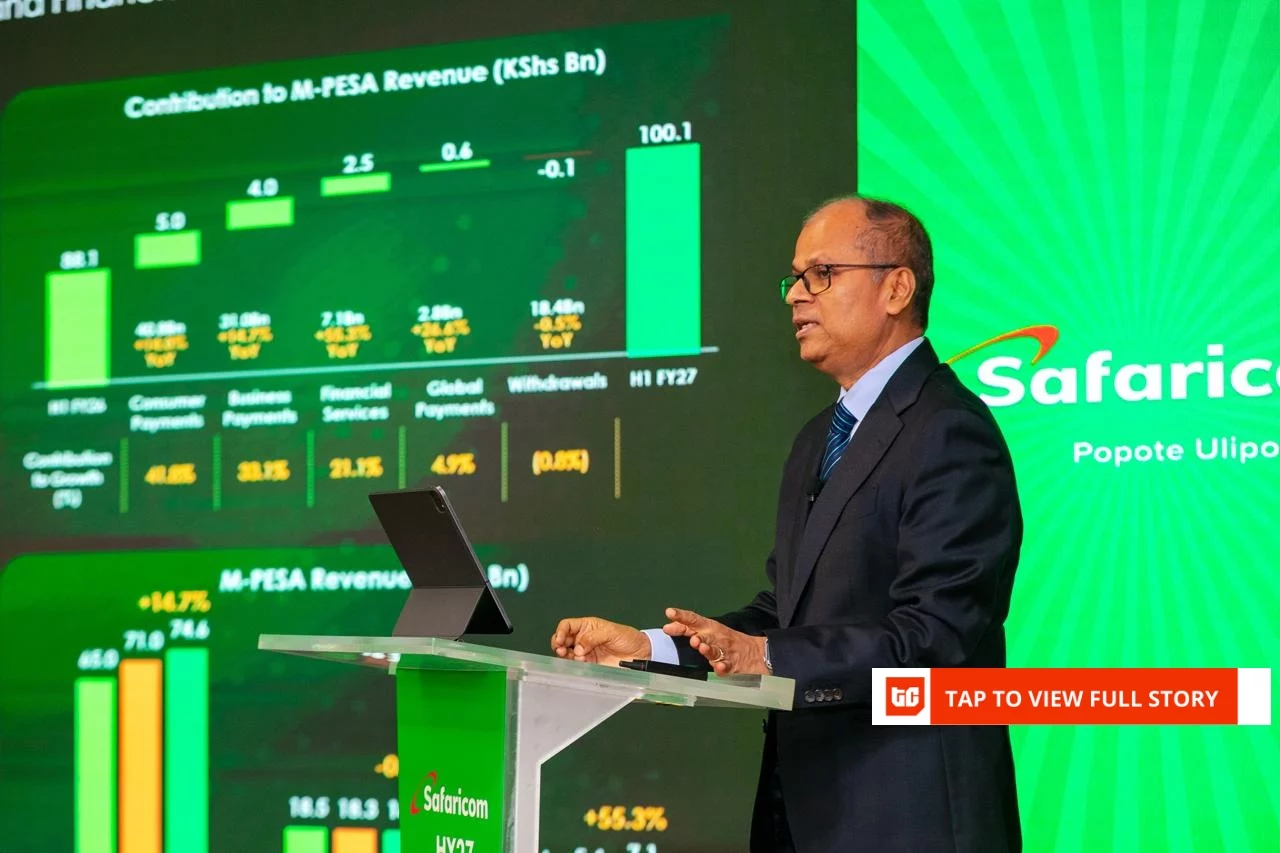
On Thursday, Safaricom said at its investor briefing held in Nairobi that Fuliza’s revenue rose 86% in the six months to September 2026, with the number of borrowers nearly doubling to 17.2 million. The service, operated by Safaricom in partnership with NCBA Bank and Kenya Commercial Bank (KCB), became the company’s largest mobile lending business by revenue, even as the average amount borrowed fell 24.6%. 

The figures point to growing reliance on short-term credit as a revenue source for M-PESA. Lending is growing much faster than payments revenue. However, smaller loan sizes and declining repayment ratios raise questions about borrower behaviour and the business’s economics.

Fuliza disbursed KES 1.16 trillion ($8.97 billion) during the period, up 84% from the previous year. Its customer base also grew 88.9% to 17.2 million.

Revenue rose at almost the same pace as customer growth. The average amount borrowed, though, declined 24.6% to KES 192 ($1.49), from KES 254.60 ($1.97).

The numbers suggest Fuliza is reaching more customers through smaller advances. Safaricom has not disclosed how much of the growth came from customers borrowing more frequently, new borrowers entering the service, or changes in credit limits.

Fuliza’s growth contrasts with Safaricom’s other mobile lending products, which it operates with banking partners. 

KCB M-PESA, a savings and loan service offered with Kenya Commercial Bank (KCB), generated KES 500 million ($3.9 million) in revenue, up 11.9%, even as its active customer base fell 7% to 4.2 million. 

M-Shwari, Safaricom’s savings and microloan service with NCBA Bank, recorded revenue growth of 7.7% to KES 1 billion ($7.8 million), while active customers fell 5.8% to 7.4 million.

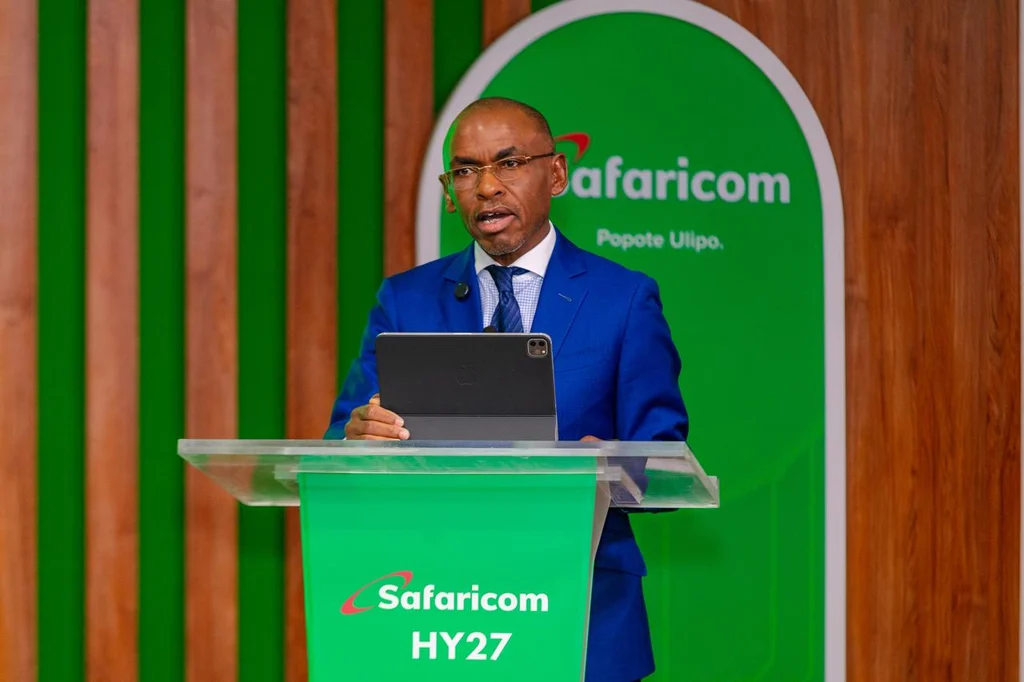
Safaricom’s CEO Peter Ndegwa during the investor briefing at the company’s Nairobi offices.

As Safaricom looks to expand M-PESA beyond payments into credit, savings, insurance and merchant services, its investor presentation shows credit revenue grew 54.4% to KES 7 billion ($54.3 million) in the half-year, compared with 13.6% growth in overall M-PESA revenue to KES 100.07 billion ($775.7 million).

Fuliza accounted for roughly 71% of revenue from the six lending products, making it the portfolio’s main source of earnings.

The repayment figures offer another dimension to the growth. Fuliza’s repayments reached KES 1.15 trillion ($8.94 billion), equivalent to 99.6% of disbursements, down from 102.4% a year earlier. KCB M-PESA’s ratio also fell to 96.7% from 99.5%, while M-Shwari’s declined to 105.3% from 108%.

“Behavioural scoring and multiple funding partners are helping us extend responsible credit, personalise access and manage portfolio risk more effectively for customers and businesses across Kenya,” Safaricom CEO Peter Ndegwa said. 

The figures show Fuliza’s growth, but not the full picture of the risk behind it. The repayment-to-disbursement ratio fell to 99.6% from 102.4%, though the comparison does not show how much of the loans issued during the period remain unpaid. Repayments recorded in the six months may include money owed from earlier lending periods.

Safaricom did not disclose Fuliza’s non-performing loan ratio in either report. The disclosures also do not show how credit risk is split between Safaricom and its banking partners. 

§

Cash still dominates everyday payments in South Africa, making it a challenging market for MoMo, MTN’s mobile-money and digital financial services platform. But as the country overhauls its payments infrastructure and opens the market to more competition, the company sees a chance to change how South Africans pay.

MTN wants MoMo to become a broader financial and transactional platform, linking consumers and merchants to payments, credit, remittances and other digital services across its African footprint.

South Africa will serve as an important test of whether the mobile-money model that worked in less banked markets can be adapted to a more mature financial system. MTN believes the answer lies not in competing with banks on basic transactions, but in using the country’s evolving payments infrastructure to build a broader digital financial platform for consumers and merchants.

The strategy includes leveraging new payment infrastructure, pursuing new licences as they become available, and expanding into lending and other financial services. MTN also sees an opportunity among consumers and businesses that continue to rely heavily on cash, as well as smaller merchants that have historically had limited access to financial services.

“The national payments infrastructure is moving very fast. This is infrastructure that we want to leverage to penetrate the market,” MTN Group Fintech chief executive officer (CEO) Serigne Dioum said at the company’s Fintech Summit in Johannesburg on Tuesday.

But South Africa is only one part of the strategy. MTN says MoMo now has more than 70 million monthly active users across 14 markets and processed more than 13 billion transactions worth over $330 billion in the first half of 2026. Its ecosystem includes more than 2.3 million merchants and one million agents, while international remittances exceeded $3 billion during the period.

“We started by giving customers access to financial services. Now we want to move from access to active participation,” Dioum said.

That means customers using their wallets to pay merchants, access loans, save, send money across borders and buy other services. Dioum pointed to Rwanda and Uganda, where customers can send money across borders through MoMo with an experience designed to resemble a domestic transfer.

MTN is also building an open Application Programming Interface (API) that allows partners to integrate their services into its ecosystem. The company says it works with banks, utilities, merchants and other businesses across its markets.

“Africa’s digital economy will increasingly depend on our ability to connect markets, enable cross-border payments, support regional trade and allow people and businesses to participate seamlessly across borders,” Mcebisi Jonas, MTN Group chairman, said.

As MoMo expands into lending, remittances, merchant payments and other financial services, MTN will face greater regulatory requirements around how those services are delivered and how customer money and data are protected.

Lesetja Kganyago, governor of the South African Reserve Bank, said the country’s payments system needs to evolve alongside technology.

“Other countries are ahead of us, and we need to catch up,” Kganyago said. 

He said innovation and regulation, particularly in payments, need to work together. The Reserve Bank is moving towards an activity-based regulatory model, under which banks and fintechs offering the same payment services, such as e-money issuance and payment acceptance, would face similar regulatory expectations.

The model would give companies such as MTN more scope to compete in payments while maintaining requirements around consumer protection, safeguarding funds and operational resilience.

“The pace of innovation creates tremendous opportunities for Africa, but sustainable progress depends on ensuring that trust keeps pace,” Nikiwe Tanga, MTN Group Fintech’s chief legal officer, added.

True scale demands moving beyond surface-level integrations to robust execution. We’ve filtered the noise out of Moonshot 2026, optimising the conference strictly for high-calibre connections between startup founders, global financial operators, enterprise leaders and individuals rewiring Africa’s technical frameworks. Get 20% off Early Bird tickets for a limited time.

Web hosting by Somee.com